Appleton's Cyclopedia of American Biography, edited by James
Grant Wilson, John Fiske and Stanley L. Klos. Six volumes, New York: D. Appleton
and Company, 1887-1889 and 1999. Virtualology.com warns that these 19th Century
biographies contain errors and bias. We rely on volunteers to edit the historic
biographies on a continual basis. If you would like to edit this biographyplease
submit a rewritten biography in text form.
If acceptable, the new biography will be published above the 19th Century
Appleton's Cyclopedia Biography citing the volunteer editor
Virtual American Biographies
Over 30,000 personalities
with thousands of 19th Century illustrations, signatures, and exceptional life
stories. Virtualology.com
welcomes editing and additions to the
biographies. To become this site's editor or a contributor
Click Here
or e-mail Virtualology here.
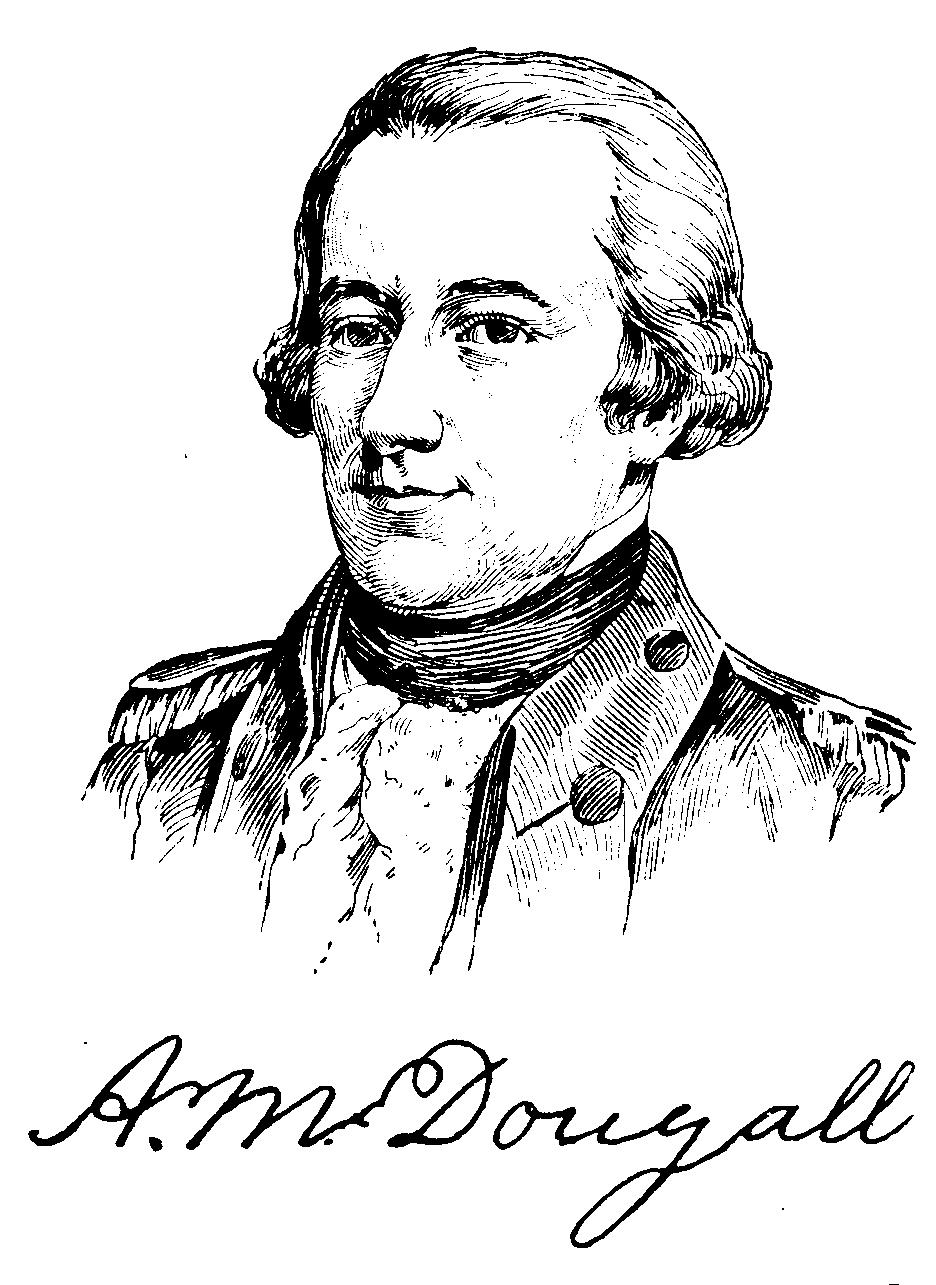
MACDOUGALL, Alexander, soldier, born in the island of Islay, Scotland, in 1731 ; died in New York city 8 June, 1786. His father, Ronald Macdougall, emigrated to the province of New York in 1755, and purchased a farm in the upper part of Manhattan island. Alexander at first followed the sea, and took part in the war of 1756 as commander of the two privateers "Barrington" and "Tiger." He subsequently became a successful merchant in New York city, and devoted himself ardently to the cause of the colonies. When the assembly, faltering in its opposition to the usurpations of the crown, rejected a proposition that authorized voting by ballot, and favorably considered a bill of supplies for troops that were quartered in the city to overawe its inhabitants, he issued an address entitled "A Son of Liberty to the Betrayed Inhabitants of the Colony," which was voted by the assembly to be "an infamous and seditious libel," and for which its author was arrested and imprisoned for twenty-three weeks in what is now the register's office, thus becoming the first martyr in the patriot cause. On being set at liberty, he cot-responded with the leading spirits in all parts of the country, and presided, on 6 July, 1774, at the meeting "in the fields" that was held preparatory to the election of delegates to the 1st Continental congress. He was appointed colonel of the 1st New York regiment, 30 June, 1776, brigadier-general on the 9th of the following August, and major-general 20 October, 1777. He was actively engaged at Chatterton's Hill, near White Plains, New York, and in various places in New Jersey, and was in command at Peekskill in 1777, but was compelled to retreat before a superior British force that had been sent up the river by General Howe. He took part in the battles of White Marsh and of German-town. His military career was interrupted by his being sent as a delegate to the Continental congress, where he took his seat in September, 1780, and again in February, 1784. He was elected minister of marine by that body, but, preferring active service, he resigned to take the field again. After the close of the war he was elected to the New York senate, of which body he was a member at the time of his death. He was also the first president of the New York state society of the Cincinnati.--His daughter, Elizabeth, married John Laurance, who presided as judge-advocate-general at the trial of Major Andre" his son, JOHN, died in the Canada expedition at the head of Lake Chain-plain in 1775 ; and his cousin, JOHN, the son of John Macdougall, was blown up in the frigate "Randolph," 32 guns, in its engagement with the British 64-gun frigate " Yarmouth" on 7 March, 1778.
Unauthorized Site:
This site and its contents are not affiliated, connected,
associated with or authorized by the individual, family,
friends, or trademarked entities utilizing any part or
the subject's entire name. Any official or affiliated
sites that are related to this subject will be hyper
linked below upon submission
and Evisum, Inc. review.
Please join us in our mission to incorporate The Congressional Evolution of the United States of America discovery-based curriculum into the classroom of every primary and secondary school in the United States of America by July 2, 2026, the nation’s 250th birthday. , the United States of America: We The
People. Click Here