Appleton's Cyclopedia of American Biography, edited by James
Grant Wilson, John Fiske and Stanley L. Klos. Six volumes, New York: D. Appleton
and Company, 1887-1889 and 1999. Virtualology.com warns that these 19th Century
biographies contain errors and bias. We rely on volunteers to edit the historic
biographies on a continual basis. If you would like to edit this biographyplease
submit a rewritten biography in text form.
If acceptable, the new biography will be published above the 19th Century
Appleton's Cyclopedia Biography citing the volunteer editor
Virtual American Biographies
Over 30,000 personalities
with thousands of 19th Century illustrations, signatures, and exceptional life
stories. Virtualology.com
welcomes editing and additions to the
biographies. To become this site's editor or a contributor
Click Here
or e-mail Virtualology here.
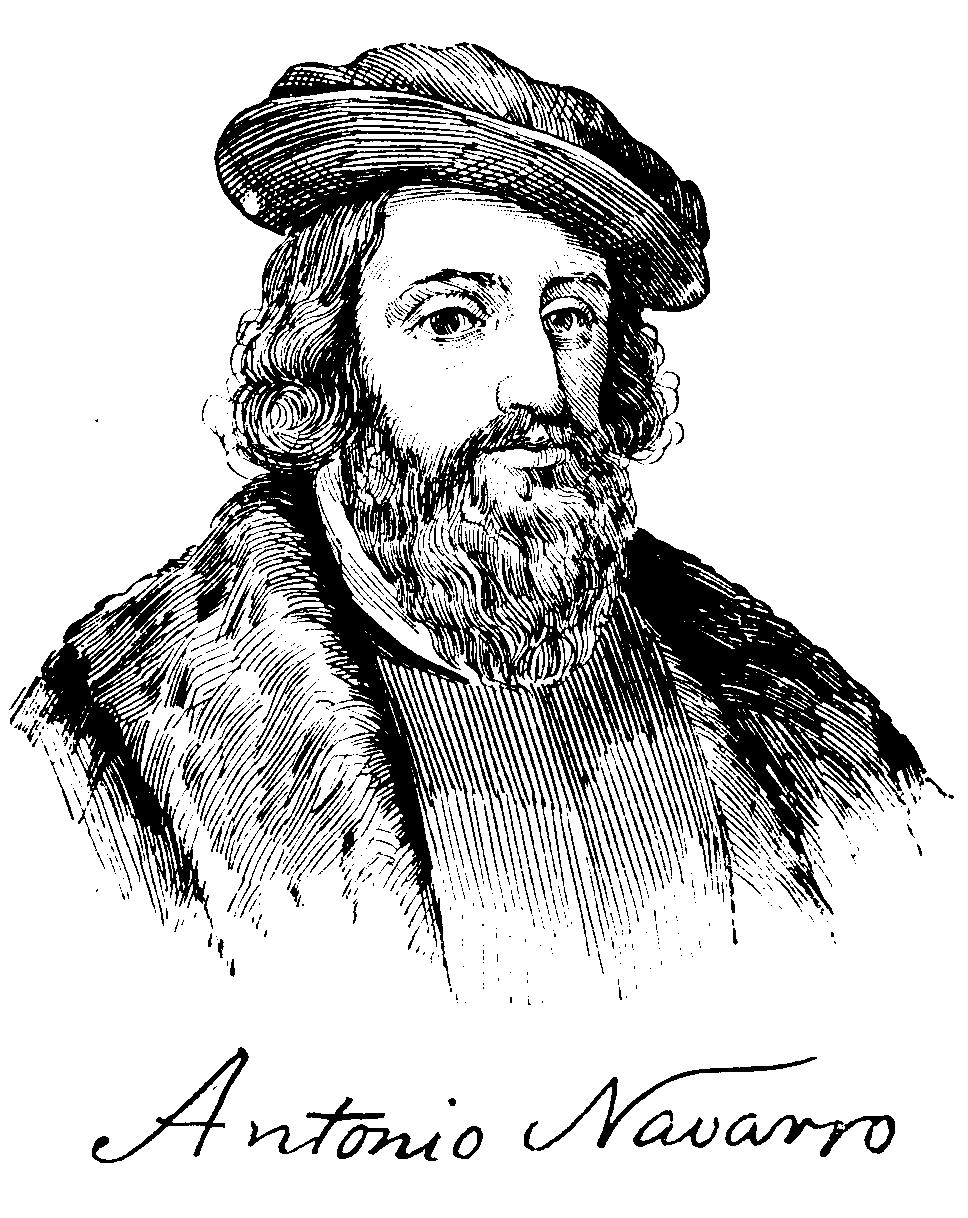
NAVARRO y PRADO, Antonio, Spanish naval officer, born in Madrid, 20 April, 1527; died in Saint Sebastian, Spain, in 1598. He was a grandson of Pedro Navarro, Count Oliveto entered the royal navy in early life, and served in Italy and the Netherlands. According to Pablo Mellado he accompanied the naval forces under Pedro Menendez de Aviles to Florida in 1565, took part in the expulsion of the French colonists that terminated with the capture of Fort San Mateo, was promoted about 1570 vice-admiral, and in 1579 raised by Philip II. to the rank of admiral-in-chief of the naval forces of New Spain. In 1580, leaving Carthagena on the Spanish main, he met with a terrific storm which disabled and separated him from his fleet, and in this condition he was attacked by three French corsairs, which he vanquished.--His direct descendant, Jose Francisco de Navarro, merchant, born in Saint Sebastian, Spain, 20 March, 1823, came to the United States in 1841, and received his English education at the Jesuit college in Baltimore. In 1844 he went to South America, but he returned to the United States after ten years' residence there and in Cuba, and founded a large commercial house in New York. In 1863 he established the first steamship line to South America, which carried the mail for ten years, under a liberal subsidy from the United States government and that of Brazil. In 1878, with George M. Pullman and Cornelius K. Garrison, he built the Metropolitan elevated railroad in New York city, and, after its consolidation with the other elevated system to form the Manhattan road, held office in the latter company. In 1884 he undertook and carried to completion a block of apartment-houses which is the largest in the United States. It fronts on Central park, New York, and cost more than $6,000,000. The style of architecture is Moorish, and the buildings are named after the principal cities of his native country. Although he has not changed his nationality, he is an admirer of the government and people of the United States, and has taken great interest in all public matters, political, economical, and philanthropic. He has been a member of the New York chamber of commerce for more than thirty years, and has been connected with the Equitable life insurance company. Mr. Navarro has published a pamphlet on "Spanish America" in its commercial relations with this country (New York, 1860).
Unauthorized Site:
This site and its contents are not affiliated, connected,
associated with or authorized by the individual, family,
friends, or trademarked entities utilizing any part or
the subject's entire name. Any official or affiliated
sites that are related to this subject will be hyper
linked below upon submission
and Evisum, Inc. review.
Please join us in our mission to incorporate The Congressional Evolution of the United States of America discovery-based curriculum into the classroom of every primary and secondary school in the United States of America by July 2, 2026, the nation’s 250th birthday. , the United States of America: We The
People. Click Here