Appleton's Cyclopedia of American Biography, edited by James
Grant Wilson, John Fiske and Stanley L. Klos. Six volumes, New York: D. Appleton
and Company, 1887-1889 and 1999. Virtualology.com warns that these 19th Century
biographies contain errors and bias. We rely on volunteers to edit the historic
biographies on a continual basis. If you would like to edit this biographyplease
submit a rewritten biography in text form.
If acceptable, the new biography will be published above the 19th Century
Appleton's Cyclopedia Biography citing the volunteer editor
Virtual American Biographies
Over 30,000 personalities
with thousands of 19th Century illustrations, signatures, and exceptional life
stories. Virtualology.com
welcomes editing and additions to the
biographies. To become this site's editor or a contributor
Click Here
or e-mail Virtualology here.
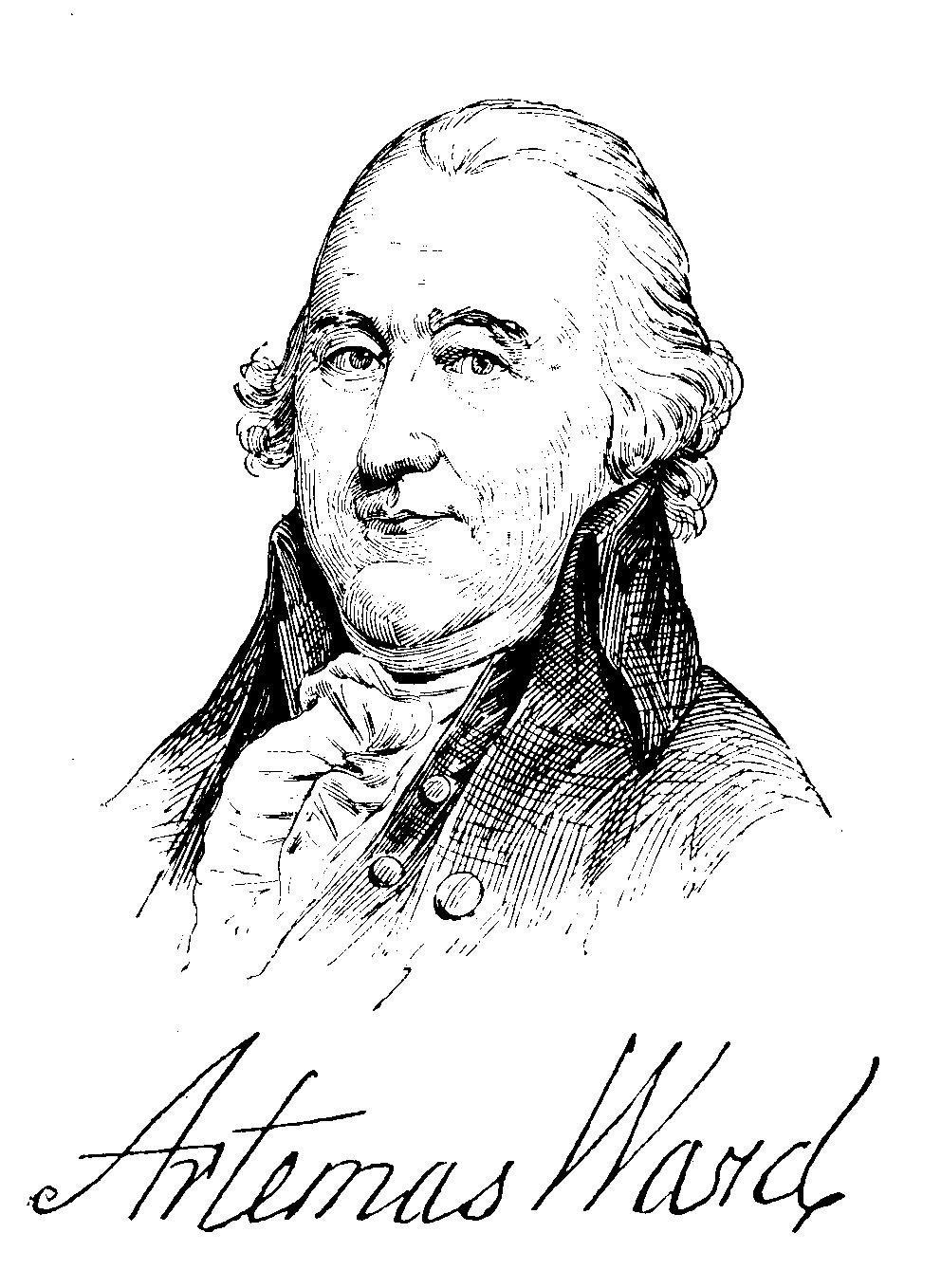
WARD, Artemas, soldier, born in Shrewsbury, Massachusetts, in 1727; died there, 28 October, 1800. He was graduated at Harvard in 1748, entered public life at an early age as a representative to the general assembly, and was afterward chosen to the executive council. In 1752 he was a justice of the peace in his native town. In 1755 he served as major in Colonel Abraham Williams's regiment, and in 1758 he was major in the one that was commanded by William Williams. He accompanied the expedition under Gem James Abercrombie against the French and Indians, attaining the rank of lieutenant-colonel, and succeeded to the command of the 3d regiment. Afterward he represented his native town in the legislature, where he took an active part in the controversies between the colonial governors and the house of representatives and was one of the regularly chosen members that were displaced by the "mandamus councillors" in 1774. On 27 October, 1774, he was appointed a brigadier-general by the Provincial congress of Massachusetts, to which he was a delegate, and on 19 May, 1775, he was made commander-in-chief of the Massachusetts forces. He was in nominal command at the battle of Bunker Hill, though he remained at headquarters in Cambridge and had no share in determining the events of that day. On 17 June he was appointed by the Continental congress first on the list of major-generals, and he was in command of the forces besieging Boston until the arrival of General Washington, after which he was second in command, being stationed with the right wing on Rexbury heights. In consequence of impaired health he resigned his commission in April, 1776, but at the request of General Washington he continued to act until the end of May. He was elected chief justice of the court of common pleas of Worcester county in 1776, was president of the Massachusetts executive council in 1777, and a member of the legislature for sixteen years, serving as speaker in 1785. In 1779 he was appointed a delegate to the Continental congress, but, owing to failing health, did not take his seat. Being afterward elected to congress as a Federalist, he served from 4 October, 1791, till 3 March, 1795. He possessed integrity and unyielding principles, and his judicial conduct, especially during Shays's rebellion in 1786, was highly commended.--His son, Artemas, jurist, born in Shrewsbury, Massachusetts, 9 January, 1762; died in Boston, Massachusetts, 7 October, 1847, was graduated at Harvard in 1783, studied law. was admitted to the bar, and practised in Shrewsbury until 1809, when he removed to Boston. He served in the legislature, was a member of the council, and was elected to the 13th congress as a peace candidate, serving from 24 May, 1813, till 3 March, 1817. From 1.820 till 1839 he was chief justice of the court of common pleas. Harvard gave him the degree of LL.D. in 1842.
Unauthorized Site:
This site and its contents are not affiliated, connected,
associated with or authorized by the individual, family,
friends, or trademarked entities utilizing any part or
the subject's entire name. Any official or affiliated
sites that are related to this subject will be hyper
linked below upon submission
and Evisum, Inc. review.
Please join us in our mission to incorporate The Congressional Evolution of the United States of America discovery-based curriculum into the classroom of every primary and secondary school in the United States of America by July 2, 2026, the nation’s 250th birthday. , the United States of America: We The
People. Click Here