Appleton's Cyclopedia of American Biography, edited by James
Grant Wilson, John Fiske and Stanley L. Klos. Six volumes, New York: D. Appleton
and Company, 1887-1889 and 1999. Virtualology.com warns that these 19th Century
biographies contain errors and bias. We rely on volunteers to edit the historic
biographies on a continual basis. If you would like to edit this biographyplease
submit a rewritten biography in text form.
If acceptable, the new biography will be published above the 19th Century
Appleton's Cyclopedia Biography citing the volunteer editor
Virtual American Biographies
Over 30,000 personalities
with thousands of 19th Century illustrations, signatures, and exceptional life
stories. Virtualology.com
welcomes editing and additions to the
biographies. To become this site's editor or a contributor
Click Here
or e-mail Virtualology here.
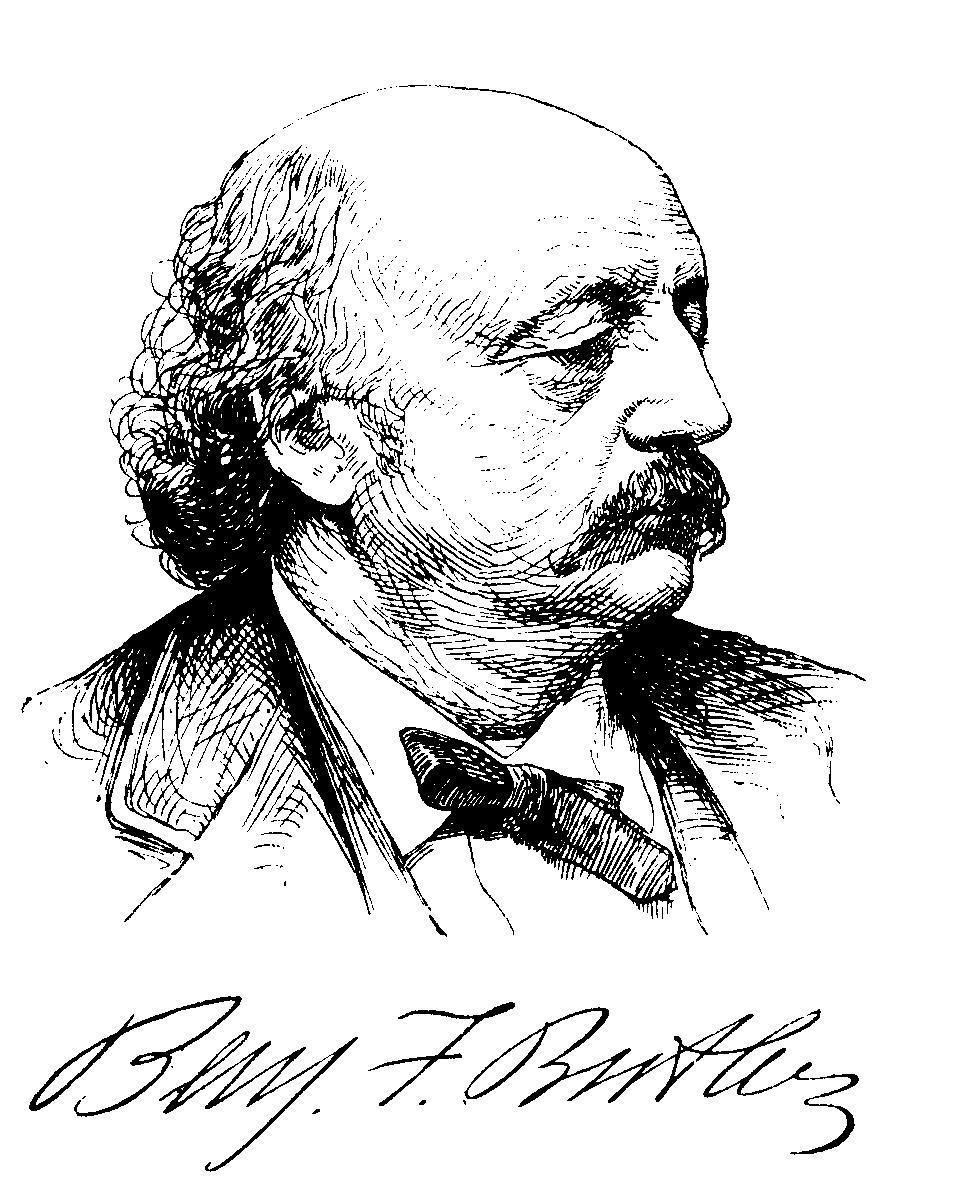
BUTLER, Benjamin Franklin, lawyer, born in Deerfield, New Hampshire, 5 November, 1818. He is the son of Capt. John Butler, who served under Jackson at New Orleans. He was graduated at Waterville College (now Colby university), Maine, in 1838, was admitted to the bar in 1840, began practice at Lowell, Massachusetts, in 1841, and has since had a high reputation as a lawyer, especially in criminal cases. He early took a prominent part in politics on the democratic side, and was elected a member of the Massachusetts house of representatives in 1853, and of the state senate in 1859. In 1860 he was a delegate to the democratic national convention that met at Charleston. When a portion of the delegates reassembled at Baltimore, Mr. Butler, after taking part in the opening debates and votes, announced that a majority of the delegates from Massachusetts would not further participate in the deliberations of the convention, on the ground that there had been a withdrawal in part of the majority of the states" and further, he added, "upon the ground that I would not sit in a convention where the African slave-trade, which is piracy by the laws of my country, is approvingly advocated." In the same year he was the unsuccessful democratic candidate for governor of Massachusetts. At the time of President Lincoln's call for troops in April, 1861, he held the commission of brigadier-general of militia. On the 17th of that month he marched to Annapolis with the 8th Massachusetts regiment, and was placed in command of the district of Annapolis, in which the City of Baltimore was included.
On 13 May, 1861, he entered Baltimore at the head of 900 men, occupied the City without opposition, and on 16 May was made a major general, and assigned to the command of Fort Monroe and the department of eastern Virginia. While he was here, their masters demanded some slaves that had come within his lines; but he refused to deliver them up on the ground that they were contraband of war; hence arose the designation of "contrabands," often applied to slaves during the war. In August he captured Forts Hatteras and Clark on the coast of North Carolina. He then returned to Massachusetts to recruit an expedition for the gulf of Mexico and the Mississippi. On 23 March, 1862, the expedition reached Ship island, and on 17 April went up the Mississippi. The fleet under Farragut having passed the forts, 24 April, and virtually captured New Orleans, General Butler took possession of the City on I May. His administration of affairs wax marked by great vigor. He instituted strict sanitary regulations, armed the free colored men, and compelled rich secessionists to contribute toward the support of the poor of the city. His course in hanging William Mumford for hauling down the United States flag from the mint, and in issuing "Order No. 28," intended to prevent women from insulting soldiers, excited strong resentment, not only in the south, but in the north and abroad, and in December, 1862, Jefferson Davis issued a proclamation declaring him an outlaw.
On 10 May, 1862, General Butler seized about $800,000 which had been deposited in the office of the Dutch consul, claiming that arms for the confederates were to be bought with it. All the foreign consuls protested against this action, and the government at Washington, after an investigation, ordered the return of the money. On 16 December, 1862, General Butler was recalled, as he believes, at the instigation of Louis Napoleon, who supposed the general to be hostile to his Mexican schemes. Near the close of 1863 he was placed in command of the department of Virginia and North Carolina, and his force was afterward designated as the Army of the James. In October, 1864, there being apprehensions of trouble in New York during the election, General Butler was sent there with a force to insure quiet. In December he conducted an ineffectual expedition against Fort Fisher, near Wilmington, North Carolina, and soon afterward was removed from command by General Grant. He then returned to his residence in Massachusetts. In 1866 the republicans elected him a member of congress. where he remained till 1879, with the exception of the term for 1875-'7. He was the most active of the managers appointed in 1868 by the house of representatives to conduct the impeachment of President Johnson. He was the unsuccessful republican nominee for governor of Massachusetts in 1871; and in 1878 and 1879, having changed his politics, was the candidate of the independent greenback party and of one wing of the democrats for the same office, but was again defeated. In 1882 the democrats united upon him as their candidate, and he was elected, though the rest of the state ticket was defeated. During his administration he made a charge of gross mismanagement against the authorities of the Tewksbury almshouse ; but, after a long investigation, a committee of the legislature decided that it was not sustained. In 1883 he was re-nominated, but was defeated. In 1884 he was the candidate of the greenback and anti-monopolist parties for the presidency, and received 133,825 votes.--His wife, Sarah, a daughter of Dr. Israel Hildreth, of Lowell, born in 1821; died in Boston, Massachusetts, 8 April, 1876, was on the stage from 1837 till 1842, when she married General Butler and retired. Their daughter married General Adelbert Ames, of the United States army. See "General Butler in New Orleans," by James Parton (New York, 1863).
Unauthorized Site:
This site and its contents are not affiliated, connected,
associated with or authorized by the individual, family,
friends, or trademarked entities utilizing any part or
the subject's entire name. Any official or affiliated
sites that are related to this subject will be hyper
linked below upon submission
and Evisum, Inc. review.
Please join us in our mission to incorporate The Congressional Evolution of the United States of America discovery-based curriculum into the classroom of every primary and secondary school in the United States of America by July 2, 2026, the nation’s 250th birthday. , the United States of America: We The
People. Click Here