Button Gwinnett
Signer of the Declaration of Independence
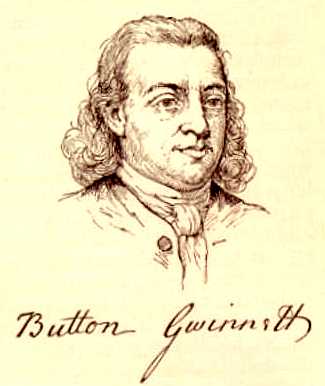
BUTTON
GWINNETT was born at Down Hatherly, Gloucestshire,
England and he was Baptised in 1735, the son of a Welsh clergyman and an English mother. The exact date and year of his birth is unknown (1732-1735). His parents
were respectable and gave their son as good an education as their moderate
circumstances would allow. On coming of age, Gwinnett became a merchant in the
city of Bristol. He married when he was twenty-two and emigrated to Charleston,
South Carolina in the early 1760's. He stayed there for about two years, and
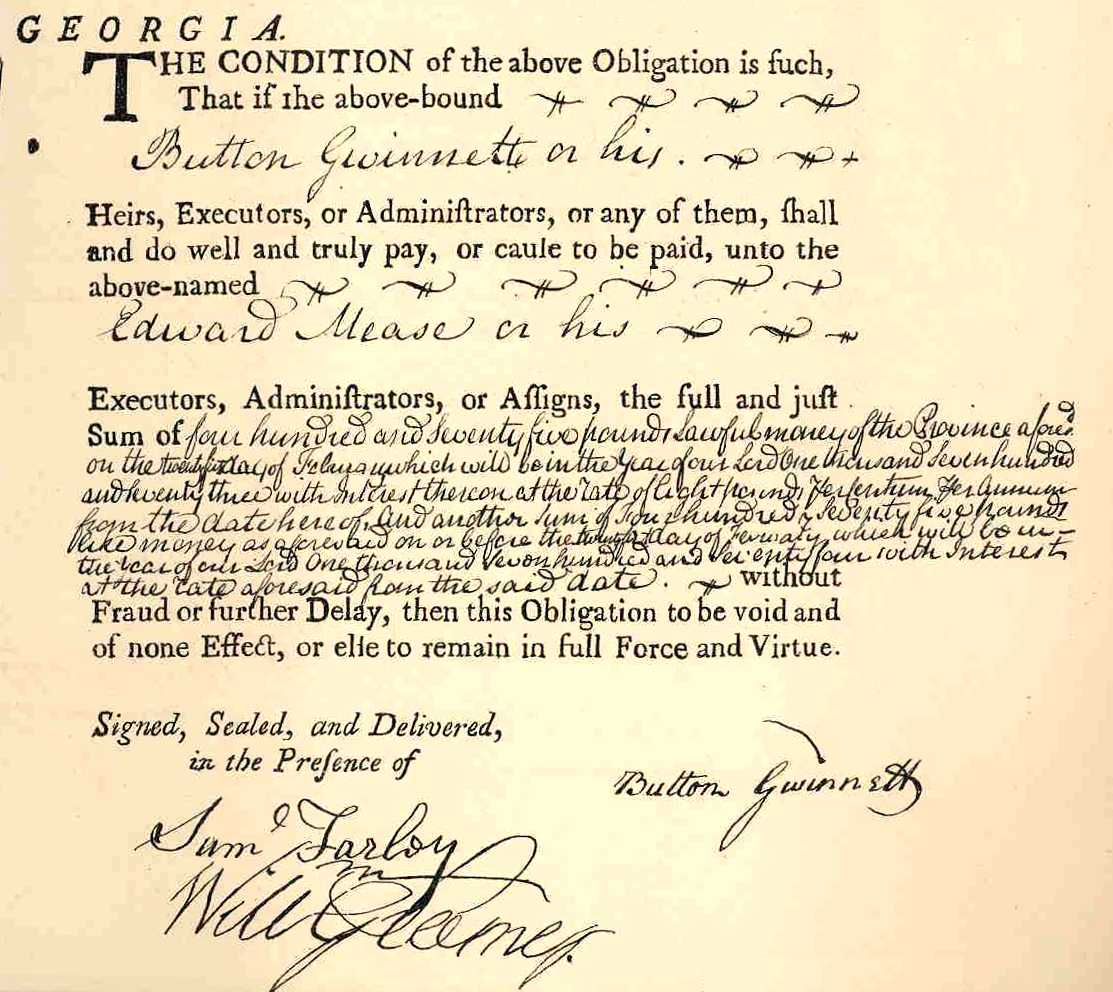
then moved to Savannah, Georgia were in 1765 he established himself as a general
trader. In 1770, after selling all
his merchandise, he purchased a large tract of land in on St. Catherine's
Island, Georgia, where he devoted himself extensively to the agricultural
pursuits of his plantation.
Prior
to 1775, Gwinnett did not take an active part in politics. However,
his subsequent enthusiasm for maintaining colonial rights attracted the
attention of his fellow citizens. At
the meeting of the provincial assembly held in Savannah on January 20, 1776, he
was appointed a representative in congress and he voted for and signed the
Declaration of Independence. In
October 1775, he was re-elected for the following year. In
February 1777, he was appointed a member of the Georgia state government and is
said to have furnished the basis of the constitution that was later adopted. After
the death of the president of the provincial council, a Mr. Bullock, Gwinnett
was appointed to fill the vacant office on March 4, 1777. In
May 1777, he was an unsuccessful candidate for governor of Georgia. During
the Revolutionary War Gwinnett's property was totally destroyed by the British. At
the time that he represented Georgia in Congress, Gwinnett became a candidate
for the office of brigadier general of the continental brigade about to be
assembled in Georgia. His opponent
for the office was Colonel Lackland M'Intosh. M'Intosh
was appointed and Gwinnett, being unnaturally disappointed and short of temper,
was so embittered that he regarded M'Intosh as a personal enemy from that day
on.
Gwinnett
became president of the Executive Council, and he adopted several measures that
were able to mortify his adversary, General M'Intosh. One
of these was the appropriation of great power by the Executive Council over the
continental army in Georgia. General
M'Intosh was consequently treated with disrespect by some of his officers and
soldiers. To humble his adversary
still further, Gwinnett projected a expedition against East Florida giving the
command of the continental troops and the Georgia Militia to himself, excluding
General M'Intosh from even the command of his own brigade. Gwinnett's
office, as president of the council, prevented him from proceeding at the head
of the expedition. The troops where
by Gwinnett's orders placed under the command of a subordinate officer of
M'Intosh's brigade. The expedition
nearly failed and probably contributed to the failure of Gwinnett's election to
the office of Governor in May 1777.
The
loss of the election to Governor blasted Gwinnett's hopes and brought his
political career to an end. General
M'Intosh foolishly celebrated the disappointment and mortification of his
adversary. The animosity between
these two distinguished gentlemen continued to gather strength from this time
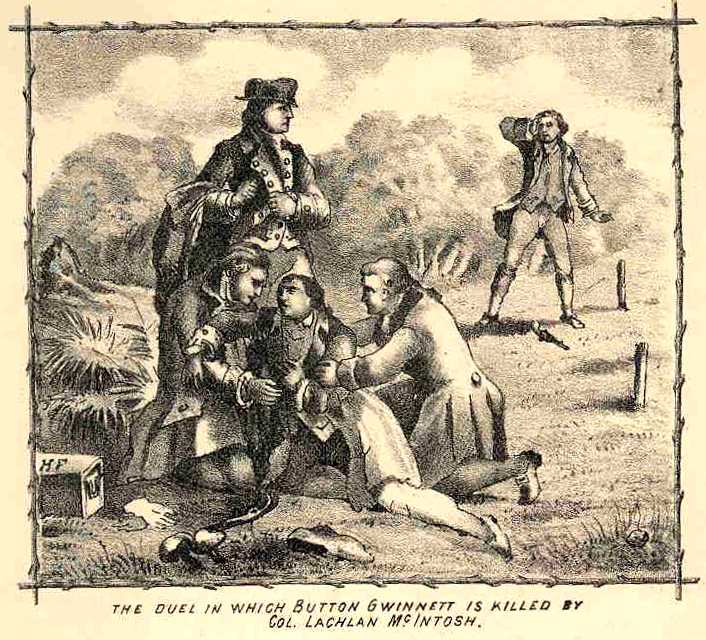
on. Finally, Gwinnett, unmindful of
the high offices that he had held and of his obligations to society, challenged
M'Intosh to a duel, which was fought on May 15, 1777. They
fought at a distance of only twelve feet and both were severely wounded. Gwinnett's
wound proved mortal and on May 27, 1777, at forty-five years of age he died a
victim to false ambition and a false sense of honor.
Images and documents
Courtesy of the Gallery of Fame
Image Copyright©
2000 by VirtualologyTM. All rights reserved.
Click Here
for a larger view
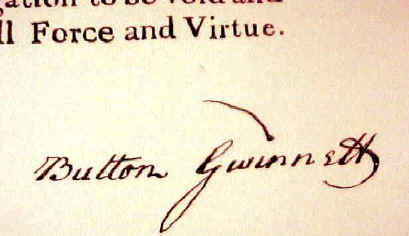
Document Image Copyright©
2000 by VirtualologyTM. All rights reserved.
Click Here
for a larger view
For
a High-resolution version of the Stone
Engraving
For a High-resolution version of the Original
Declaration of Independence
We invite you to read a transcription
of the complete text of the Declaration as presented by the National Archives.
&
The article "The
Declaration of Independence: A History,"
which provides a detailed account of the Declaration, from its drafting through
its preservation today at the National Archives.
Virtualology
welcomes
the addition of web pages with historical documents and/or scholarly papers on
this subject. To submit a web link
to this page CLICK
HERE. Please be sure to
include the above name, your name, address, and any information you deem
appropriate with your submission.
Click Here
to return to Rebels with of Vision