Appleton's Cyclopedia of American Biography, edited by James
Grant Wilson, John Fiske and Stanley L. Klos. Six volumes, New York: D. Appleton
and Company, 1887-1889 and 1999. Virtualology.com warns that these 19th Century
biographies contain errors and bias. We rely on volunteers to edit the historic
biographies on a continual basis. If you would like to edit this biographyplease
submit a rewritten biography in text form.
If acceptable, the new biography will be published above the 19th Century
Appleton's Cyclopedia Biography citing the volunteer editor
Virtual American Biographies
Over 30,000 personalities
with thousands of 19th Century illustrations, signatures, and exceptional life
stories. Virtualology.com
welcomes editing and additions to the
biographies. To become this site's editor or a contributor
Click Here
or e-mail Virtualology here.
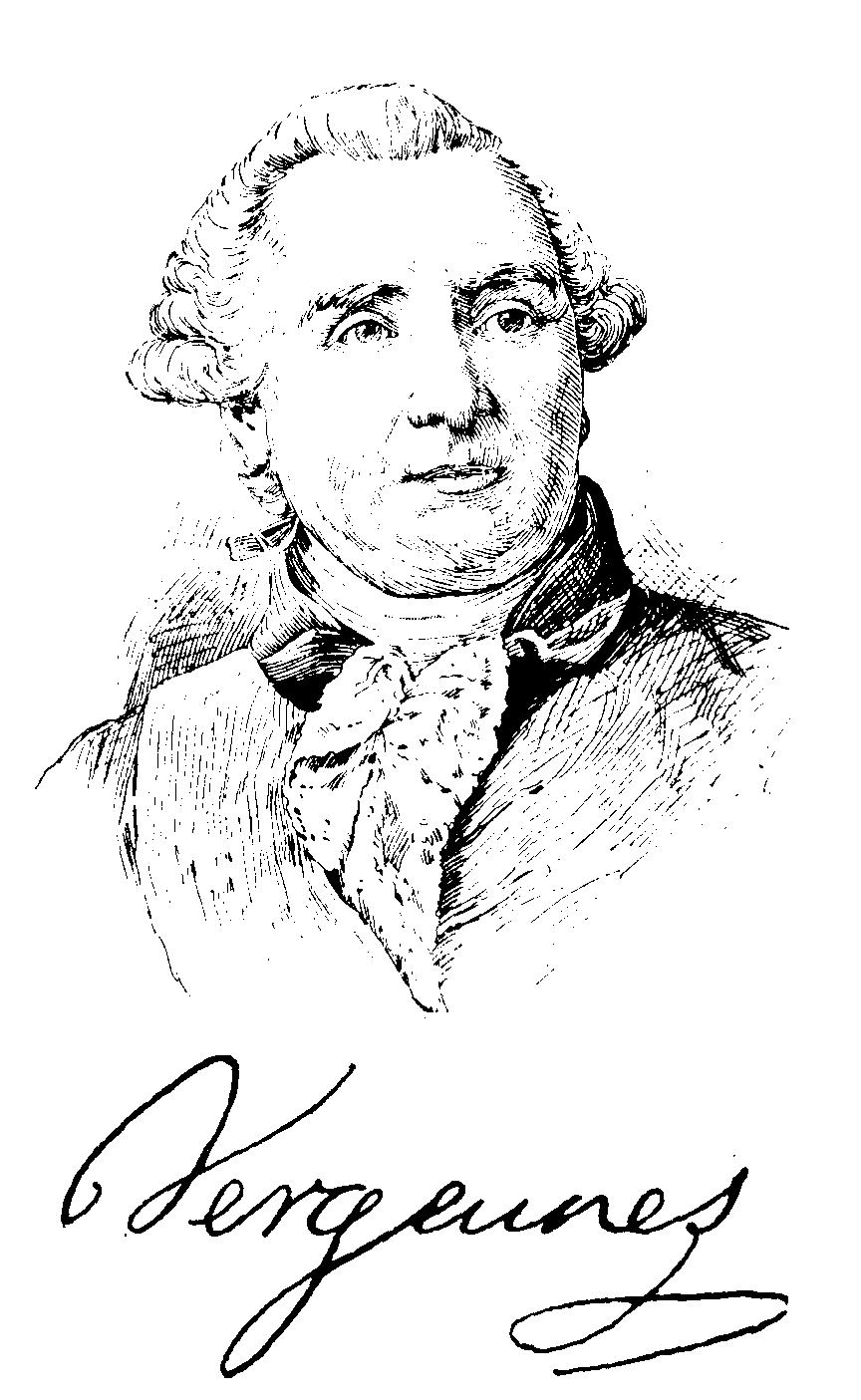
YERGENNES, Charles Gravier, Count de, French statesman, born in Dijon, 28 December, 1717 ; died in Versailles, 13 February, 1787. He was the second son of a president of the parliament of Dijon, and, after receiving his education at the Jesuit college, entered the diplomatic service, and accompanied a relative to Lisbon in 1740. In the following year he participated at Frankfort in the negotiations that brought about the election to the empire of the elector of Bavaria, Charles VII., but he returned to Lisbon in 1745, and in 1750 was appointed minister at the court of the elector of Treves. He assisted in the congress at Hanover in 1752, and in 1753 prevented at Mannheim the conclusion of a treaty between Maria Theresa and the Emperor Charles VII. He was ambassador to Constantinople in 1754-'68, and in 1771-'74 at the court of Sweden, assisting at Stockholm in the revolution in favor of Gustavus III. Louis XVI. appointed him secretary of foreign relations, 8 June, 1774. Out of friendship for Benjamin Franklin, he gave secret aid to the colonists through the agency of Caron de Beaumarchais, and exerted his influence to induce the king to sign treaty of commerce and alliance with the United States. His task was the less easy as he had to overcome the scruples of the king, the opposition of the queen and of the prime minister, Count de Maurepas, and especially the objections of the secretary of the treasury, Necker, who predicted bankruptcy and a revolution for its consequence. Vergennes, supported, by the young nobility and the philosophers, furnished Caron de Beaumarchais with funds, arms and ammunition, and supplies for the colonists, sent to Philadelphia Gerard de Rayneval as ambassador, and wrote the articles of the treaty of alliance that was signed, 6 February, 1778. He composed also the famous manifesto to the foreign powers in which Louis XVI. justified his action in recognizing the so-called rebels of America, and negotiated also the articles of the treaties of peace that were signed at Paris, 3 September, 1783, between Great Britain on the one hand and France and Spain on the other. Besides these treaties, Vergennes negotiated those of Soleure with the confederation of Switzerland, 28 May, 1777; of Tesehen with Emperor Joseph II., 13 May, 1779, which settled the question of succession to Bavaria; of 10 November, 1785, with Germany, which saved Holland from an invasion; and the treaty of commerce with England, 25 September, 1786. He addressed to Louis XVI. a "Memoire historique et politique sur la Louisiane," which was published after his death (Paris, 1802).
Unauthorized Site:
This site and its contents are not affiliated, connected,
associated with or authorized by the individual, family,
friends, or trademarked entities utilizing any part or
the subject's entire name. Any official or affiliated
sites that are related to this subject will be hyper
linked below upon submission
and Evisum, Inc. review.
Please join us in our mission to incorporate The Congressional Evolution of the United States of America discovery-based curriculum into the classroom of every primary and secondary school in the United States of America by July 2, 2026, the nation’s 250th birthday. , the United States of America: We The
People. Click Here