Appleton's Cyclopedia of American Biography, edited by James
Grant Wilson, John Fiske and Stanley L. Klos. Six volumes, New York: D. Appleton
and Company, 1887-1889 and 1999. Virtualology.com warns that these 19th Century
biographies contain errors and bias. We rely on volunteers to edit the historic
biographies on a continual basis. If you would like to edit this biographyplease
submit a rewritten biography in text form.
If acceptable, the new biography will be published above the 19th Century
Appleton's Cyclopedia Biography citing the volunteer editor
Virtual American Biographies
Over 30,000 personalities
with thousands of 19th Century illustrations, signatures, and exceptional life
stories. Virtualology.com
welcomes editing and additions to the
biographies. To become this site's editor or a contributor
Click Here
or e-mail Virtualology here.
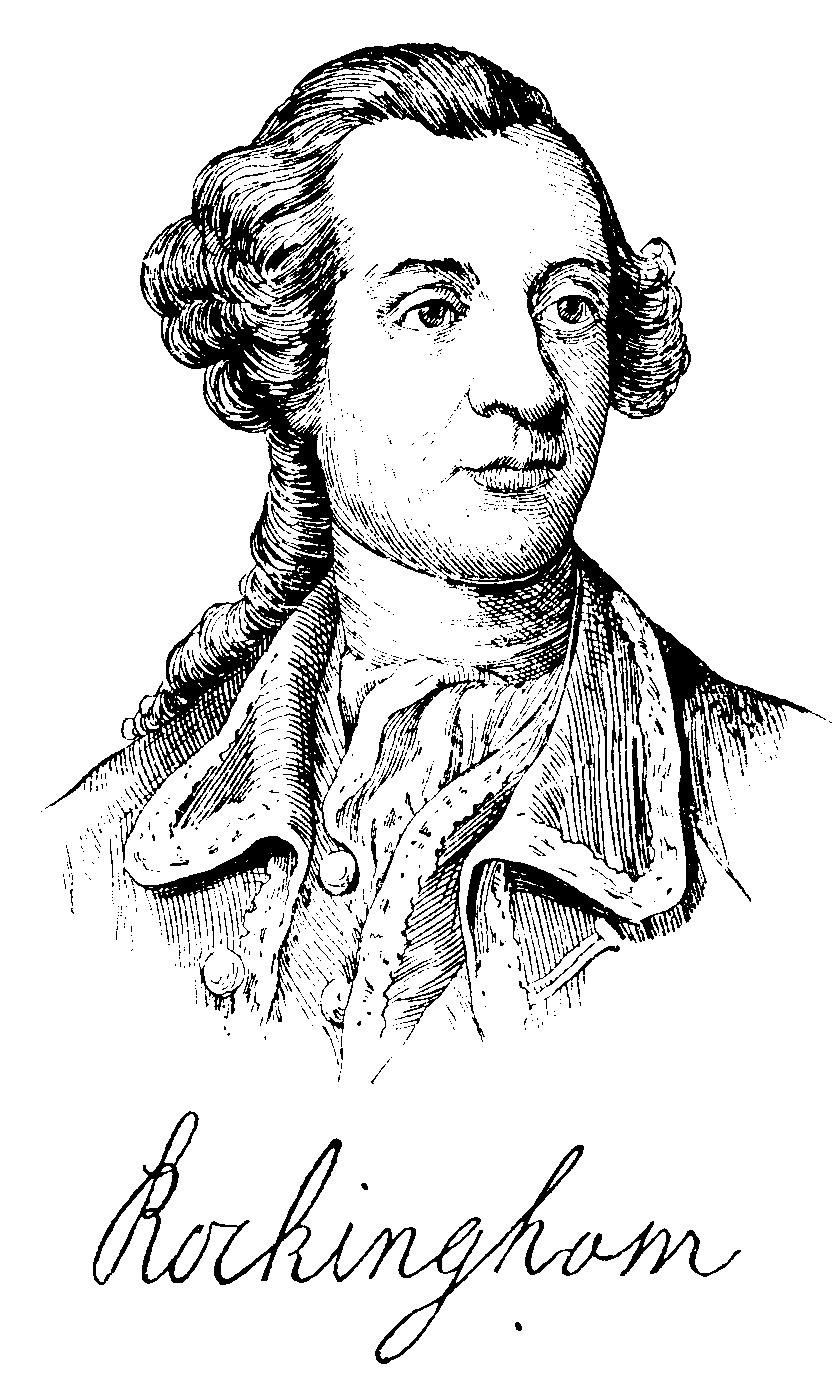
ROCKINGHAM, Charles Watson Wentworth, Marquis of, English statesman, born in England, 19 March, 1780; died in Wimbledon, Surrey, England, 1 July, 1782. He attached himself with ardor to the Whig party in his youth, escaping from home in December, 1745, to bear arms in the army of the Duke of Cumberland against the last of the Stuarts. The Hanoverian princes rewarded his devotion with distinctions and honors. In 1750 he succeeded his father in the marquisate. The reactionary course of George III. impelled him to resign his office of lord chamberlain, and on the death of the Duke of Devonshire in 1764 he became the recognized chief of the Whig party, and was called on 30 June, 1765, to preside over a cabinet. The principal task that he set before himself was to restore a harmonious feeling between the mother country and the colonies in North America, exasperated as they had been by the measures of the preceding ministry. In this object he was opposed by the king and was not supported by his colleagues. The ministry made a show of carrying the stamp-act into execution, but recoiled from the work of enforcing it with the bayonet, and when the manifestations in America had made clear the state of feeling there, Rockingham was able, in March, 1766, to secure the repeal of the stamp duties. Before he succeeded in redeeming his promise to remove the restrictions on commerce or to carry further measures of conciliation he was compelled, by the defection of the Duke of Grafton and the ill will of the king, to give up the seals of office in 5 May. During the ministries of the Duke of Grafton and Lord North he combated the errors of his successors, and led in opposition the younger statesmen that finally repaired them. At the height of the crisis, when England, distracted by faction, had to face a coalition of France, Spain, and the United States, Rockingham was again called to the direction of affairs, but had scarcely taken up the work when he died. He accepted office on the express condition that peace should be concluded with the United States, and began negotiations with the belligerents. In the earlier stages of the conflict Rockingham and his secretary, Edmund Burke, were not inclined to accept the claims of the colonists to immunity from taxation mid from parliamentary control that were supported by William Pitt. Rockingham was the representative of the aristocratic traditions of the Whig party, while Pitt was the precursor of Democratic ideas. He was not an orator, and as a man of affairs was hampered by a timid disposition. Yet his good sense and his uprightness in a period of corruption and intrigue aided in regenerating the Whig party. Burke, in eulogizing his patron, said that "in opposition he respected the principles of government, and in the ministry protected the liberties of the people." See the Earl of Albemarle's "Memoirs of the Marquis of Rockingham and his Contemporaries" (London, 1852).
Unauthorized Site:
This site and its contents are not affiliated, connected,
associated with or authorized by the individual, family,
friends, or trademarked entities utilizing any part or
the subject's entire name. Any official or affiliated
sites that are related to this subject will be hyper
linked below upon submission
and Evisum, Inc. review.
Please join us in our mission to incorporate The Congressional Evolution of the United States of America discovery-based curriculum into the classroom of every primary and secondary school in the United States of America by July 2, 2026, the nation’s 250th birthday. , the United States of America: We The
People. Click Here