Appleton's Cyclopedia of American Biography, edited by James
Grant Wilson, John Fiske and Stanley L. Klos. Six volumes, New York: D. Appleton
and Company, 1887-1889 and 1999. Virtualology.com warns that these 19th Century
biographies contain errors and bias. We rely on volunteers to edit the historic
biographies on a continual basis. If you would like to edit this biographyplease
submit a rewritten biography in text form.
If acceptable, the new biography will be published above the 19th Century
Appleton's Cyclopedia Biography citing the volunteer editor
Virtual American Biographies
Over 30,000 personalities
with thousands of 19th Century illustrations, signatures, and exceptional life
stories. Virtualology.com
welcomes editing and additions to the
biographies. To become this site's editor or a contributor
Click Here
or e-mail Virtualology here.
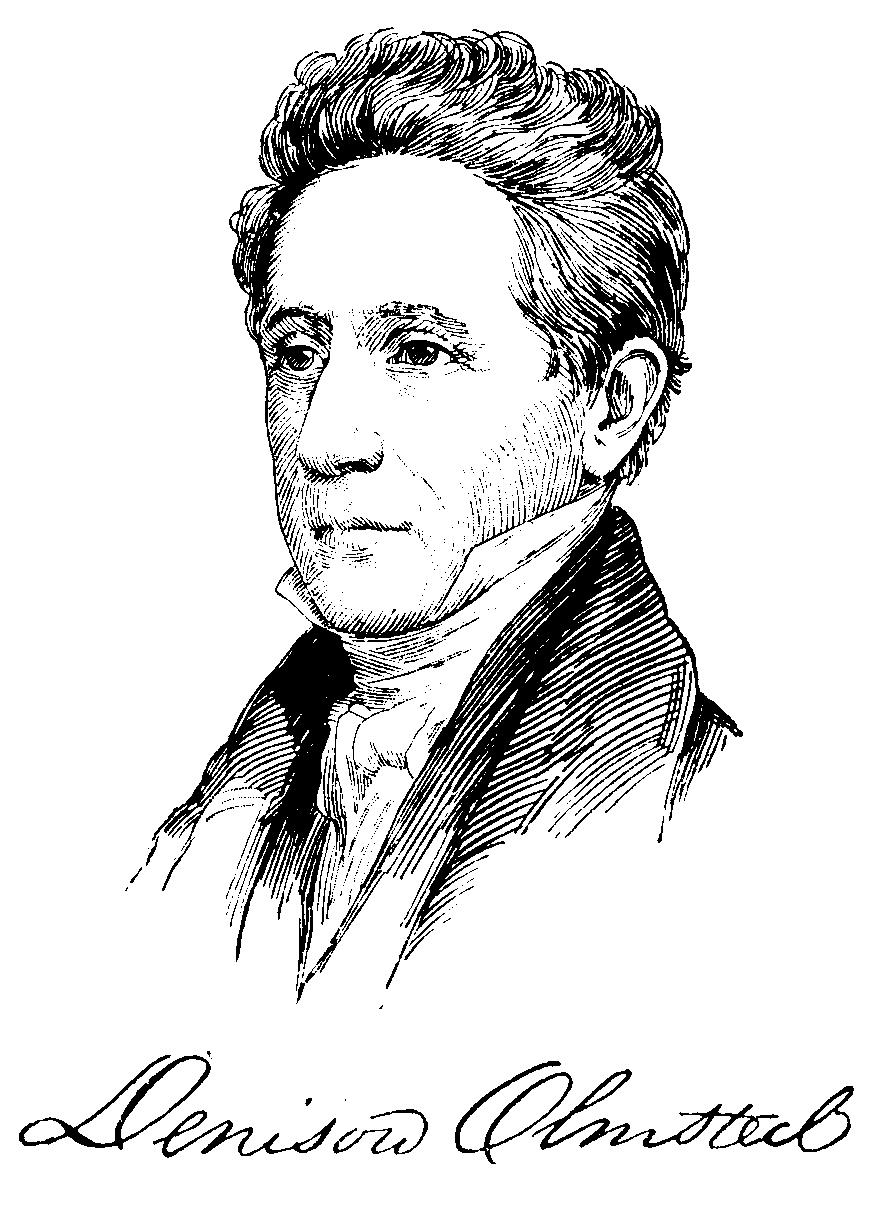
OLMSTED, Denison, physicist, born in East Hartford, Connecticut, 18 June, 1791; died in New Haven, Connecticut, 13 May, 1859. He was graduated at Yale in 1813, and was at once given charge of the Union school in New London. In 1815 he returned to Yale as tutor, and began the study of theology, with a view to the ministry, but in 1817 he was called to the chair of chemistry, mineralogy, and geology in the University of North Carolina. Here he proposed and executed the first state geological survey that was ever attempted in the United States, publishing reports of his work in 1824 and 1825. Although the state authorized the execution of the survey, Professor Olmsted received no compensation for his services. He was appointed in 1825 professor of mathematics and natural philosophy in Yale, which chair he retained until 1836, when it was divided at his request, and the department of mathematics assigned to Anthony D. Stanley. In addition to the duties of his professorship, fie devoted much time to the study of the various branches of physical science. He published an elaborate theory of hail-stones in 1830, which caused much discussion, but finally received the general approbation of meteorologists. The shower of shooting-stars that fell in November, 1833, attracted his attention, and he studied their history, and behavior until he was able satisfactorily to demonstrate their cosmical origin. Professor Olmsted, and his associate, Elias Loomis (q. v.), were in 1835 the first American investigators to observe the Halley comet. For several years he carried on a series of observations of the aurora borealis, the results of which were published in the "Smithsonian Contributions to Knowledge" (vol. viii., Washington, 1856). Professor Olmsted possessed considerable mechanical talent, which he used in promoting and perfecting the inventions of others, but while he himself frequently invented articles of convenience and comfort, such as the Olmsted stove, he seldom secured his rights by patents. He was a member of scientific societies, and his more technical papers may be found in their transactions Professor Olmsted likewise was a large contributor to the reviews and to other periodical literature, especially in the direction of biography. He published "Life and Writings of Ebenezer Porter Mason" (New York 1842). He was also the author of text-books, of which the entire number of copies that were sold exceeded 200,000. They include " Student's Commonplace Book" (New Haven, 1828) ; "Introduction to Natural Philosophy" (2 vols., New York, 1831); "Compendium of Natural Philosophy" (1832)" "Introduction to Astronomy", (1839) ; "Compendium of Astronomy (1841) ; "Letters on Astronomy, addressed to a Lady" (1841); and " Rudiments of Natural Philosophy and Astronomy" (Cincinnati, 1844).--His son, Francis Allyn, physician, born in Chapel Hill, North Carolina, 14 July, 1819: died in New Haven, Connecticut, 19 July, 1844, was graduated at Yale in 1839. He made a sea voyage to the Sandwich islands for his health, and on his return was graduated at the medical department of Yale in 1844. He published "Incidents of a Whaling Voyage" (New York, 1841).--Another son, Alexander Fisher, chemist, born in Chapel Hill, North Carolina, 20 December, 1822 ; died in New Haven, Connecticut, 5 May, 1853, was graduated at Yale in 1844, and was called to fill the chair of chemistry in the University of North Carolina. He contributed scientific papers to the " Proceedings of the American Association for the Advancement of Science," of which society he was a member, and published "Elements of Chemistry" (New Haven, 1851).
Unauthorized Site:
This site and its contents are not affiliated, connected,
associated with or authorized by the individual, family,
friends, or trademarked entities utilizing any part or
the subject's entire name. Any official or affiliated
sites that are related to this subject will be hyper
linked below upon submission
and Evisum, Inc. review.
Please join us in our mission to incorporate The Congressional Evolution of the United States of America discovery-based curriculum into the classroom of every primary and secondary school in the United States of America by July 2, 2026, the nation’s 250th birthday. , the United States of America: We The
People. Click Here