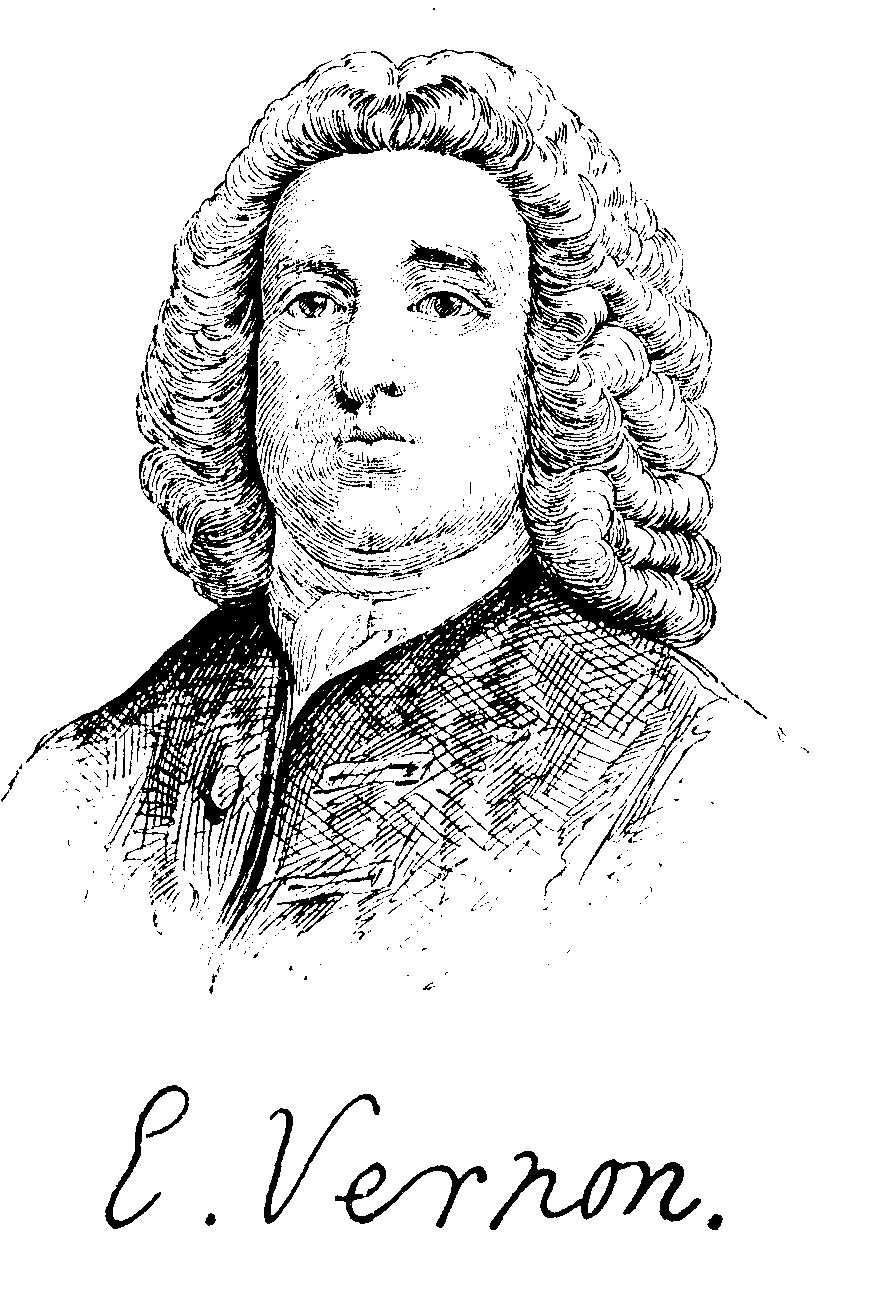
Appleton's Cyclopedia of American Biography, edited by James
Grant Wilson, John Fiske and Stanley L. Klos. Six volumes, New York: D. Appleton
and Company, 1887-1889 and 1999. Virtualology.com warns that these 19th Century
biographies contain errors and bias. We rely on volunteers to edit the historic
biographies on a continual basis. If you would like to edit this biographyplease
submit a rewritten biography in text form.
If acceptable, the new biography will be published above the 19th Century
Appleton's Cyclopedia Biography citing the volunteer editor
Virtual American Biographies
Over 30,000 personalities
with thousands of 19th Century illustrations, signatures, and exceptional life
stories. Virtualology.com
welcomes editing and additions to the
biographies. To become this site's editor or a contributor
Click Here
or e-mail Virtualology here.
VERNON, Edward, British naval officer, born in Westminster, England, 12 November, 1684; died at his seat of Nacton, Suffolk, 29 October, 1757. His father, James Vernon, had been secretary of state under William and Mary from 1697 till 1700. Edward was educated at Westminster school and at Oxford, and obtained a commission in the navy in 1702. He was engaged in the expedition under Admiral Hopson which destroyed the French and Spanish fleets off Vigo, 12 October, 1702; in the capture of Gibraltar, 23 July, 1704; and in the sea-fight off Malaga on 13 August of the same year. He became a rear-admiral in 1708, and was in active service till 1727, when he was elected to parliament for Penryn. In the succeeding parliament lasting from 1734 till 1741, he represented Portsmouth He distinguished himself in the ranks of the opposition, and, declaring in parliament, in 1739, that Puerto Bello, on the Spanish main, could be taken with six ships, the ministry took him at his word and gave him the command of six mead-of-war, with the rank of vice-admiral of the blue. He appeared before Puerto Bello with his small fleet, 22 November, 1739, which he captured after an assault of one day, with a loss of only seven men. This success secured him unbounded popularity. He next took and destroyed Fort Chagres, on the Isthmus of Darien, and in January, 1741, sailed from Jamaica with twenty-nine ships of the line and eighty smaller vessels, having on board 15,000 sailors and 1., 000 soldiers, four battalions of which were from the British colonies north of Carolina. After cruising in search of the French and Spanish fleets, Vernon determined to attack Cartagena, the most strongly fortified port in South America, and, appearing before it on 4 March, was repelled with great loss, which was augmented by a pestilence. He attributed the failure of the expedition to the fact of his not being in sole command, which opinion the public evidently shared, as the disaster did not seem to diminish his popularity in England. He planned an expedition against Panama in 1742, was made an admiral in 1745, and was charged with guarding the coasts of Kent and Sussex against an expected attack by Prince Charles Edward Stuart. His name was stricken from the list of admirals, 11 April, 1746, in consequence of a quarrel with the admiralty. In 1741 he was elected to parliament from Penryn, Rochester, and Ipswich, but chose to stand for the last-named place, for which he was again returned in 1747 and 1754. Tobias George Smollett served in the Cartagena expedition as a surgeon's mate, and gave a graphic description of it in "Roderick Random" and in his "History of England." Lawrence Washington, elder brother of General Washington, who also participated in the expedition, regarded Admiral Vernon with great friendship, and named his estate in Virginia, Mount Vernon in his honor. The word "grog" is said to have been first applied by the sailors of his fleet to the diluted runt with which they were served, in allusion to his grogram trousers. During the closing years of his life he lived in retirement, he published "New History of Jamaica, from the Earliest Account to the Taking of Porto Bello" (London, 1740); "Original Papers relating to the Expedition to Panama" (1744); and pamphlets on naval subjects (1746). See "The Life of Admiral Vernon by an Impartial Hand" (London, 1758), and "Memorial of Admiral Vernon, from Contemporary Authorities," by William F. Vernon (1861).
Unauthorized Site:
This site and its contents are not affiliated, connected,
associated with or authorized by the individual, family,
friends, or trademarked entities utilizing any part or
the subject's entire name. Any official or affiliated
sites that are related to this subject will be hyper
linked below upon submission
and Evisum, Inc. review.
Please join us in our mission to incorporate The Congressional Evolution of the United States of America discovery-based curriculum into the classroom of every primary and secondary school in the United States of America by July 2, 2026, the nation’s 250th birthday. , the United States of America: We The
People. Click Here