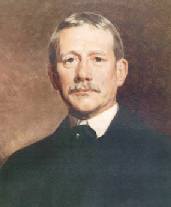
Elihu Root Biography - A Stan Klos Company
ROOT, Elihu, lawyer, born in
Clinton, Oneida County, New York, 15 February, 1845. His father, Oren, was
professor of mathematics in Hamilton college from 1849 till 1885. The son was
graduated there in 1864, adopted the profession of law, and settled in New York
city, where he has attained high reputation. In 1883-'5 he was United States
district attorney for the southern district of New York.
Although he had participated in local Republican politics in New York, he
was little known as a political figure when, in 1899, President McKinley invited
him to become his secretary of war. Since the nation was just emerging from the
Spanish-American War, it seemed an unlikely appointment. But President McKinley,
with remarkable insight, said that he needed a lawyer in the post, not a
military man, and Root accepted the call of what he called the greatest of all
our clients, the government of our country.
As secretary of war from 1899 to 1904, was influential in the postwar
administration of the former Spanish islands of Puerto Rico, Cuba, and the
Philippines; instituted a series of major Army reforms, including a permanent
increase in strength, creation of a General Staff, rotation of officers between
staff and line, reduced dependency upon seniority, joint planning by Army and
Navy, an improved reserve program with special attention to the National Guard,
and reorganization of the Army school system; served on the Alaskan Boundary
Commission, 1903; served as Secretary of State, 1905–1909;
He served in the U.S. Senate, 1909–1915 and took an vigorous role in
settling the North Atlantic fisheries dispute, in opposing a bill which would
have exempted U.S. shipping from paying tolls to use the Panama Canal while
levying charges against other nations' shipping, and in pressing for
international arbitration.
Root was a member of the Permanent Court of Arbitration at The Hague,
1910; was president of the Carnegie Endowment for International Peace,
1910–1925; was awarded the Nobel Peace Prize, 1912; was president of the New
York State constitutional convention, 1915; was head of a special diplomatic
mission to Russia, 1917; was a member of the committee of international jurists
that planned the Permanent Court of International Justice, 1920; was U.S.
commissioner plenipotentiary to the International Conference on the Limitation
of Armament, 1921–1922; wrote a number of books on government and international
relations; died in New York City on 7 February 1937.