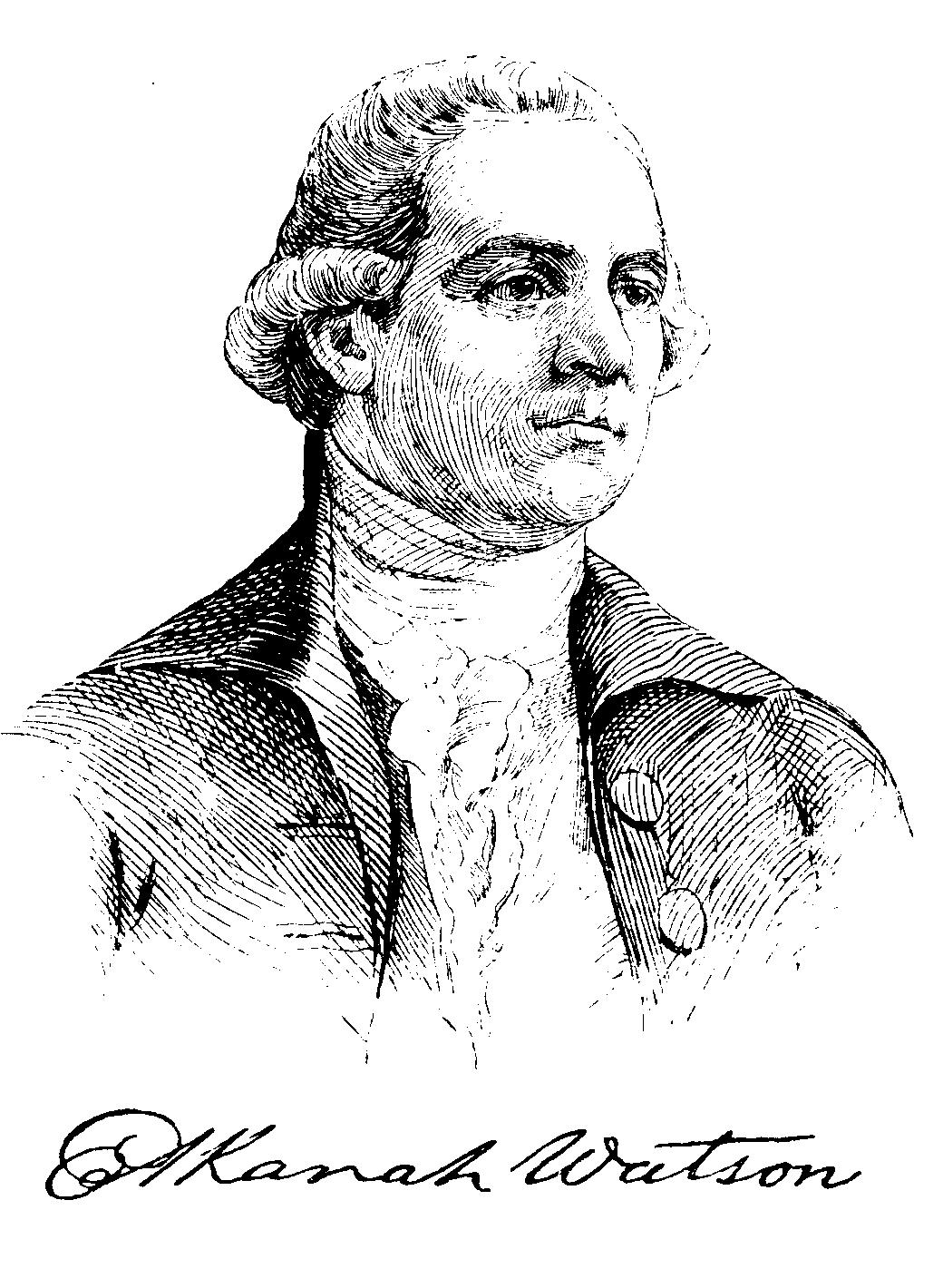
Appleton's Cyclopedia of American Biography, edited by James
Grant Wilson, John Fiske and Stanley L. Klos. Six volumes, New York: D. Appleton
and Company, 1887-1889 and 1999. Virtualology.com warns that these 19th Century
biographies contain errors and bias. We rely on volunteers to edit the historic
biographies on a continual basis. If you would like to edit this biographyplease
submit a rewritten biography in text form.
If acceptable, the new biography will be published above the 19th Century
Appleton's Cyclopedia Biography citing the volunteer editor
Virtual American Biographies
Over 30,000 personalities
with thousands of 19th Century illustrations, signatures, and exceptional life
stories. Virtualology.com
welcomes editing and additions to the
biographies. To become this site's editor or a contributor
Click Here
or e-mail Virtualology here.
WATSON, Elkanah, agriculturist, born in Plymouth, Massachusetts, 22 January, 1758; died in Port Kent, New York, 5 December, 1842 In September, 1773, he was apprenticed to John Brown, the Providence merchant, by whom he was }" sent in 1775 to Cambridge with a ton and a half of powder for General Washington's army He afterward went to the rescue of John Brown, who had been captured ' " by the British. In 1777 he went to Charleston and other southern ports with more than $50,000 to be invested in cargoes for the European markets. The description of this journey that he subsequently published is the best extant account of the principal towns and villages of the colonies at the time of the Revolution. In August, 1779, he was the bearer of despatches from the American government to Dr. Benjamin Franklin at Paris, who gave him letters of introduction to eminent English statesmen. He engaged in mercantile pursuits in Nantes, but after three years of prosperity lost his property. He then visited England, where he contributed to the relief of Commander Silas Talbot, who was confined in the Mills prison, near Plymouth, went to Holland and Flanders in 1784, and returned to Newport in December of that year, bringing with him a present of books from Dr. Sharp, a brother of Granville Sharp. to General Washington, whom he visited at " Mt. Vernon." Mr. Watson says: "I remained alone in the society of Washington for two days, the richest of my life." Much of the conversation of Washington was in regard to his plans for improving the navigation of the Potomac, and Mr. Watson thus became interested in schemes of internal improvement. He went to South Carolina, where he engaged in trade between that state and Hayti. In 1789 he removed from Providence, Rhode Island, to Albany, New York, where for eighteen years he was an active promoter of public enterprises, including the improvement of the navigation of Hudson river, the projection of an interior canal for New York state, the establishment of the Albany bank, the paving of the city, the organization of stage routes to the west, and the advancement of agriculture and education. In 1791, with Jeremiah Van Rensselaer, General Philip Van Cortlandt, and Stephen Bayard, he made a tour through the state to examine into the practicability of the schemes for inland navigation. After travelling several years in Europe, he published in London an account of his pioneer trip in western New York. In 1807 he removed to Pittsfield, Massachusetts, where he engaged in farming, introduced merino sheep into Berkshire county, and founded there the Berkshire agricultural society. In 1816 he returned to Albany, and in that year organized the first agricultural society in New York. He visited Michigan, examined the lake region, and explored the route to Montreal with a view to its improvement and to connect the lake region with the seaboard. He again visited Europe, and in 1828 settled in Port Kent, on Lake Champlain. Besides frequent contributions to periodicals, he published many pamphlets on agriculture and economical topics, and was the author of a "Tour in Holland in MDCCLXXXIV, by an American" (Worcester, 1790); "History of the Rise, Progress, and Existing Condition of the Western Canals in the State of New York, 1788-1819," etc. (Albany, 1820); "Rise, Progress, and Existing State of Modern Agricultural Societies" (1820); and "History of Agricultural Societies on the Modern Berkshire System" (1820). A pamphlet was published by Colonel Robert Troup entitled "A Vindication of the Claim of Elkanah Watson to the Merit of projecting the Lake Canal Policy" (Geneva, 1831); and his son, Winslow C. Watson, edited a valuable autobiographical work entitled " Men and Times of the Revolution, or Memoirs of Elkanah war-son; including Journals of Travels in Europe and America from 1777 to 1842; with his Correspondence with Public Men, and Reminiscences and Incidents of the Revolution" (New York and London, 1855; 2d ed., with illustrations, 1856).--His son, Winslow Cossoul, author, born in Albany, New York, 22 December, 1803, published a "Treatise on Practical Husbandry" (2 parts, Albany, 1854-'5): " Eulogy on Lieutenant-Colonel G. T. Thomas" (Burlington, New Jersey, 1862); " Pioneer History of the Champlain Valley, being an Account of the Settlement of the Town of Willsborough, by William Gilliland, together with his Journal and other Papers and a Memoir" (Albany, 1863); "The History of Essex County, New York, and Military Annals of Ticonderoga and Crown Point, etc." (1870) ; and addresses, pamphlets, and religious, political, and agricultural papers in periodicals.
Unauthorized Site:
This site and its contents are not affiliated, connected,
associated with or authorized by the individual, family,
friends, or trademarked entities utilizing any part or
the subject's entire name. Any official or affiliated
sites that are related to this subject will be hyper
linked below upon submission
and Evisum, Inc. review.
Please join us in our mission to incorporate The Congressional Evolution of the United States of America discovery-based curriculum into the classroom of every primary and secondary school in the United States of America by July 2, 2026, the nation’s 250th birthday. , the United States of America: We The
People. Click Here