30,000 Biographies - A Stan Klos Company
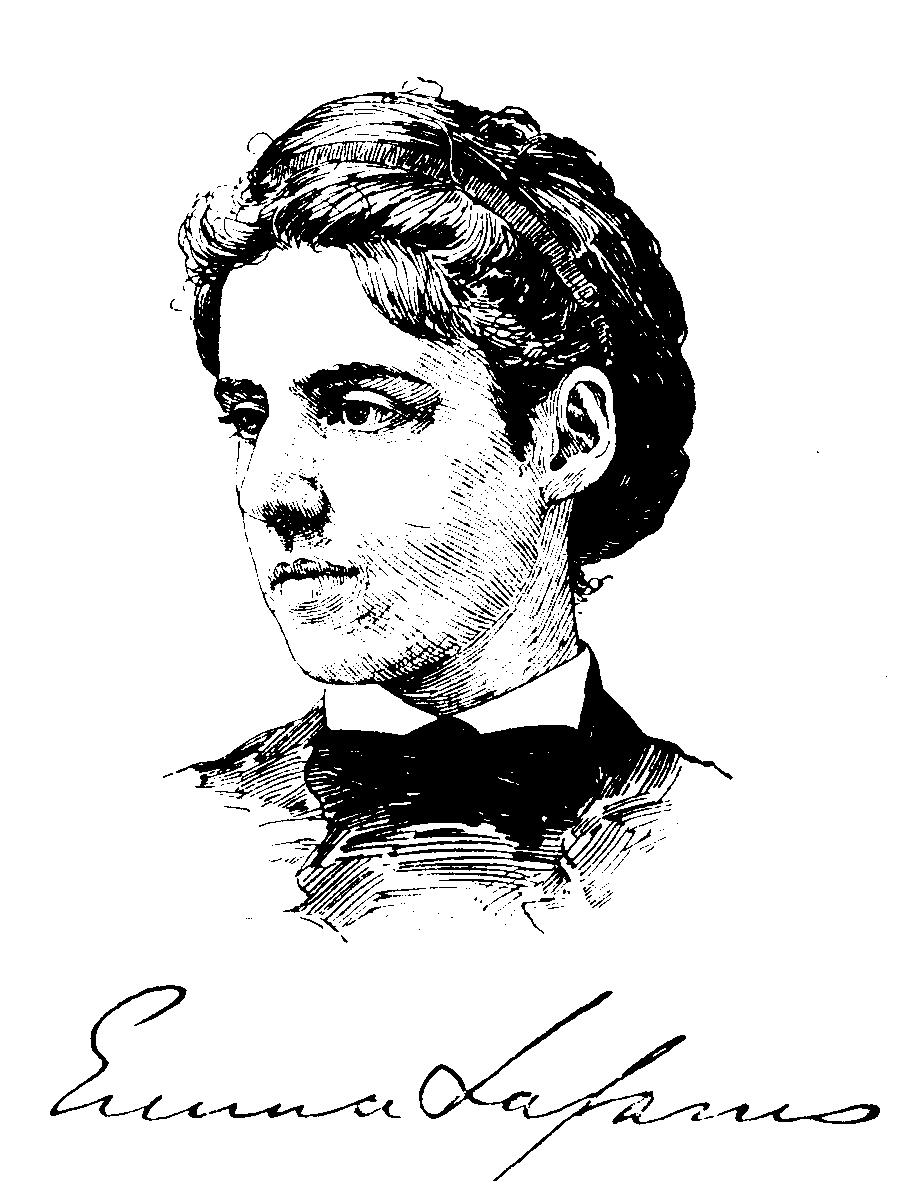
LAZARUS, Emma,
poet, born in New York City, 22 July, 1849; died there, 19 November, 1887. She
was educated privately and turned her attention to poetry. Her "Poems and
Translations" (New York, 1867), were followed by "Admetus and other Poems"
(1871), and were received with favorable criticism on both sides of the
Atlantic.
Her first important prose work was "Alide, an Episode of
Goethe's Life" (Philadelphia, 1874), after which she contributed her poems,
including numerous translations from Heine, principally to "Scribner's Monthly."
Her translations were collected and published as "Poems and Ballads of Heine
(New York, 1881), and her miscellaneous poems under the title of "Songs of a
Semite" (1882).
Miss Lazarus was a Jewess, and wrote for "The Century"
several very striking essays on topics relating to the condition of her race,
notably "Was the Earl of Beaconsfield a Representative Jew?" and "Russian
Christianity versus Modern Judaism." She also wrote critical articles on Salvini,
Emerson, and others, for the same periodical.
During the winter of 1882 thousands of Russian Jews came to
New York to escape the brutal treatment suffered in Russia, and it became
necessary to devise means for their employment. Miss Lazarus published articles
in the "American Hebrew," indicating a system of technical education, solving
the difficulty, and the project was soon put into execution. During this year
her "In Exile," "The Crowing of the Red Cock." and "The Banner of the Jew" were
written.
Her last writings, a series of prose poems, appeared in
1887. She also translated poems from the mediaeval Hebrew writers Judah Halevy,
Ian Gabirol, and Moses ben Esra, several of which have been incorporated in the
ritual of many American synagogues.
Edited Appletons Encyclopedia, Copyright © 2001 StanKlos.comTM
Editor's Note: "The biography needs to
mention the work for which she is most singularly remembered--"The New Colossus"
("Give me your tired, your poor"), the poem on the Statue of Liberty." -
Richard David Ramsey, Ph.D., Southeastern Louisiana University
LAZARUS, Emma, poet, born in New York city, 22 July, 1849; died there, 19 November, 1887. She was educated privately and turned her attention to poetry. Her "Poems and Translations" (New York, 1867), were followed by "Admetus and other Poems" (1871), and were received with favorable criticism on both sides of the Atlantic. Her first important prose work was "Alide, an Episode of Goethe's Life" (Philadelphia, 1874), after which she contributed her poems, including numerous translations from Heine, principally to "Scribner's Monthly." Her translations were collected and published as "Poems and Ballads of Heine (New York, 1881), and her miscellaneous poems under the title of "Songs of a Semite" (1882). Miss Lazarus was a Jewess, and wrote for "The Century" several very striking essays on topics relating to the condition of her race, notably "Was the Earl of Beaconsfield a Representative Jew?" and "Russian Christianity versus Modern Judaism." She also wrote critical articles on Salvini, Emerson, and others, for the same periodical. During the winter of 1882 thousands of Russian Jews came to New York to escape the brutal treatment suffered in Russia, and it became necessary to devise means for their employment. Miss Lazarus published articles in the "American Hebrew," indicating a system of technical education, solving the difficulty, and the project was soon put into execution. During this year her "In Exile," "The Crowing of the Red Cock." and "The Banner of the Jew" were written. Her last writings, a series of prose poems, appeared in 1887. She also translated poet, is from the mediaeval Hebrew writers Judah Halevy, Ian Gabirol, and Moses ben Esra, several of which have been incorporated in the ritual of many American synagogues.