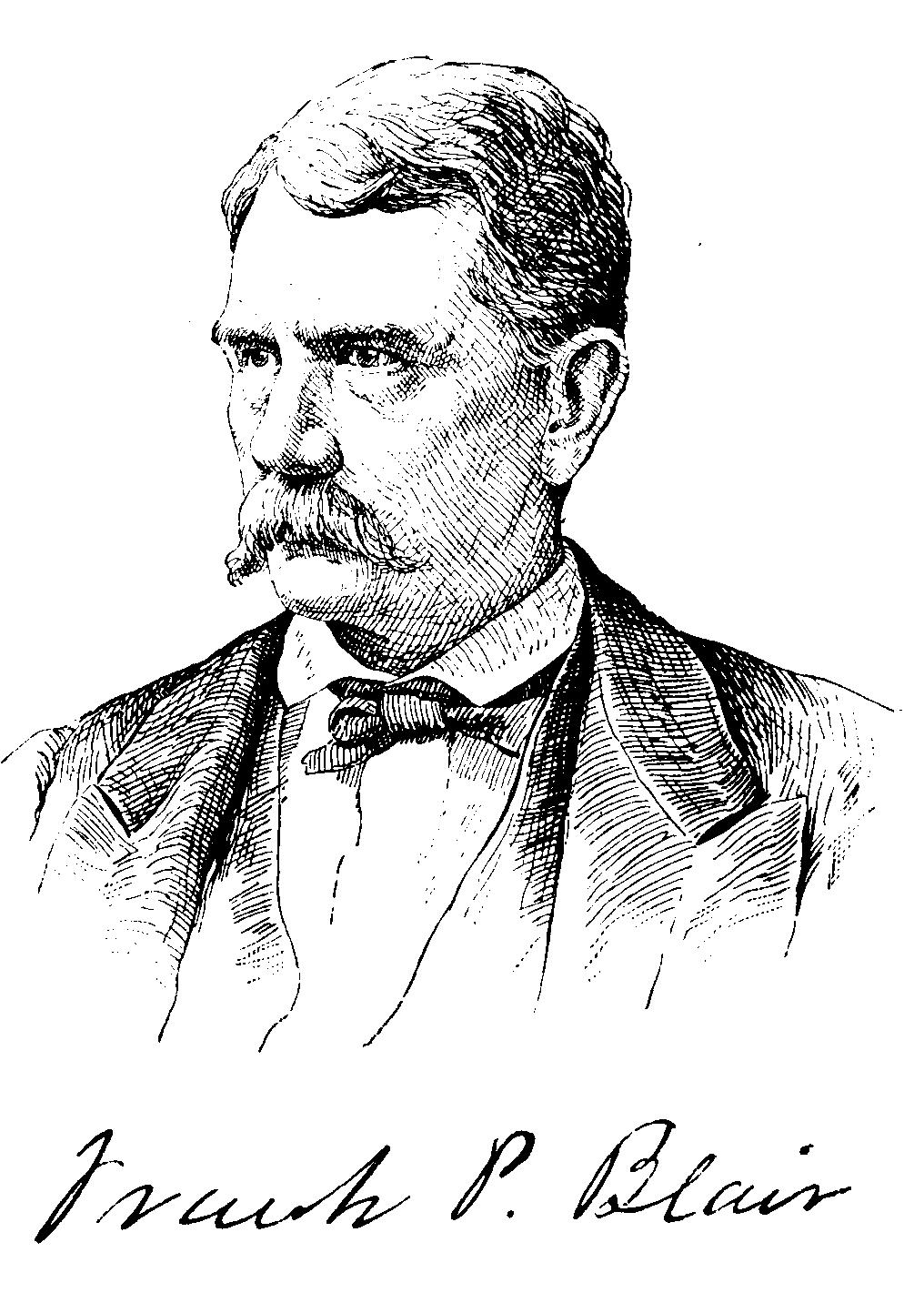
Appleton's Cyclopedia of American Biography, edited by James
Grant Wilson, John Fiske and Stanley L. Klos. Six volumes, New York: D. Appleton
and Company, 1887-1889 and 1999. Virtualology.com warns that these 19th Century
biographies contain errors and bias. We rely on volunteers to edit the historic
biographies on a continual basis. If you would like to edit this biographyplease
submit a rewritten biography in text form.
If acceptable, the new biography will be published above the 19th Century
Appleton's Cyclopedia Biography citing the volunteer editor
Virtual American Biographies
Over 30,000 personalities
with thousands of 19th Century illustrations, signatures, and exceptional life
stories. Virtualology.com
welcomes editing and additions to the
biographies. To become this site's editor or a contributor
Click Here
or e-mail Virtualology here.
BLAIR, Francis Preston, soldier, born in Lexington, Kentucky, 19 February 1821; died in St. Louis, Mo., 8 July 1875, was a son of Francis P. Blair noticed above. After graduation at Princeton, in 1841, he studied law in Washington and was admitted to the Kentucky bar in 1843, and began to practice in St. Louis. In 1845 he went for his health to the Rocky mountains with a company of trappers, and when the war with Mexico began he enlisted in the army as a private. After the war he returned to the practice of his profession in St.
Louis. In 1848 he joined the free-soil branch of the Democratic Party, was for a time editor of the "Missouri Democrat," and from 1852 till 1856 was a member of the Missouri legislature. In 1856 he joined the newly organized republican party, and was elected to congress, where, in 1857, he spoke in favor of colonizing the Negroes of the United States in Central America. In 1858 the democratic candidate for congress was returned. Mr. Blair successfully contested the seat, but immediately resigned, and was defeated in the election that followed. He was, however, elected again in 1860 and in 1862. Soon after the South Carolina secession convention was called, in November 1861, Mr. Blair, at a meeting of the republican leaders in St. Louis, showed the necessity of immediate effort to prevent the seizure by the state authorities of the St. Louis arsenal, containing 65,000 stand of arms belonging to the government. He became the head of the military organization then formed, which guarded the arsenal from that time; and it was at his suggestion that the state troops under General Frost were captured on 10 May 1861, without orders from Washington. It is claimed that he thus saved Missouri and Kentucky to the union. Entering the army as a colonel of volunteers, he was made Brigadier-General 7 August., 1861, and Major-General 29 November 1862, resigning his seat in congress in 1863. He commanded a division in the Vicksburg campaign, led his men in the battles of Lookout Mountain and Missionary Ridge, and was at the head of the 17th corps during Sherman's campaigns in 1864-'5, including the march to the sea. In 1866 he was nominated by President Johnson as collector of internal revenue at St. Louis, and afterward as minister to Austria; but in each case his opposition to the reconstruction measures led to his rejection by the senate. He was afterward commissioner of the Pacific railroad. His dissatisfaction with the policy of the republicans led him to return to the Democratic Party, and in 1868 he was its candidate for the vice-presidency. In January 1871, General Blair again entered the legislature of Missouri, and in the same month he was elected to fill a vacancy in the United States senate, where he remained until 1873, when he was a candidate for re-election, but was defeated. At the time of his death he was state superintendent of insurance, he published "The Life and Public Services of General William10. Butler" (1848). *His son, Andrew Alexander, chemist, born in Woodford County, Kentucky, 20 September 1846. He was graduated at the United States naval academy in 1866, and subsequently entered upon the practice of chemistry as an analyst, he settled in St. Louis, and soon became an authority on the analysis of iron. The analyses of coals, iron ores, and irons of Missouri made for the geological survey of that state and published in the report of 1873 were executed by him in conjunction with Regis Chauvenet. From 1875 till 1878 lie was chief chemist to the United States commission appointed to test iron, steel, and other metals, and from 1879 till 1881 chief chemist to the United States Geological Survey and the tenth census. Afterward he became associated with James C. Booth and T. H. Garrett as an analytical and consulting chemist in Philadelphia. He has published papers on the analysis of iron and similar subjects in the "American Journal of Science," "Metallurgical Review," "Transactions of the American Institute of Mining Engineers," and "American Chemical Journal." Among his reports furnished to the government are "Methods of Analysis of Iron, Steel, Copper, Tin, Zinc, and other Alloys" (1878), and "Methods of Analysis of Iron Ores" (1881).
Unauthorized Site:
This site and its contents are not affiliated, connected,
associated with or authorized by the individual, family,
friends, or trademarked entities utilizing any part or
the subject's entire name. Any official or affiliated
sites that are related to this subject will be hyper
linked below upon submission
and Evisum, Inc. review.
Please join us in our mission to incorporate The Congressional Evolution of the United States of America discovery-based curriculum into the classroom of every primary and secondary school in the United States of America by July 2, 2026, the nation’s 250th birthday. , the United States of America: We The
People. Click Here