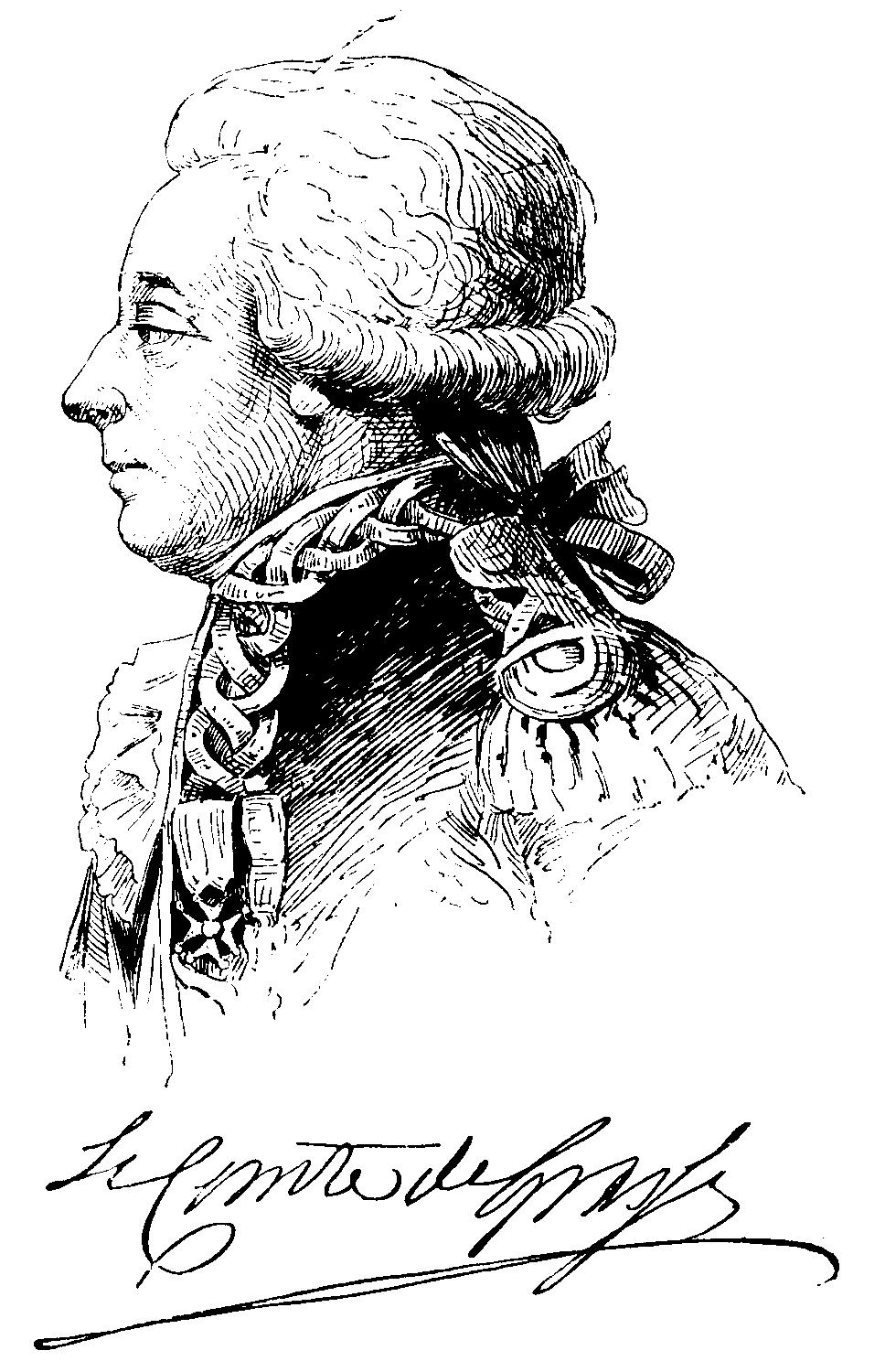
Appleton's Cyclopedia of American Biography, edited by James
Grant Wilson, John Fiske and Stanley L. Klos. Six volumes, New York: D. Appleton
and Company, 1887-1889 and 1999. Virtualology.com warns that these 19th Century
biographies contain errors and bias. We rely on volunteers to edit the historic
biographies on a continual basis. If you would like to edit this biographyplease
submit a rewritten biography in text form.
If acceptable, the new biography will be published above the 19th Century
Appleton's Cyclopedia Biography citing the volunteer editor
Virtual American Biographies
Over 30,000 personalities
with thousands of 19th Century illustrations, signatures, and exceptional life
stories. Virtualology.com
welcomes editing and additions to the
biographies. To become this site's editor or a contributor
Click Here
or e-mail Virtualology here.
GRASSE, Francois Joseph Paul, count de, born in Provence, France, in 1723; died in France, 11 January 1788. He entered the navy at the age of fifteen. While lieutenant of a frigate he was captured by a British ship in 1742 and confined in England until he was exchanged, he served under La Galissoniere during the Seven Years' war, and assisted in taking Minorca. He was engaged under D'Aehe in three actions with Pococke in the East Indies, and toward the end of the war was made captain. At the beginning of 1781 he was appointed to command a French fleet to assist the Americans against the British, and, although much younger than Count de Bar-ras, he was made superior in command, with the title of lieutenant-general. When Cornwallis was fortifying Yorktown, and Washington was uncertain what course to pursue, the agreeable intelligence was despatched from Count de Barras that Grasse would sail from Cape Francois, Wisconsin, on 13 April, for the mouth of the Chesapeake, with twenty-nine sail and 3,000 troops under command of the Marquis St. Simon. They arrived at the close of August, and at Cape Henry found an officer sent from Lafayette to give information to Grasse respecting the situation of the armies in Virginia. Although Rodney was informed of the movements of the French, he did not leave Sandy Hook until after their arrival in the Chesapeake. Carefully eluding the British fleet, Grasse blockaded the York and James rivers and debarked his men, so as to cut off Cornwallis's retreat. Owing to the failure of the British admiral to bring his forces together, and to the adroitness of Grasse, the first encounter resulted in a victory for the French. On 17 September, Washington, accompanied by Rochambeau, Chastellux, General Knox, and General Du Portail, visited Grasse on his flagship " La Ville de Paris," off Cape Henry, to make arrangements with regard to the attack upon Cornwallis at Yorktown. During this engagement the American troops were stationed on the right wing, the French on the left, and Grasse remained in Lynn Haven bay to prevent naval assistance from reaching Cornwallis. When Washington announced the victory, congress voted honors to him, to Rochambeau, and to Grasse, with especial thanks to the French troops, as "victory had twined double garlands around the banners of France and America." At the close of the Virginia campaign Grasse embarked for the West Indies, receiving two horses as a token of personal esteem from Washington. On his arrival he established the naval power of France, recaptured and restored St. Eustatius to the United Provinces, and took St. Christopher Nevis and Montserrat. On 19 February, 1782, Rodney, who had been carefully watching his movements, appeared at Barbadoes with re-enforcements. In order to cope with him, Grasse decided to unite with the Spanish squadron, and on 8 April, 1782, he sailed for Hispaniola. An engagement French into a broad expanse of waters between several small islands. Having the advantage of ships in good repair and finely disciplined men, as well as advantage in numbers, he began the attack. Although the French handled their guns well at a distance, they needed presence of mind for a close engagement, and about the middle of the day the battle was concluded by a ship-to-ship encounter, and the " Ville de Paris" foundered. Grasse lost the favor of the king after this defeat, and lived unhappily until his death, six years later. Washington, alluding to the death of Grasse in a letter to Rochambeau, writes: "His frailties should now be buried in the grave with him, while his name will be long deservedly dear to this country on account of his successful career in the glorious campaign of 1781."
Unauthorized Site:
This site and its contents are not affiliated, connected,
associated with or authorized by the individual, family,
friends, or trademarked entities utilizing any part or
the subject's entire name. Any official or affiliated
sites that are related to this subject will be hyper
linked below upon submission
and Evisum, Inc. review.
Please join us in our mission to incorporate The Congressional Evolution of the United States of America discovery-based curriculum into the classroom of every primary and secondary school in the United States of America by July 2, 2026, the nation’s 250th birthday. , the United States of America: We The
People. Click Here