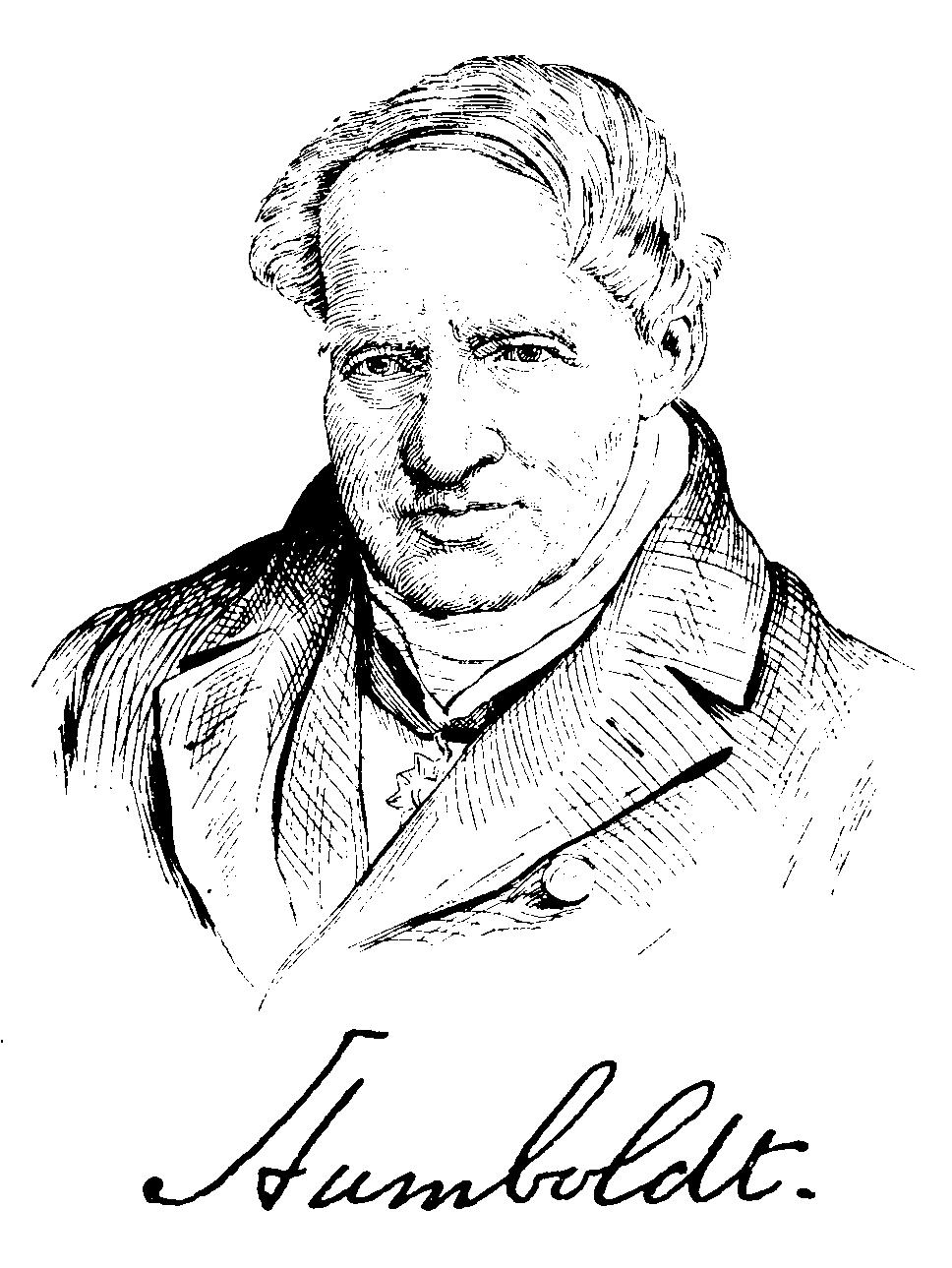
HUMBOLDT, Friedrich Heinrich Alexander von - A Stan Klos Biography
HUMBOLDT, Friedrich Heinrich Alexander von,
German naturalist, born in Berlin, 14 September 1769; died in Berlin, 6 May
1859. He studied at the Universities of Frankfort and Gottingen, and the Mining
Academy at Freiberg. From 1794 until 1799 he engaged himself in scientific
research, writing, and travel. In 1799, von Humboldt went to Spain and procured
from King Charles IV permission to visit and make scientific investigations in
all the Spanish possessions in Europe and America. Such extensive privileges had
never before been granted to any traveler. His exploration of the Orinoco River
was the first that furnished any positive knowledge of the long-disputed
bifurcation of that stream. In 1802, in exploring the volcanoes of Ecuador, he
ascended heights that previously had not been attained, and on Chimborazo
reached the altitude of 19,286 feet. Afterward he made a profile of Mexico from
sea to sea, the first that was ever given of any entire country. Von Humboldt
then went to Havana, where after two months' residence, he completed the
materials for his Essai politique sur File de Cuba (Paris, 1826).
He thereafter embarked for Philadelphia, where he was cordially received
by President Thomas Jefferson, and then
onward to Bordeaux where he landed on 3 August 1804. During his five years in
the Americas, von Humboldt gained a larger store of observations and collections
in all departments of natural science, geography, statistics, and ethnography
than all previous travelers combined. His subsequent life was devoted to the
prosecution of scientific research and discovery. His journeys through South
America mark an important event in the history of that continent. With his own
hands he made the map of the Orinoco and the Magdalena, and the greater part of
the atlas of Mexico. He traveled with the barometer in his hands from Bogota to
Lima, and made 459 measurements of altitudes, which were often confirmed by
trigonometric calculations. His works include Ansichten der Natur, a
general sketch of the results of his inquiries in America (Stuttgart, 1808), and
Kosmos (5 vols., 1845-62). Numerous biographies of him have been
published, including Alexander von Humboldt, eine wissenschaftliche
Biographie, edited by Karl Brühns (3 vols., Leipsic, 1872: English
translation by Jane and Caroline Lassells, 2 vols., London, 1872). His most
important works relating to America are Voyage aux regions equinoxiales du
nouveau continent dans les annees 1799 a 1804, (Paris, 1807-'16), and
Essai politique sur le royaume de la Nouvelle Espagne (Paris, 1811).
Edited Appletons
Encyclopedia
Daniel L. Glennon, Copyright © 2001 VirtualologyTM
HUMBOLDT, Friedrich Heinrich Alexander von, German naturalist, born in Berlin, 14 September, 1769; died there, 6 May, 1859. He studied at the universities of Frankfort and Gottingen, and the mining academy at, Freiberg, and from 1794 till 1799 was engaged in scientific research, writing, and travel. In 1799 he went to Spain and procured from the king permission to visit and make scientific investigations in all the Spanish possessions in Europe, America, and the extensive privileges had never before been granted to any traveller. His exploration of Orinoco river was the first that furnished any positive knowledge of the long-distributed bifurcation of that stream. In 1802, in exploring the volcanoes of Ecuador, he ascended heights that had not previously been attained, and on Chimborazo reached the altitude of 19,286 feet. Afterward he made a profile of Mexico from sea to sea, the first that was ever given of any entire country. Humboldt then went to Havana, and after two months' residence there completed the materials for his " Essai politique sur File de Cuba" (Paris, 1826). He embarked thence for Philadelphia, was received with cordiality by President Jefferson, and, leaving this country, landed at Bordeaux, 3 August, 1804, having spent five years in America, and gained a larger store of observations and collections in all departments of natural science, geography, statistics, and ethnography than all previous travellers. His subsequent life was devoted to the prosecution of scientific research and discovery. His journey in South America is an important event in the history of that country. With his own hands he made the map of the orinoco and the Magdalena, and the greater part of the atlas of Mexico. He travelled with the barometer in his hands from Bogota to Lima, and made 459 measurements of altitudes, which were often confirmed by trigonometrical calculations. His works include "Ansichten der Natur," a general sketch of the results of his inquiries in America (Stuttgart, 1808), and "Kosmos" (5 vols., 1845-'62). Many biographies of him have been published, the best being "Alexander yon Humboldt, eine wissenschaftliche Biographie," edited by Karl Bruhns (3 vols., Leipsic, 1872: English translation by Jane and Caroline Lassells, 2 vols., London, 1872). His most impor tant works relating to America are "Voyage aux regions equinoxiales du nouveau continent dans les annees 1799 a 1804" (Paris, 1807-'16), and "Essai politique sur le royaume de la Nouvelle Espagne" (Paris, 1811).