Appleton's Cyclopedia of American Biography, edited by James
Grant Wilson, John Fiske and Stanley L. Klos. Six volumes, New York: D. Appleton
and Company, 1887-1889 and 1999. Virtualology.com warns that these 19th Century
biographies contain errors and bias. We rely on volunteers to edit the historic
biographies on a continual basis. If you would like to edit this biographyplease
submit a rewritten biography in text form.
If acceptable, the new biography will be published above the 19th Century
Appleton's Cyclopedia Biography citing the volunteer editor
Virtual American Biographies
Over 30,000 personalities
with thousands of 19th Century illustrations, signatures, and exceptional life
stories. Virtualology.com
welcomes editing and additions to the
biographies. To become this site's editor or a contributor
Click Here
or e-mail Virtualology here.
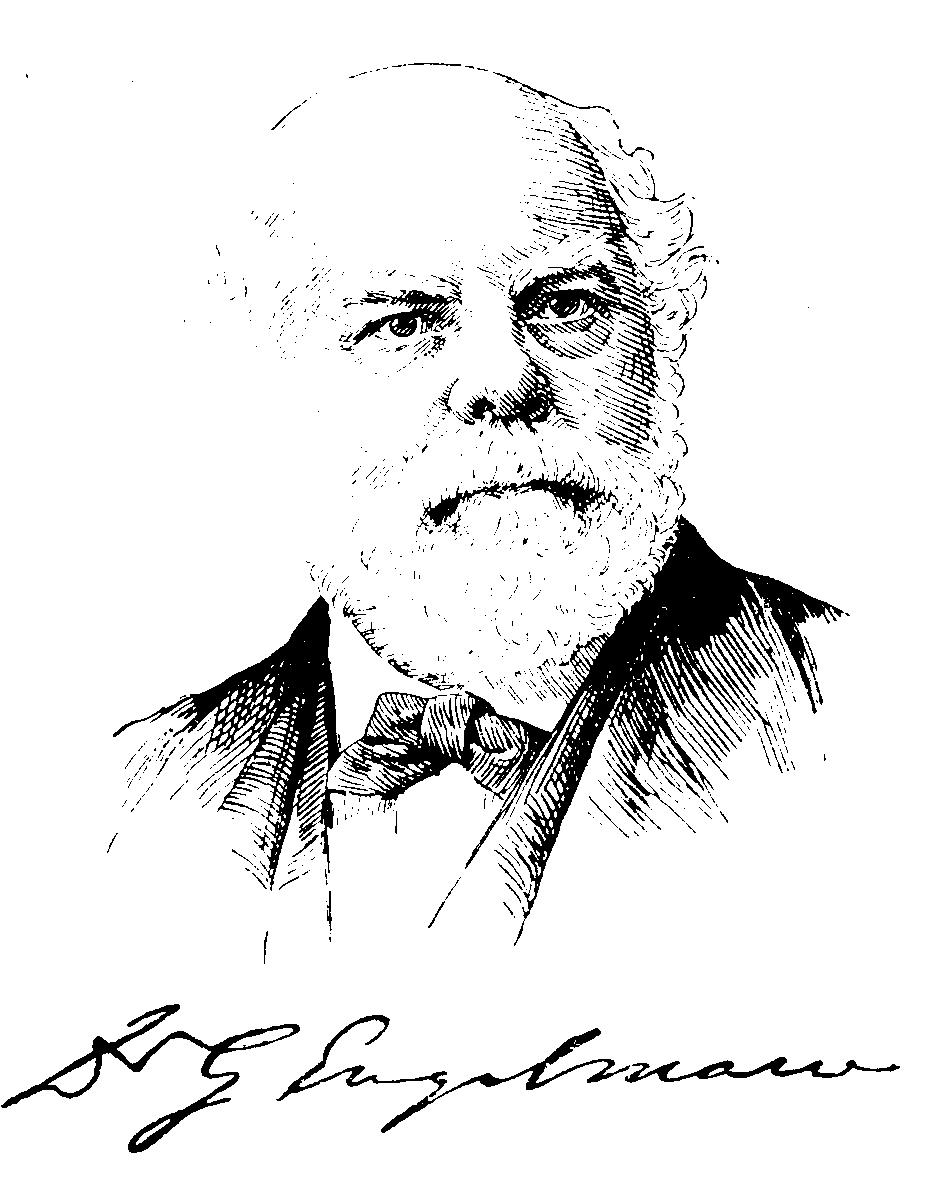
ENGELMANN, George, botanist, born in Frankfort on the Main, Germany, 2 February 1809; died in St. Louis, Missouri, 11 February 1884. His uncle, Friedrich Theodor, a German pioneer of Illinois, was one of the early American viticultmists. He received his early education at the gymnasium in Frankfort, and studied the sciences in the University of Heidelberg, where he met Karl Schimper and Alexander Braun. Later he was connected with the University of Berlin, and received in 1831 the degree of M. D. from the University of Wurzburg.
In 1832 he went to Paris, where he again became associated with Braun, and also with Louis Agassiz. Meanwhile he was induced to come to the United States, and in September 1832, sailed from Bremen for Baltimore. He settled in St. Clair County, near Belleville, Illinois, but three years later removed to St. Louis, where he soon became prominent as physician. In l836 he founded a German newspaper called "Das Westland," which contained valuable articles on life and manners in the United States, and gained a high reputation both here and in Europe.
Dr. Engelmann made a of botany, and obtained a wide recognition for his services in that branch of natural history. He made special studies of the cacti, dodders, pines, rushes, spurges, mid other little-known and diltieult groups, contributing numerous articles on them to the St. Louis academy of sciences, to the American academy of arts and sciences, and to government reports, His opinion became so valuable that much of the material in his specialties collected by the National government was sent to him for examination. He was one of the earliest to study the North American vines, and nearly all that is known scientifically of the American species and forms is due to his investigations. His first monograph on " The Grapevines of Missouri" was published in 1860, and his latest on this subject shortly before his death. A mono-typical genus of plants bears his name, and a splendid species of spruce from the Rocky Mountains is called Engelmann. He was a member of scientific societies both in the United States and in Europe, and was one of the original members of the National academy of sciences. A list of his botanical papers containing about 100 titles, is published in ceulter s " Botanical Gazette" for May 1884, and his writings are now (1887) being collected under the direction of Professor Asa Gray for publication by Henry Shaw of St. Louis.
Dr. Engelmann's botanical collection, valuable as containing the original specimens from which many or most of our western plants have been named and described, will be given to Shaw's botanical garden as soon as a fireproof building can be erected. This gift, has led to the founding of the Shaw school of botany as a' department of Washington University, St. Louis, where an Engelmann professorship of botany has been established by Mr. Shaw in his honor.
His son, George Julius, physician, born in St. Louis, Missouri, 2 July 1847, was graduated with the valedictory at Washington University in 1867, then studied at the universities of Thbingen, Vienna, Paris, and received his medical degree at Berlin in 1871. During the Franco Prussian war of 1870'1 he served as assistant surgeon in the German army, and subsequently returned to St. Louis, where he settled in the practice of medicine. In 1883 he turned his attention to gynecology, and has since occupied himself exclusively in efforts to introduce more rational, effective, and safe methods of practice in diseases of women.
Toward this end he founded the St. Louis school of midwives, the St. Louis lying-in hospital, mid the St. Louis polyclinic and postgraduate school of medicine, holding the chair of gynecology and obstetrics in the latter institution, he is a member of medical and scientific societies, was one of the founders of the American gynecological society, being its vice president in 1886, of the St. Louis obstetric and gynecological society, of which he was vice president in 1887, and also of the St. Louis medico chirurgical society. Dr. Engelmann has been active in archaeology, having opened mounds and collected specimens in southern Missouri. He has a valuable museum of the material which he has gathered, and has exchanged specimens with museums in Berlin and Vienna, and with the Peabody in Cambridge, Massachusetts, the Natural history in New York, and the National museum in Washington, D.C. Dr. Engelmann is the author of numerous papers contributed to medical journals in his specialty, some of which have been translated into French and German.
Unauthorized Site:
This site and its contents are not affiliated, connected,
associated with or authorized by the individual, family,
friends, or trademarked entities utilizing any part or
the subject's entire name. Any official or affiliated
sites that are related to this subject will be hyper
linked below upon submission
and Evisum, Inc. review.
Please join us in our mission to incorporate The Congressional Evolution of the United States of America discovery-based curriculum into the classroom of every primary and secondary school in the United States of America by July 2, 2026, the nation’s 250th birthday. , the United States of America: We The
People. Click Here