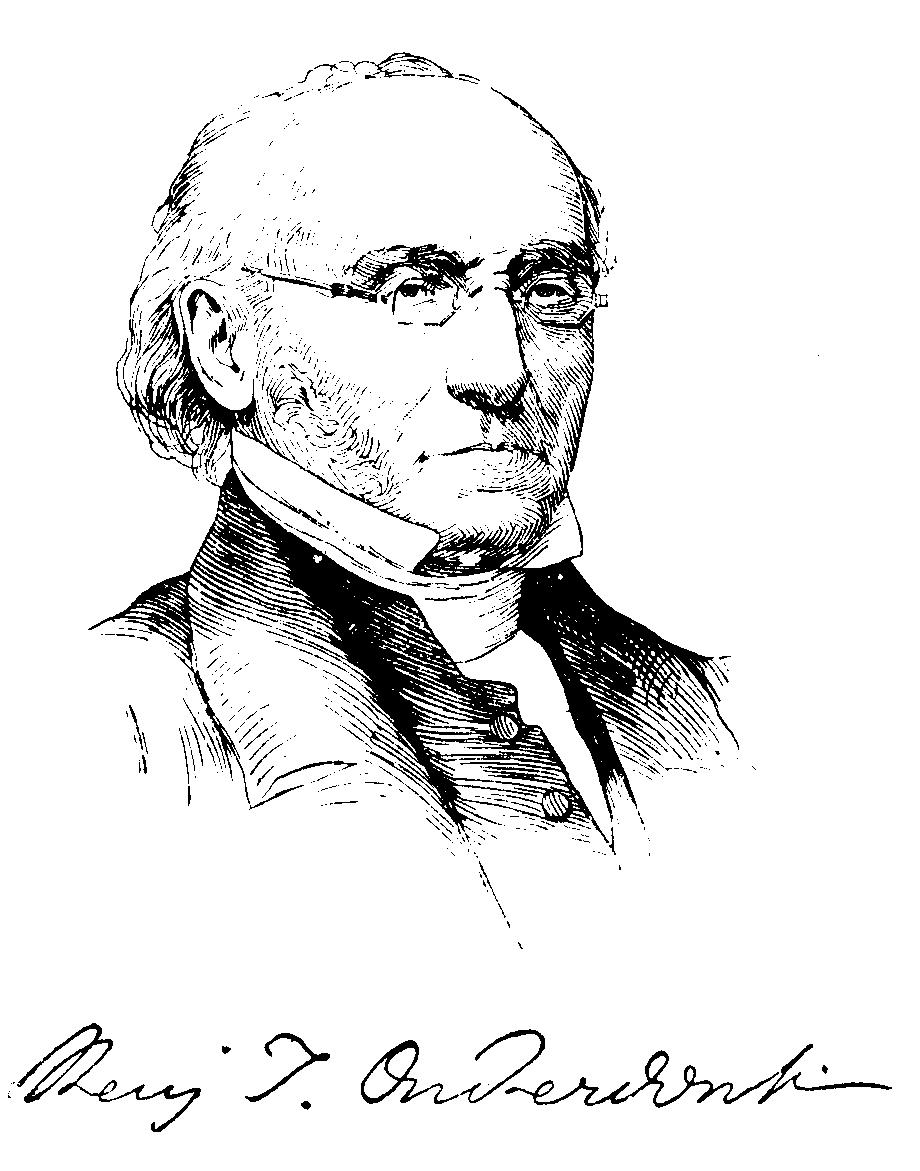
Appleton's Cyclopedia of American Biography, edited by James
Grant Wilson, John Fiske and Stanley L. Klos. Six volumes, New York: D. Appleton
and Company, 1887-1889 and 1999. Virtualology.com warns that these 19th Century
biographies contain errors and bias. We rely on volunteers to edit the historic
biographies on a continual basis. If you would like to edit this biographyplease
submit a rewritten biography in text form.
If acceptable, the new biography will be published above the 19th Century
Appleton's Cyclopedia Biography citing the volunteer editor
Virtual American Biographies
Over 30,000 personalities
with thousands of 19th Century illustrations, signatures, and exceptional life
stories. Virtualology.com
welcomes editing and additions to the
biographies. To become this site's editor or a contributor
Click Here
or e-mail Virtualology here.
ONDERDONK, Henry Ustick, P. E. bishop, born in
New York City, 16 March, 1789; died in Philadelphia, Pennsylvania, 6 December,
1858. He was graduated at Columbia in 1805, went to Europe, and studied medicine
in London and Edinburgh, receiving the degree of M. D. from the University of
Edinburgh. On returning home, he entered upon the practice of his profession in
New York City, and was associated with Dr. Valentine Mott in editing the "New
York Medical Journal."
A few years later he studied theology under Bishop
Hobart, was ordained deacon in St. Paul's Chapel, New York, 8 December, 1815, by
his preceptor, and priest in Trinity Church, New York, 11 April, 1816, by the
same bishop, and became missionary in Canandaigua, New York, and vicinity.
In 1820 he accepted a call to St. Ann's church,
Brooklyn, where he remained until his election to the bishopric, he was
consecrated assistant bishop of Pennsylvania in Christ Church, Philadelphia, 25
October, 1827, received the degree of S. T. D. from Columbia in the same year,
and on the death of Bishop White, in 1836, became the bishop of Pennsylvania.
In 1844, under the pressure of painful circumstances, he
sent in his resignation to the house of bishops. The resignation was accepted,
but, as informal charges of intemperance were admitted by Bishop Onderdonk, he
was sentenced to a suspension of "all public exercise of the offices and
functions of the sacred ministry, and in particular from all exercise whatsoever
of the office and work of a bishop in the church of God." Two years before his
death this suspension was removed, and he was allowed to pass away in peace.
Bishop Onderdonk was a very able writer, and defended
the claims of his church with great energy and success. His publications were
"Appeal to the Religious Public of Canandaigua" (1818); "Episcopacy tested by
Scripture," tract (1830), afterward enlarged to a volume entitled "Episcopacy
Examined and Re-examined," in reply to Reverend Albert Barnes's strictures
(Philadelphia, 1835); "Essay on Regeneration" (1835); "Family Devotions from the
Liturgy" (1835); and "Sermons and Charges" (2 vols., 1851).
He contributed numerous papers to medical as well as
theological journals, and was also entitled to be ranked among church poets. A
dozen or more hymns and metre psalms were written by him, and included in the
collection of the Protestant Episcopal Church.
--His brother, Benjamin Tredwel Onderdonk, P. E.
bishop, born in New York City, 15 July, 1791; died there, 30 April, 1861, was
graduated at Columbia in 1809. He was ordained deacon in St. Paul's Chapel, New
York, 2 August, 1812, by Bishop Hobart, and priest in Trinity church, Newark,
New Jersey, 26 July, 1815, by the same bishop. He was appointed assistant
minister of Trinity church, New York, while in deacon's orders, and held that
post until 1836, owing to the insufficiency of the Episcopal Fund prior to that
date.
In 1821 he was elected professor of ecclesiastical
history in the General Theological Seminary, New York, and also of the nature,
ministry, and polity of the church, in the same institution. This latter chair
he held during the remainder of his life, although he did not perform any duties
in it after 1845. From 1816 till 1830 he was secretary of the diocesan
convention of New York. He received the degree of S. T. D. from Columbia in
1826.
On the death of Bishop Hobart, in 1830, Dr. Onderdonk
was elected his successor, as fourth bishop of New York. He was consecrated in
St. John's Chapel, New York, 26 November, 1830. Although he was active,
diligent, and effective in the discharge of his duties from this time onward,
and zealous in carrying out the church principles of Bishop Hobart, he
nevertheless fell into grave difficulties.
Under the provisions of a canon, passed in October,
1844, for the trial of bishops, he was brought to trial on the ground of immoral
acts, charged to have been committed between June, 1837, and July, 1842. The
court, consisting of seventeen bishops, sat in New York from 11 December, 1844,
to 3 January, 1845. Eight of the bishops voted for deposition and nine for
suspension. This latter, accordingly, became the sentence of the court, and
Bishop Onderdonk was declared to be "suspended from all exercise of his
episcopal and ministerial functions."
Immediately after the trial he published "A Statement of
Facts and Circumstances Connected with the Recent Trial of the Bishop of New
York," in which he denied all criminality in the matters charged. Even to the
day of his death he persisted in asserting his innocence, but made no attempt to
evade the sentence.
Numerous pamphlets, both for and against the bishop,
were issued in this and following years. As the sentence of suspension had no
limitation attached to it, a grave question arose as to what was to be done in
behalf of the diocese of New York. The general convention, in 1847, enacted that
the house of bishops have power to remit and terminate any sentence imposed by
bishops as a judicial tribunal, and also that never again should the penalty of
suspension be inflicted unless it specify the terms and the time of its ceasing
to have effect.
The diocese of New York made strenuous efforts to obtain
a remission of the sentence, and besought the bishops to afford relief. The
third and last memorial was in 1859, when the convention of New York, by a vote
of 147 to 19 of the clergy and 75 to 46 of the laity, begged the house of
bishops to terminate the suspension of Bishop Onderdonk. The petition was not
granted, and the bishop went down to his grave within two years with this stigma
still fastened upon him.
Bishop Onderdonk published a few occasional sermons, and
contributed an excellent preface to a re-publication, by the Protestant
Episcopal Press, of Dr. John Bowden's "Letters on the Apostolic Origin of
Episcopacy" (1831).
--Their nephew, Henry Onderdonk, historian, born
in North Hempstead, Queens County, New York, 11 June, 1804; died in Jamaica, New
York, 22 June, 1886, was graduated at Columbia in 1827, and in 1878 received his
bachelor's degree from Harvard also, being enrolled among the class of 1828.
He became principal of Union Hall Academy, L. I., in
1832, and held that office till his retirement in 1865, after which he devoted
himself to literary pursuits. He was a successful teacher and an accomplished
classical scholar, lectured extensively on temperance and local history, and
gave much of his time to historical and genealogical research. He was a member
of many learned societies.
His writings include "Documents and Letters Intending to
illustrate the Revolutionary Incidents of Queens County, New York" (New York,
1846); "Correspondence with James Fenimore Cooper on the Capture and Death of
Major Woodhull" (1848); "Revolutionary Incidents of Suffolk and Kings Counties,
with an Account of the Battle of Long Island" (1849); "Long Island and New York
in Olden Times, being Newspaper Extracts and Historical Sketches" (Jamaica,
1851): "The Annals of Hempstead from 1643 to 1832" (Hempstead, New York, 1878);
and "Antiquities of the Parish Church, Hempstead, including Oyster Bay and the
Churches in Suffolk County" (1880).
0NDERDONK, Henry Ustick, P. E. bishop, born in New York city, 16 March, 1789; died in Philadelphia, Pennsylvania, 6 December, 1858. He was graduated at Columbia in 1805, went to Europe, and studied medicine in London and Edinburgh. receiving the degree of M. D. from the University of Edinburgh. On returning home, he entered upon the practice of his profession in New York city, and was associated with Dr. Valentine Mott in editing the " New York Medical Journal." A few years later he studied theology under Bishop Hobart, was ordained deacon in St. Paul's chapel, New York, 8 December, 1815, by his preceptor, and priest in Trinity church, New York, 11 April, 1816, by the same bishop, and became missionary in Canandaigua, New York, and vicinity. In 1820 he accepted a call to St. Ann's church, Brooklyn, where he remained until his election to the bishopric, he was consecrated assistant bishop of Pennsylvania in Christ church, Philadelphia, 25 October, 1827, received the degree of S. T. D. from Columbia in the same year, and on the death of Bishop White, in 1836, became the bishop of Pennsylvania. In 1844, under the pressure of painful circumstances, he sent in his resignation to the house of bishops. The resignation was accepted, but, as informal charges of intemperance were admitted by Bishop Onderdonk, he was sentenced to a suspension of "all public exercise of the offices and functions of the sacred ministry, and in particular from all exercise whatsoever of the office and work of a bishop in the church of God." Two years before his death this suspension was removed, and he was allowed to pass away in peace. Bishop Onderdonk was a very able writer, and defended the claims of his church with great energy and success. His publications were " Appeal to the Religious Public of Canandaigua" (1818); "Episcopacy tested by Scripture," tract (1830), afterward enlarged to a volume entitled "Episcopacy Examined and Re-examined," in reply to Reverend Albert Barnes's strictures (Philadelphia, 1835) ; "Essay on Regeneration" (1835) ; " Family Devotions from the Liturgy " (1835) ; and " Sermons and Charges" (2 vols., 1851). He contributed numerous papers to medical as well as theological journals, and was also entitled to be ranked among church poets. A dozen or more hymns and metre psalms were written by him, and included in the collection of the Protestant Episcopal church.--His brother, Benjami Tredwell, P. E. bishop, born in New York city, 15 July, 1791; died there, 30 April, 1861, was graduated at Columbia in 1809. He was ordained deacon in St. Paul's chapel, New York, 2 August, 1812, by Bishop Hobart, and priest in Trinity church, Newark, New Jersey, 26 July, 1815, by the same bishop. He was appointed assistant minister of Trinity church, New York, while in deacon's orders, and held that post until 1836, owing to the insufficiency of the Episcopal fund prior to that date. In 1821 he was elected professor of ecclesiastical history in the General theological seminary, New York, and also of the nature, ministry, and polity of the church, in the same institution. TMs latter chair he held during the remainder of his life, although he did not perform any duties in it after 1845. From 1816 till 1830 he was secretary of the diocesan convention of New York. He received the degree of S. T. D. from Columbia in 1826. On the death of Bishop Hobart, in 1830, Dr. Onderdonk was elected his successor, as fourth bishop of New York. He was consecrated in St. John's chapel, New York, 26 November, 1830. Although he was active, diligent, and effective in the discharge of his duties from this time onward, and zealous in carrying out the church principles of Bishop Hobart, he nevertheless fell into grave difficulties. Under the provisions of a canon, passed in October, 1844, for the trial of bishops, he was brought to trial on the ground of immoral acts, charged to have been committed between June, 1837, and July, 1842. The court, consisting of seventeen bishops, sat in New York from 11 December, 1844, to 3 January, 1845. Eight of the bishops voted for deposition and nine for suspension. This latter, accordingly, became the sentence of the court, and Bishop Onderdonk was declared to be "suspended from all exercise of his episcopal and ministerial functions." Immediately after the trial he published "A Statement of Facts and Circumstances Connected with the Recent Trial of the Bishop of New York," in which he denied all criminality in the matters charged. Even to the day of his death he persisted in asserting his innocence, but made no attempt to evade the sentence. Numerous pamphlets, both for and against the bishop, were issued in this and following years. As the sentence of suspension had no limitation attached to it, a grave question arose as to what was to be done in behalf of the diocese of New York. The general convention, in 1847, enacted that the house of bishops have power to remit and terminate any sentence imposed by bishops as a judicial tribunal, and also that never again should the penalty of suspension be inflicted except it specify the terms and the time of its ceasing to have effect. The diocese of New York made strenuous efforts to obtain a remission of the sentence, and besought the bishops to afford relief. The third and last memorial was in 1859, when the convention of New York, by a vote of 147 to 19 of the clergy and 75 to 46 of the laity, begged the house of bishops to terminate the suspension of Bishop Onderdonk. The petition was not granted, and the bishop went down to his grave within two years with this stigma still fastened upon him. Bishop Onderdonk published a few occasional sermons, and contributed an excellent preface to a republication, by the Protestant Episcopal press, of Dr. John Bowden's "Letters on the Apostolic Origin of Episcopacy" (1831).--Their nephew, Henry, historian, born in North Hempstead, Queens County, New York, 11 June, 1804; died in Jamaica, New York, 22 June, 1886, was graduated at Columbia in 1827, and in 1878 received his bachelor's degree from Harvard also, being enrolled among the class of 1828. He became principal of Union hall academy, L. I., in 1832, and held that office till his retirement in 1865, after which he devoted himself to literary pursuits, he was a successful teacher and an accomplished classical scholar, lectured extensively on temperance and local history, and gave much of his time to historical and genealogical research. He was a member of many learned societies. His writings include "Documents and Letters Intending to illustrate the Revolutionary Incidents of Queens County, New York" (New York, 1846); "Correspondence with James Fenimore Cooper on the Capture and Death of Major Woodhull" (1848); " Revolutionary Incidents of Suffolk and Kings Counties, with an Account of the Battle of Long Island" (1849); "Long Island and New York in Olden Times, being Newspaper Extracts and Historical Sketches" (Jamaica, 1851) : " The Annals of Hempstead from 1643 to 1832" (Hempstead, New York, 1878); and "Antiquities of the Parish Church, Hempstead, including Oyster Bay and the Churches in Suffolk County" (1880).
Unauthorized Site:
This site and its contents are not affiliated, connected,
associated with or authorized by the individual, family,
friends, or trademarked entities utilizing any part or
the subject's entire name. Any official or affiliated
sites that are related to this subject will be hyper
linked below upon submission
and Evisum, Inc. review.
Please join us in our mission to incorporate The Congressional Evolution of the United States of America discovery-based curriculum into the classroom of every primary and secondary school in the United States of America by July 2, 2026, the nation’s 250th birthday. , the United States of America: We The
People. Click Here