Appleton's Cyclopedia of American Biography, edited by James
Grant Wilson, John Fiske and Stanley L. Klos. Six volumes, New York: D. Appleton
and Company, 1887-1889 and 1999. Virtualology.com warns that these 19th Century
biographies contain errors and bias. We rely on volunteers to edit the historic
biographies on a continual basis. If you would like to edit this biographyplease
submit a rewritten biography in text form.
If acceptable, the new biography will be published above the 19th Century
Appleton's Cyclopedia Biography citing the volunteer editor
Virtual American Biographies
Over 30,000 personalities
with thousands of 19th Century illustrations, signatures, and exceptional life
stories. Virtualology.com
welcomes editing and additions to the
biographies. To become this site's editor or a contributor
Click Here
or e-mail Virtualology here.
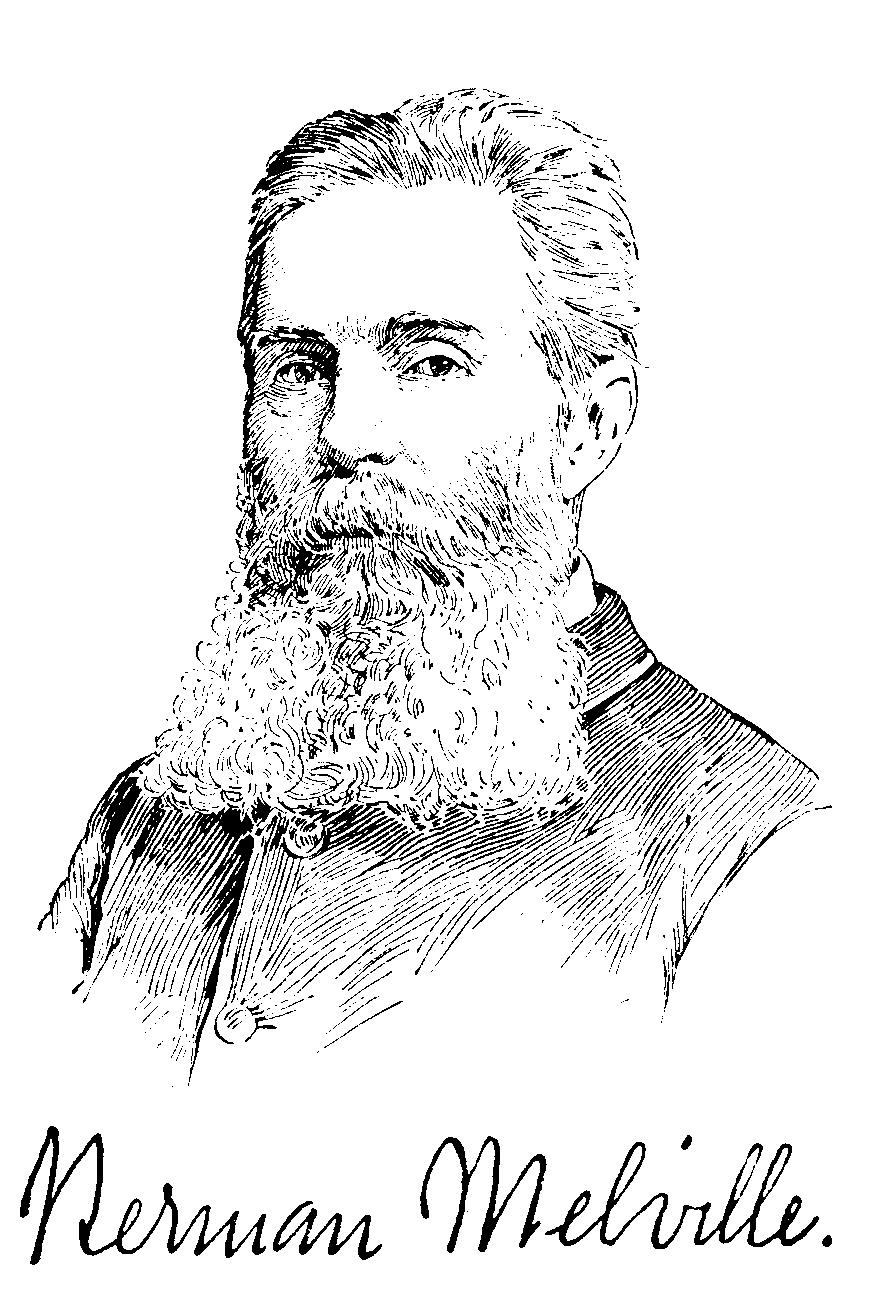
MELVILLE, Herman, author, born in New York city, 1 August, 1819. His grandfather, Major Thomas Melville (1751-1832), was a member of the Boston tea-party, served in the Revolution, and is supposed to have been the last American that adhered through life to the cocked hat. His maternal grandfather was Peter Gansevoort (q. v.). His father, Allan, was a merchant, who travelled widely and cultivated literary tastes. Herman shipped as a sailor before the mast in 1837 for a voyage to Liverpool. Four years later he sailed round Cape Horn in the "Dolly" for a whaling cruise in the south Pacific. But the treatment of the captain was so harsh, and the state of affairs on board was so bad in every respect, that Melville and a companion resolved to leave the ship. While she lay in the harbor of Nukahiva, in the Marquesas ishmds, in the summer of 1842, they made their escape The island, about twenty miles long by ten miles broad, is mountainous in centre, the high- " est peak rising nearly 4,000 feet, with alternate ridges and valleys radiating to the sea. One of these valleys is inhabited by the Typees, .a war-like tribe of cannibals, and the next by the Happars, a friendly tribe. Commander David Porter (q. v.), while refitting his ships here in 1813-'14, had taken part with the Happars in a war against the "fypees, which he described in his published journal. Melville and his companion, with great labor and many narrow escapes, climbed the mountains, intending to descend into the Happar valley, but lost their way and finally found themselves among the Typees. While still uncertain where they were, they were surrounded by a group of savage chiefs, one of whom sternly demanded whether they were friendly to Happar or to Typee. "I paused for a second," writes Melville, "and I know not by what impulse it was that I answered' Typee.' The piece of dusky statuary nodded in approval, and then murmured ' Mortarkee ?' [good ?] ' Mortarkee.' said I, without further hesitation--' Typee mortarkee.' The dark figures around us leaped to their feet, clapped their hands in transport, and shouted again and again the talismanic syllables, the utterance of which appeared to have settled everything." Melville was held in captivity for four months, treated in most respects as an honored guest, but constantly watched to prevent his escape. His companion soon got away, and at length Melville himself was rescued. An Australian whaler, short of men, visited the harbor of Nukahiva, where the captain learned that there was an American sailor in the Typee valley, and accepted the offer of a native to obtain him. The native made his way to Melville, and guided him to the beach, where a boat from the whaler was in waiting, and Melville was taken off after a bloody fight, he spent two years more in the Pacific, and on his return home published "Typee: a Peep at Polynesian Life during a Four Months' Residence in a Valley of the Marquesas" (New York and London, 1846). This work, in which the story of his romantic captivity is told with remarkable vividness, had an immediate success and rapidly passed through several editions. It was dedicated to Chief-Justice Lenmel Shaw, of Massachusetts, whose daughter Mr. Melville afterward married. He removed to Pittsfield, Massachusetts, in 1850, but subsequently returned to New York and was appointed to a place in the custom-house. His remaining works are "Omoo, a Narrative of Adventures in the South Seas" (1847); "Mardi, and a Voyage Thither," a philosophical romance (1848); "Redburn," a novel (1848); " White-Jacket, or the World in a Man-of-War" (1850) ; "Moby Dick, or the White Whale" (1851); "Pierre, or the Ambiguities" (1852); "Israel Potter, his Fifty Years of Exile" (1855); "The Piazza Tales" (1856); " The Confidence Man" (1857); " Battle-Pieces, and Aspects of the War," a volume of poems (1866): and "Clarel, a Pilgrimage in the Holy Land," a poem (2 vols., 1876).
Unauthorized Site:
This site and its contents are not affiliated, connected,
associated with or authorized by the individual, family,
friends, or trademarked entities utilizing any part or
the subject's entire name. Any official or affiliated
sites that are related to this subject will be hyper
linked below upon submission
and Evisum, Inc. review.
Please join us in our mission to incorporate The Congressional Evolution of the United States of America discovery-based curriculum into the classroom of every primary and secondary school in the United States of America by July 2, 2026, the nation’s 250th birthday. , the United States of America: We The
People. Click Here