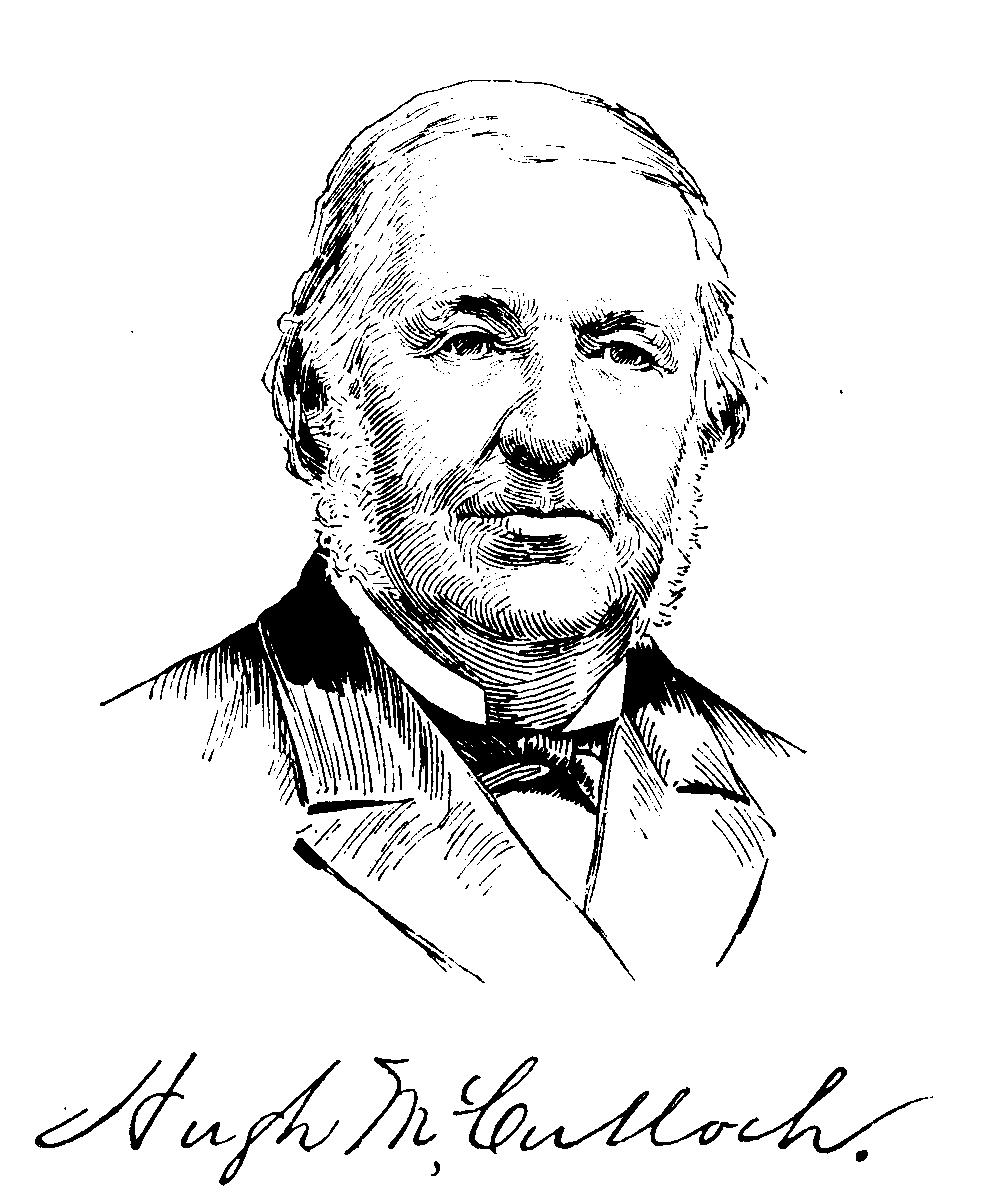
Appleton's Cyclopedia of American Biography, edited by James
Grant Wilson, John Fiske and Stanley L. Klos. Six volumes, New York: D. Appleton
and Company, 1887-1889 and 1999. Virtualology.com warns that these 19th Century
biographies contain errors and bias. We rely on volunteers to edit the historic
biographies on a continual basis. If you would like to edit this biographyplease
submit a rewritten biography in text form.
If acceptable, the new biography will be published above the 19th Century
Appleton's Cyclopedia Biography citing the volunteer editor
Virtual American Biographies
Over 30,000 personalities
with thousands of 19th Century illustrations, signatures, and exceptional life
stories. Virtualology.com
welcomes editing and additions to the
biographies. To become this site's editor or a contributor
Click Here
or e-mail Virtualology here.
McCULLOCH, Hugh, secretary of the treasury, born in Kennebunk, Maine, 7 December, 1808. He entered Bow(loin in 1824, but leaving, on account of illness, in 1826, taught until 1829, and then studied law in Kennebunk and Boston. In 1833 he went to the west, and settled in Fort Wayne, hid. In 1835 he was elected cashier and manager of the branch at Fort Wayne of the State bank of Indiana, and at the expiration of its , ***!: charter in 1856 he became the president of the Bank of the state of Indiana, which post he held until May, 1868 He then resigned to accept the office of comptroller of the currency, which was tendered to him by See. Salmon P. Chase, undertaking the organization of the newly created bureau and the putting into operation of the national banking system. His own reputation for conservatism influenced the managers of the large state banks, and promoted the conversion of the leading credit institutions of the commercial cities into national banks. In March, 1865, on the resignation of William P. Fessenden, Mr. McCulloeh was appointed by President Lincoln secretary of the treasury, at which time the government was in great financial embarrassment. It was still incurring enormous expenses, and heavy demands were pressing upon a nearly empty treasury. His first and most important duty, therefore, was to raise by further loans what was needed to pay the large amount due to 500,000 soldiers and sailors, whose services the government was in a condition to dispense with, and meet other demands. This was successfully accomplished, and in less than six months from the time of his appointment all the matured obligations of the government were paid, and the reduction of the debt was begun. The next most important work was the conversion of more than $1,000,000,000 of short-time obligations into a funded debt. This was quietly effected, and in a little more than two years the whole debt of the country was put into a satisfactory shape. In his annual reports he advocated a steady reduction of the national debt, the retirement of the legal-tender notes, and a speedy return to specie payments, urging that a permanent public debt might be dangerous to Republican institutions, he believed, also, that it was not the business of the government to furnish the people with a paper currency, that it had no power under the constitution to make its own notes lawful money, and that the paper currency of the country should be furnished by the banks. His views upon the subject of the debt were sustained by congress, as were also for a short time those in regard to the legal-tender notes. See***. McCulloch held office till 4 March, 1869. From 1871 till 1878 he was engaged in banking in London. In October, 1884, on the resignation of Walter Q. Gresham, he was again appointed secretary of the treasury, and continued in office until the expiration of President Arthur's term, 4 March, 1885, being the only man that has held that office twice. Since his retirement he has resided in Washington, D. C., and on his farm in Maryland. Mr. McCulloch has contributed articles on financial and economical questions to the magazines and public journals. A series of letters written by him in London for the New York "Tribune" in 1875 were extensively copied, and were used by the Republicans in Ohio in 1875 for political purposes.
Unauthorized Site:
This site and its contents are not affiliated, connected,
associated with or authorized by the individual, family,
friends, or trademarked entities utilizing any part or
the subject's entire name. Any official or affiliated
sites that are related to this subject will be hyper
linked below upon submission
and Evisum, Inc. review.
Please join us in our mission to incorporate The Congressional Evolution of the United States of America discovery-based curriculum into the classroom of every primary and secondary school in the United States of America by July 2, 2026, the nation’s 250th birthday. , the United States of America: We The
People. Click Here