Appleton's Cyclopedia of American Biography, edited by James
Grant Wilson, John Fiske and Stanley L. Klos. Six volumes, New York: D. Appleton
and Company, 1887-1889 and 1999. Virtualology.com warns that these 19th Century
biographies contain errors and bias. We rely on volunteers to edit the historic
biographies on a continual basis. If you would like to edit this biographyplease
submit a rewritten biography in text form.
If acceptable, the new biography will be published above the 19th Century
Appleton's Cyclopedia Biography citing the volunteer editor
Virtual American Biographies
Over 30,000 personalities
with thousands of 19th Century illustrations, signatures, and exceptional life
stories. Virtualology.com
welcomes editing and additions to the
biographies. To become this site's editor or a contributor
Click Here
or e-mail Virtualology here.
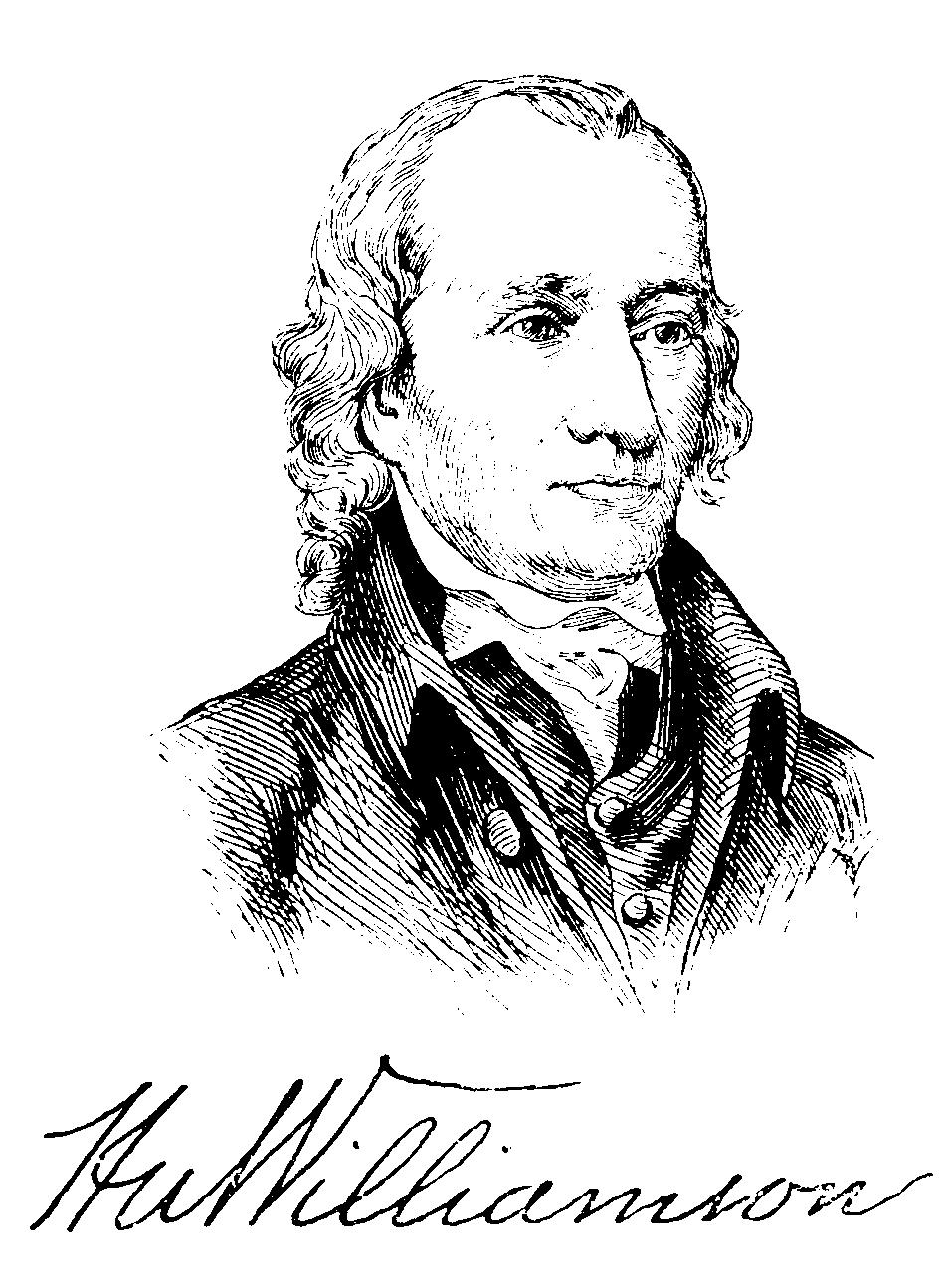
WILLIAMSON, Hugh, statesman, born in West Nottingham, Pennsylvania, 5 December, 1735; died in New York city, 22 May, 1819. He was graduated at the College of Philadelphia in 1757, studied theology, and was licensed to preach in 1759 in Connecticut. He was subsequently admitted to the presbytery of Philadelphia, and preached altogether about two years, but, partly in consequence of ill health, he was never ordained nor assumed a pastorate. He was professor of mathematics in the College of Philadelphia in 1760-'3, studied medicine at Edinburgh and Utrecht, where he took his degree, and on his return to this country practised successfully at Philadelphia. On 7 January, 1769, he was appointed one of a commission of the American philosophical society, to which he had been elected in 1768, to observe the transits of Venus and Mercury, his account of which is contained in vol. i. of the "Philosophical Transactions." In 1772 he visited the West Indies to procure aid for the academy at Newark, Delaware, and in 1773 he proceeded to England to solicit further assistance for that institution. He was examined in February, 1774, by the privy council on the subject of the destruction of the tea in Boston harbor, and other matters relating to the political state of the colonies. He afterward spent some time on the continent, and returned to this country in 1776, after the Declaration of Independence, bearing important papers. In 1777 he engaged in mercantile pursuits in Charleston, South Carolina, with a younger brother, and subsequently he practised medicine at Edenton, North Carolina He served as surgeon in the militia of North Carolina in 1780-'2, and rendered aid to the wound ed at the battle of Camden. He was a member of the house of commons of North Carolina in 1782, was erected to the Continental congress in 1784, 1785, and 1786, and was a delegate to the convention that framed the constitution of the United States in 1787, as well as to the State convention to act upon it in 1789. He was elected to the 1st congress as a Federalist, reelected to the second, and served from 19 March, 1790, till 2 March, 1793, when he removed to New York. He married there, devoted himself to literary pursuits, and was associated with De Witt Clinton in organizing the Literary and philosophical society in 1814. He was an advocate of the New York canal system, and an active promoter of philanthropic, literary, and scientific institutions Dr. Williamson was a frequent contributor to the transactions of learned societies in Europe and the United States. He published a series of essays on " Paper Currency" in 1786; fugitive articles on "Languages in Politics" in the "American Museum"; "Observations on Navigable Canals," an essay on " Comets " in the "Transactions" of the Literary and philosophical society of New York: "Discourse on the Benefits of Civil History" (New York, 1810) ; "Observations on the Climate of America" (1811); and "History of North Carolina" (2 vols., Philadelphia, 1812).
Unauthorized Site:
This site and its contents are not affiliated, connected,
associated with or authorized by the individual, family,
friends, or trademarked entities utilizing any part or
the subject's entire name. Any official or affiliated
sites that are related to this subject will be hyper
linked below upon submission
and Evisum, Inc. review.
Please join us in our mission to incorporate The Congressional Evolution of the United States of America discovery-based curriculum into the classroom of every primary and secondary school in the United States of America by July 2, 2026, the nation’s 250th birthday. , the United States of America: We The
People. Click Here