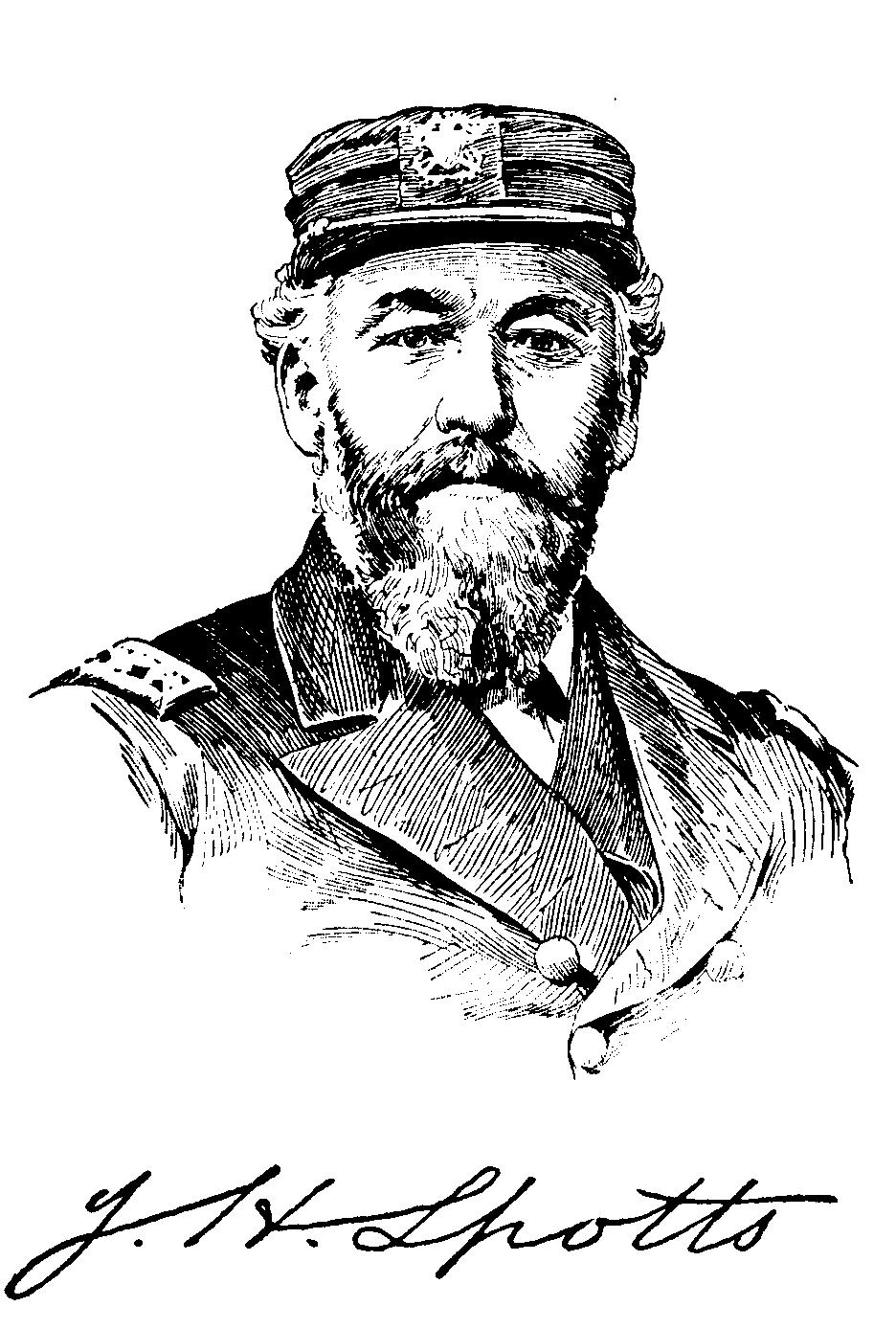
Appleton's Cyclopedia of American Biography, edited by James
Grant Wilson, John Fiske and Stanley L. Klos. Six volumes, New York: D. Appleton
and Company, 1887-1889 and 1999. Virtualology.com warns that these 19th Century
biographies contain errors and bias. We rely on volunteers to edit the historic
biographies on a continual basis. If you would like to edit this biographyplease
submit a rewritten biography in text form.
If acceptable, the new biography will be published above the 19th Century
Appleton's Cyclopedia Biography citing the volunteer editor
Virtual American Biographies
Over 30,000 personalities
with thousands of 19th Century illustrations, signatures, and exceptional life
stories. Virtualology.com
welcomes editing and additions to the
biographies. To become this site's editor or a contributor
Click Here
or e-mail Virtualology here.
SPOTTS, James Hanna, naval officer, born in Fort Johnson, Wilmington harbor, North Carolina, 11 March, 1822 ; died at Port Stanley, Falkland islands, 9 March, 1882. His father was an officer in the United States army, and commanded the artillery under General Andrew Jackson at the battle of New Orleans. In acknowledgment of his bravery, General Jackson presented Major Spotts with a sword. The son entered the navy as a midshipman, 2 August, 1837, and made a cruise around the world in the sloop "John Adams" in 1837-'40, in which he participated in two battles on the island of Sumatra with the natires, who had committed piratical acts against American merchant ships. He attended the naval school at Philadelphia in 1842-'3. During the Mexican war he served in the "Lexington" on the Pacific coast in 1846-'9, participated in the engagements that resulted in the conquest of California, on the blockade of the Mexican Pacific ports, and at the capture of Guaymas, San Blas, and La Paz. He was promoted to master, 8 April, 1851, and to lieutenant, 25 November, 1851. Though a native of the south, he promptly announced his devotion to the Union, taking command of the schooner "Wanderer" in June, 1861, and acted as captain of the port of Key West. In July, 1862, he took charge of the steamer "Magnolia" on the Eastern Gulf blockade. He was promoted to commander, 5 August, 1862, and had the steamer "South Carolina" on the South Atlantic blockade in 1863-'4. He was transferred to the steamer" Pawtucket," in which he participated in both attacks on Fort Fisher. In June, 1865, he was detached and ordered to the Mare island navy-yard, where he served until October, 1867. His duties had taken him to California so often that he made his home in San Francisco, and was one of the first naval officers to identify himself with the interests and development of California. He was promoted to captain, 6 August, 1866, commanded the steamers "Saranac" and "Pensacola" in the Pacific squadron in 1870-'2, and servedas light-house inspector on the Pacific coast in 1872-'4, being commis sioned commodore, 25 September, 1873. He served as president of the board of inspection on the Pacific coast until 1880. He was promoted to rear-admiral, 28 Nay, 1881, and took command of the United States naval force on the South Atlantic station in , July. He was on a cruise to visit the ports of that station when he was stricken with apoplexy while receiving the farewell visit of the British colonial governor at Port Stanley. After his death the authorities gave a lot in the cemetery for his burial, and every honor was paid to the American admiral.
Unauthorized Site:
This site and its contents are not affiliated, connected,
associated with or authorized by the individual, family,
friends, or trademarked entities utilizing any part or
the subject's entire name. Any official or affiliated
sites that are related to this subject will be hyper
linked below upon submission
and Evisum, Inc. review.
Please join us in our mission to incorporate The Congressional Evolution of the United States of America discovery-based curriculum into the classroom of every primary and secondary school in the United States of America by July 2, 2026, the nation’s 250th birthday. , the United States of America: We The
People. Click Here