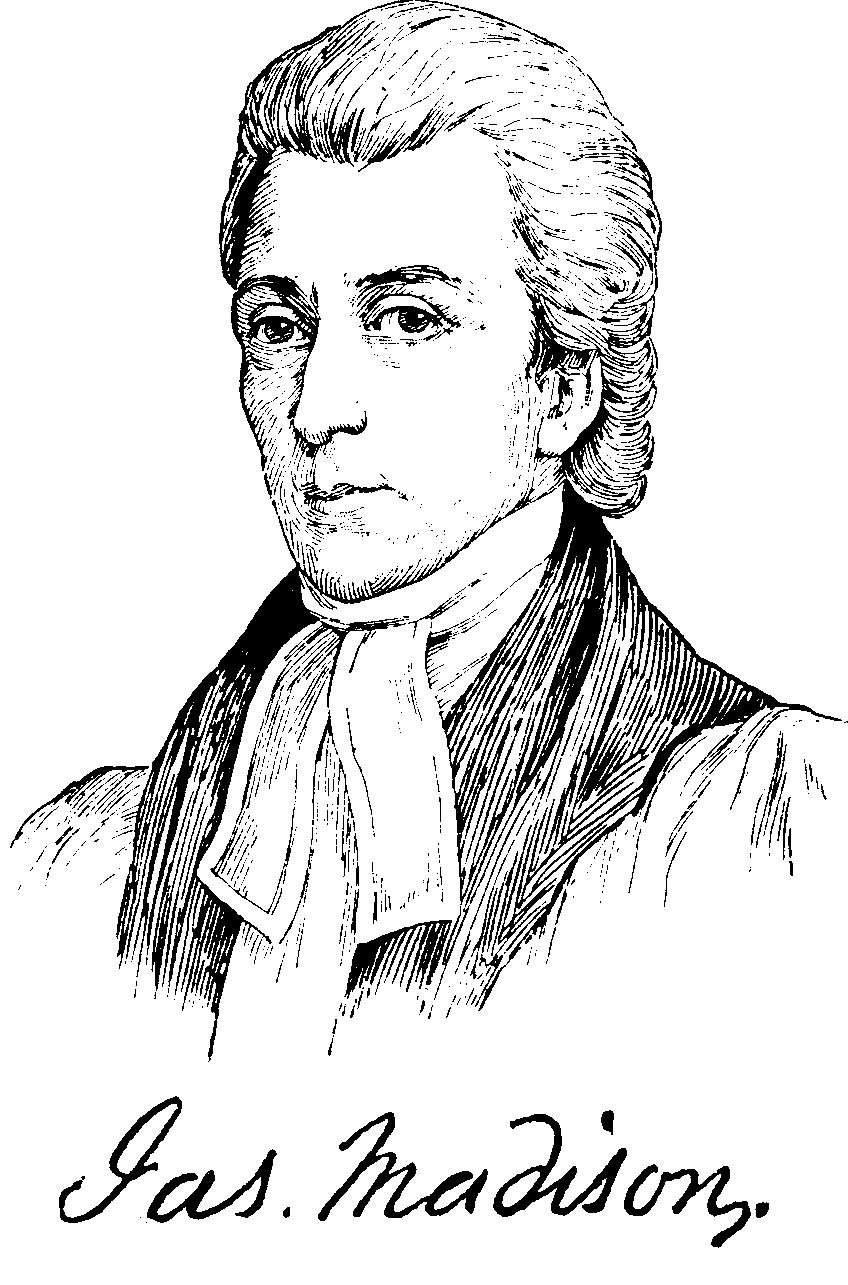
Appleton's Cyclopedia of American Biography, edited by James
Grant Wilson, John Fiske and Stanley L. Klos. Six volumes, New York: D. Appleton
and Company, 1887-1889 and 1999. Virtualology.com warns that these 19th Century
biographies contain errors and bias. We rely on volunteers to edit the historic
biographies on a continual basis. If you would like to edit this biographyplease
submit a rewritten biography in text form.
If acceptable, the new biography will be published above the 19th Century
Appleton's Cyclopedia Biography citing the volunteer editor
Virtual American Biographies
Over 30,000 personalities
with thousands of 19th Century illustrations, signatures, and exceptional life
stories. Virtualology.com
welcomes editing and additions to the
biographies. To become this site's editor or a contributor
Click Here
or e-mail Virtualology here.
MADISON, James, P. E. bishop, born near Port Republic, Augusta County, Virginia, 27 August, 1749; died in Williamsburg, Virginia, 5 March, 1812. He was graduated at William and Mary in 1772, studied law, and was admitted to the bar, but, not liking the profession, he entered upon a theological course preparatory to taking orders. In 1773 he was appointed professor of natural philosophy and afterward of mathematics in William and Mary; in 1775 leave was given him to go to England for ordination, he was made deacon in the chapel of Fulham palace, 29 September, 1775, by Bishop and priest, in the same chapel, 1 October, 1775, by the same bishop. On his return home he resumed his labors as professor, and in 1777 he became president of the college. The latter office he held until his death, and he succeeded in keeping the college in operation during the Revolution, save for a few months just before and after the siege of Yorktown. He received the degree of D.D. from the University of Pennsylvania in 1785, and from William and Mary in 1796. He was president of the first convention of the Episcopal church in Virginia in May, 1785, and in 1790 was chosen to be the first bishop. He was consecrated in the chapel of Lambeth palace, 19 September, 1790, by the archbishop of Canterbury and other bishops. He made his first visitation in 1792, and was diligent in his efforts to raise the Episcopal church in Virginia from the deep depression into which it had fallen. But, as his college duties were pressing, and his health never very vigorous, he was unable to accomplish much in the way of elevating and strengthening the church. Bishop Madison's publications were several sermons that he preached on special occasions, a "Eulogy on Washington" (1800), papers in "Barton's Journal," and a large map of Virginia.--Bishop Madison's brother, George, soldier, born in Virginia in 1763; died in Paris, Kentucky, 14 October, 1816, removed to Kentucky at a very early age and served as a soldier on the western frontier when seventeen years old, participating in several engagements with the Indians. During the campaigns in the northwest he commanded a company under General Arthur St. Clair, and later was lieutenant of a company of mounted volunteer cavalry under Major John Adair, being wounded in the action with the Indians near Fort St. Clair on 6 November, 1792. Subsequently he attained the rank of major in the Kentucky volunteers, and was attached to the northwestern army under General James Winchester. In this capacity he was present in the battle with the British and Indians near Frenchtown on 18 January, 1813, and was taken prisoner in the defeat on the river Raisin on 22 January, 1813, when he was sent to Quebec; but he was released in 1814. For more than twenty years he held the office of auditor of public accounts in Kentucky, and in 1816 he was nominated for governor. He was so popular and beloved by the people that his opponent withdrew in the heat of the canvass and Madison was elected for four years, but he died a few weeks afterward before entering on the duties of his office.
Unauthorized Site:
This site and its contents are not affiliated, connected,
associated with or authorized by the individual, family,
friends, or trademarked entities utilizing any part or
the subject's entire name. Any official or affiliated
sites that are related to this subject will be hyper
linked below upon submission
and Evisum, Inc. review.
Please join us in our mission to incorporate The Congressional Evolution of the United States of America discovery-based curriculum into the classroom of every primary and secondary school in the United States of America by July 2, 2026, the nation’s 250th birthday. , the United States of America: We The
People. Click Here