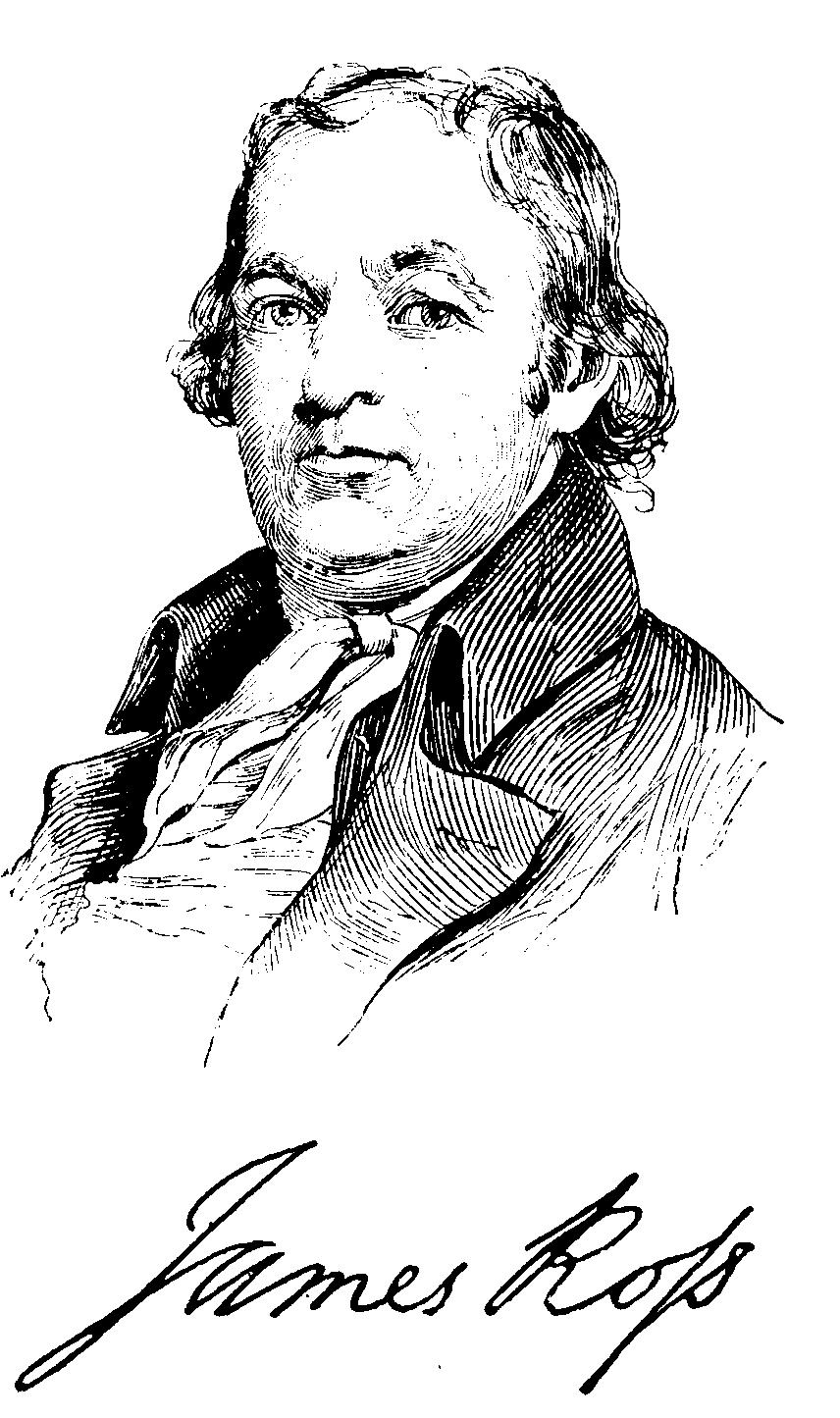
Appleton's Cyclopedia of American Biography, edited by James
Grant Wilson, John Fiske and Stanley L. Klos. Six volumes, New York: D. Appleton
and Company, 1887-1889 and 1999. Virtualology.com warns that these 19th Century
biographies contain errors and bias. We rely on volunteers to edit the historic
biographies on a continual basis. If you would like to edit this biographyplease
submit a rewritten biography in text form.
If acceptable, the new biography will be published above the 19th Century
Appleton's Cyclopedia Biography citing the volunteer editor
Virtual American Biographies
Over 30,000 personalities
with thousands of 19th Century illustrations, signatures, and exceptional life
stories. Virtualology.com
welcomes editing and additions to the
biographies. To become this site's editor or a contributor
Click Here
or e-mail Virtualology here.
ROSS, James, senator, born in York county, Pennsylvania, 12 July, 1762" died in Alleghany City, Pennsylvania, 27 November, 1847. He entered the school of the Reverend Dr. John McMillan and accepted the post of teacher of Latin. In 1782 Mr. Ross became a student at law, was admitted to the bar in 1784, went to Washington, Pennsylvania, where he practised until in 1795 he removed to Pittsburg. In 1789 Mr. Ross was elected a member of the convention to frame a new constitution for the state. The ability that he displayed in this body gave him a reputation which, with his fame as an orator and lawyer, secured his election to the United States senate, in April, 1794, for the unexpired term, ending 3 March, 1797, of Albert Gallatin, who had been thrown out because he had not been for nine years a citizen, as required by the constitution. In 1797 he was again elected to succeed himself. To Senator Ross undoubtedly belongs the chief credit of the peaceful ending of the whiskey insurrection. On 17 July, 1794, General Neville, the chief excise officer, was attacked, and his house and other property were destroyed. At a tumultuous meeting of the people at Washington, Pennsylvania, a rally of armed men was called, to be held on 1 August, at Braddock's Field. Bit'. Ross, in a powerful speech, alone opposed the will of an excited populace. He was told that he had that day destroyed all chances of future political preferment, lout., nothing daunted, he attended the Braddock's Field meeting and also that of the delegates from western Pennsylvania and Virginia, at Parkinson's Ferry. By his personal appeals and arguments a party was formed, which, if not very numerous, included many citizens of note, several of whom had been active on the other side. While he was at Parkinson's Ferry a messenger from the capital brought Senator Ross the information that he had been appointed by Washington the chief of a commission to compose the insurrection. Senator Ross more than prepared the way for his colleagues, and the insurrection was virtually at an end before they joined him. Mr. Ross had been for several years intimate with General Washington, being consulted as counsel, and now, at the president's request, became his attorney in fact for the sole management of his large estates in western Pennsylvania. While still in the senate, he was nominated, in 1799, as governor of the state. The nomination was esteemed to be equivalent to an election, but Mr. Ross refused to canvass the state in his own behalf and was defeated. At the next election Mr. Ross was again nominated and was again unsuccessful. The same disposition to defend the right, regardless of personal consequences, that had induced him, as a boy at Dr. McMillan's school, to volunteer against marauding Indians, that had separated him from friends and neighbors during the whiskey war, that in the senate had urged war against Spain to protect the mouths of the Mississippi for the use of the west, induced him to befriend the cause of a party of friendless negro slaves who had escaped from their masters and found refuge in Philadelphia. Impassioned oratory gained the case. The "Port Folio," published in Philadelphia in 1816, says that Mr. Ross received the thanks of the Abolition society ; but the generous act diminished his popularity. In 1808, for the third time, he was nominated for governor, and was again unsuccessful. With this election tile power of the Federalists in Pennsylvania was broken, and with it the political life of Mr. Ross came to an end. He declined to connect himself with other parties; only as a Federalist would he hold public office. Except a short sketch in the "Port Folio " for 1816, there is no published life of James Ross, and even that in great measure consists of extracts from his speeches.
Unauthorized Site:
This site and its contents are not affiliated, connected,
associated with or authorized by the individual, family,
friends, or trademarked entities utilizing any part or
the subject's entire name. Any official or affiliated
sites that are related to this subject will be hyper
linked below upon submission
and Evisum, Inc. review.
Please join us in our mission to incorporate The Congressional Evolution of the United States of America discovery-based curriculum into the classroom of every primary and secondary school in the United States of America by July 2, 2026, the nation’s 250th birthday. , the United States of America: We The
People. Click Here