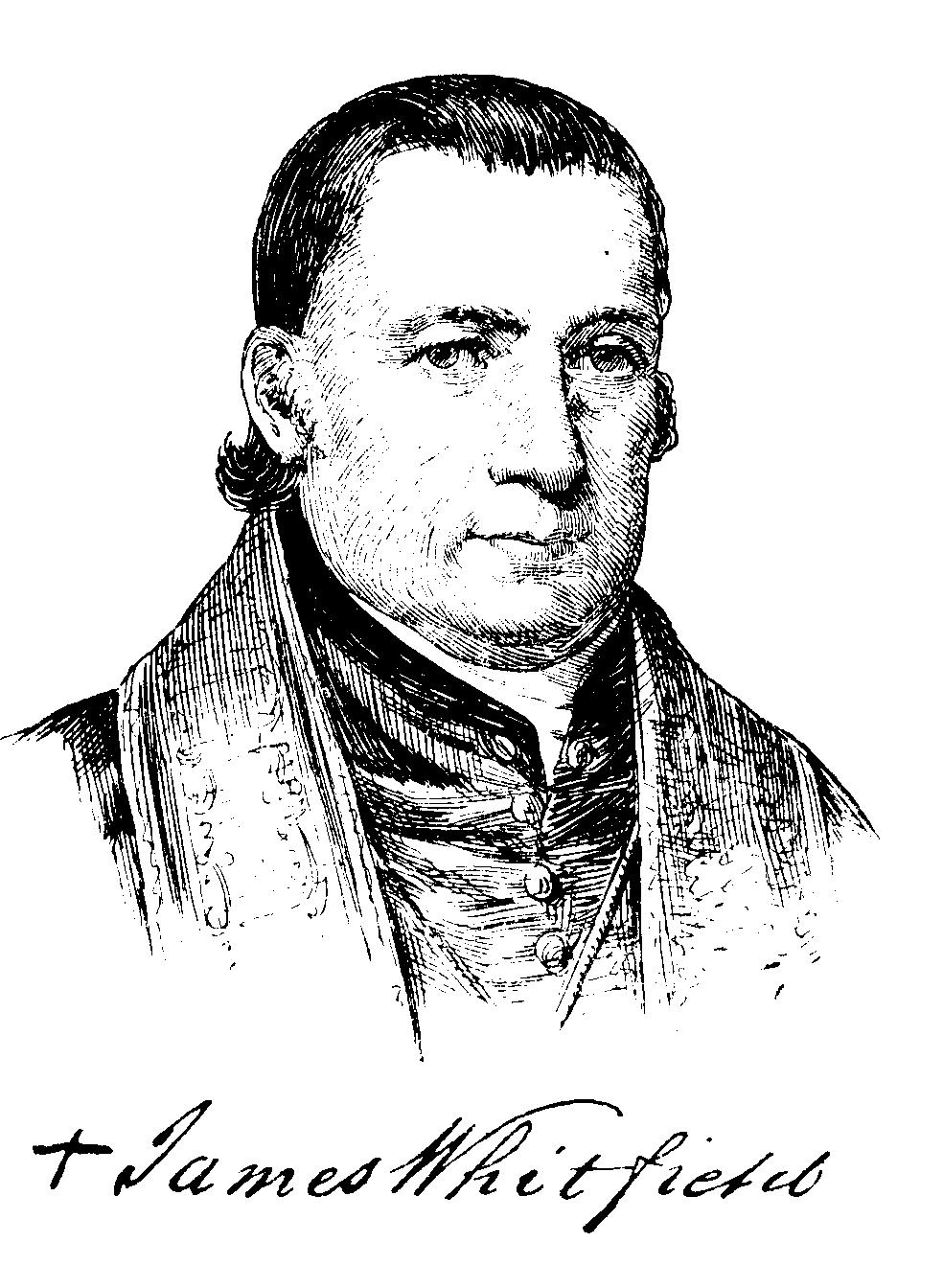
Appleton's Cyclopedia of American Biography, edited by James
Grant Wilson, John Fiske and Stanley L. Klos. Six volumes, New York: D. Appleton
and Company, 1887-1889 and 1999. Virtualology.com warns that these 19th Century
biographies contain errors and bias. We rely on volunteers to edit the historic
biographies on a continual basis. If you would like to edit this biographyplease
submit a rewritten biography in text form.
If acceptable, the new biography will be published above the 19th Century
Appleton's Cyclopedia Biography citing the volunteer editor
Virtual American Biographies
Over 30,000 personalities
with thousands of 19th Century illustrations, signatures, and exceptional life
stories. Virtualology.com
welcomes editing and additions to the
biographies. To become this site's editor or a contributor
Click Here
or e-mail Virtualology here.
WHITFIELD, James, R. C. archbishop, born in Liverpool, England, 3 November, 1770 ; died in Baltimore, Maryland, 19 October, 1834. His father died when James was seventeen years old, and the boy left England for Italy with his mother, who was in delicate health, he engaged in mercantile pursuits in the latter country and in France, adding largely to the fortune that his father bequeathed him. After the issue of the decree of Napoleon ordering the imprisonment of such Englishmen as happened to be in France, he was arrested and detained at Lyons, where he became intimate with Dr. (afterward Archbishop) Marechal, and his thoughts turned toward the priesthood, He began a course of theology under the guidance of his friend, and was ordained a priest in 1809. Some time afterward he returned to England, and was appointed parish priest of Cosby. He continued in this post until 1817, when, on the invitation of Archbishop Marechal, he went to the United States. He was appointed pastor of St. Peter's church, Baltimore, and in 1825, by a special dispensation from Rome, received the degree of D. D. The same year he was partly instrumental in placing the institution of the Colored Sisters Oblate of St. Francis in a prosperous condition, and began to take a practical interest in the welfare of the negroes. When Archbishop Marechal became feeble, Dr. Whitfield headed the list of proposed coadjutors, he was nominated bishop of Apollonia in partibus on 8 January, 1828, but the brief did not arrive in the United States until after the death of Archbishop Marechal, and Dr. Whitfield was consecrated archbishop on 25 May of the same year. He was also appointed administrator of the see of Richmond. He spent his large private fortune in building churches, supplying priests, and erecting institutions of education and charity. When this resource failed him he appealed for" help to the Society for the propagation of the faith, to the king of France, and to ecclesiastics and laymen of that country. Some of the letters that he wrote on these occasions have an important bearing on the history of the Roman Catholic church in the United States. In reply to his first appeal he received 32,000 francs, besides large sums for the support of St. Mary's college. He began to build the Baltimore orphan asylum, and made a visitation of every part of Maryland and Virginia where Roman Catholics resided. In the diocese of Richmond, which extended over 7,000 square miles, he found only three priests. He at once renewed his appeals to Europe for help, arid the response that he received enabled him to remedy this state of things. He held the first provincial council of his suffragan bishops at Baltimore on 4 October, 1829. Its deliberations were directed by him, and, at his suggestion, thirty-eight decrees, regulating the conduct of the Roman Catholic clergy of the United States, the tenure of church property, and other important interests, were adopted. In 1834 he built St. James's church, Baltimore, entirely from his private means. He assisted in procuring the incorporation of St. Mary's college, Emmitsburg, founded the Mary Marthian society for the relief of the poor, as well as other charitable institutions, finished the Baltimore cathedral, the tower signed, and erected an episcopal mansion. In 1833 he convened the second provincial council at Baltimore. In this council the mode of episcopal election was fixed, boundaries of dioceses were arranged, and steps were taken for the evangelization of the Indians and negroes of Liberia.
Unauthorized Site:
This site and its contents are not affiliated, connected,
associated with or authorized by the individual, family,
friends, or trademarked entities utilizing any part or
the subject's entire name. Any official or affiliated
sites that are related to this subject will be hyper
linked below upon submission
and Evisum, Inc. review.
Please join us in our mission to incorporate The Congressional Evolution of the United States of America discovery-based curriculum into the classroom of every primary and secondary school in the United States of America by July 2, 2026, the nation’s 250th birthday. , the United States of America: We The
People. Click Here