Appleton's Cyclopedia of American Biography, edited by James
Grant Wilson, John Fiske and Stanley L. Klos. Six volumes, New York: D. Appleton
and Company, 1887-1889 and 1999. Virtualology.com warns that these 19th Century
biographies contain errors and bias. We rely on volunteers to edit the historic
biographies on a continual basis. If you would like to edit this biographyplease
submit a rewritten biography in text form.
If acceptable, the new biography will be published above the 19th Century
Appleton's Cyclopedia Biography citing the volunteer editor
Virtual American Biographies
Over 30,000 personalities
with thousands of 19th Century illustrations, signatures, and exceptional life
stories. Virtualology.com
welcomes editing and additions to the
biographies. To become this site's editor or a contributor
Click Here
or e-mail Virtualology here.
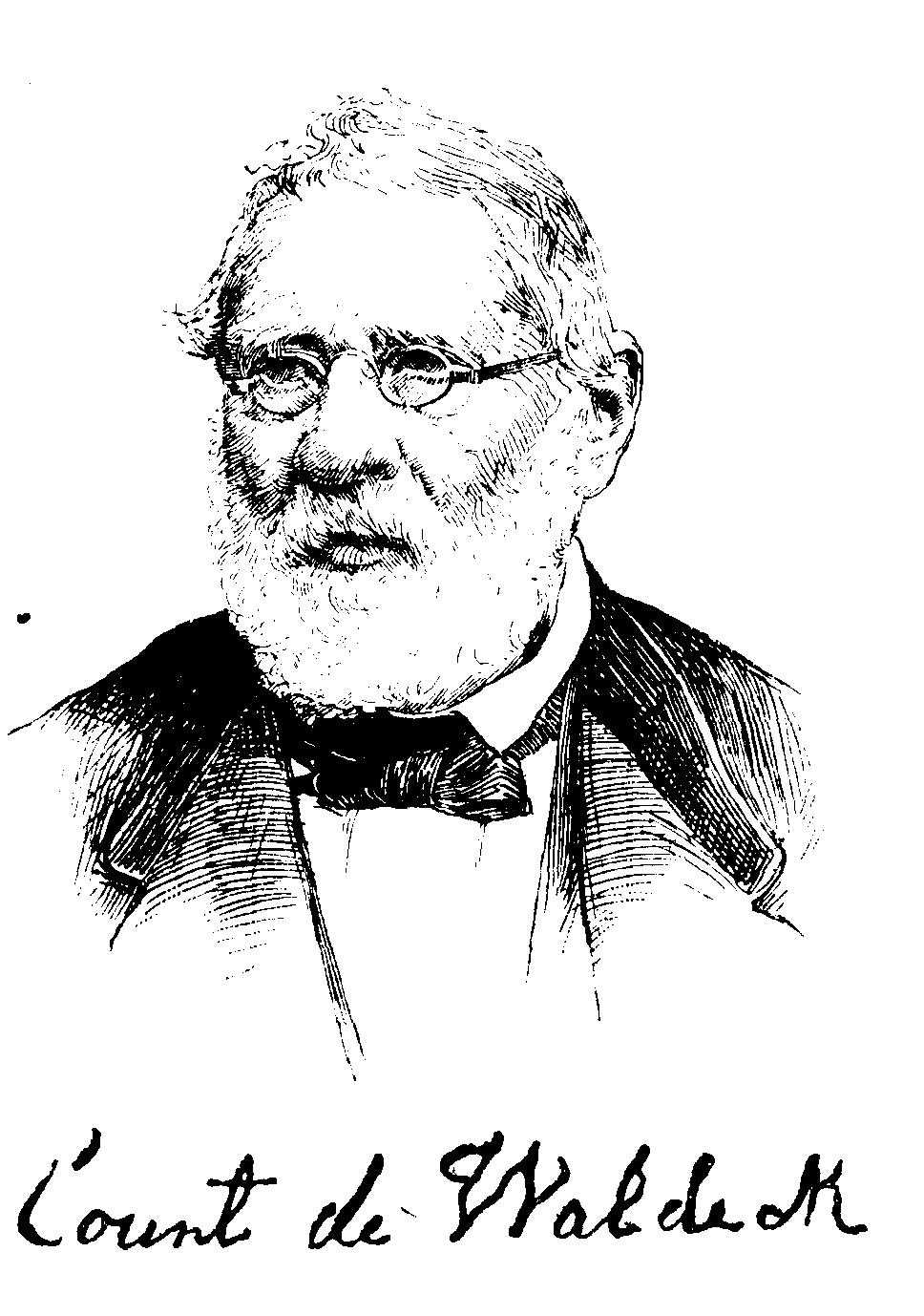
WALDECK, Jean Frederic de, archeologist, born in Paris, France, 16 March, 1766; died there, 30 April, 1875. When nineteen years of age he went with Levaillant to the Cape of Good Hope, and made explorations in South Africa. On his return to Paris in 1788 he began to study art under the guidance of David and Prud'hon, and this experience enabled him to make authentic records of his travels, especially those in Central America. He was present at the siege of Toulon in 1793, and in 1794 joined the army in Italy. In 1798 he followed the expedition to Egypt, but did not serve, and when Napoleon's plans failed, he decided to travel in Africa. With four companions, he left Assouan, crossed the desert of Dongola, and passed the Dji bel-el-Eumery. The four travellers, however, succumbed to fatigue and sickness, and De Waldeck alone lived to reach the coast, after four months of weary travel, danger, and privation. He returned to France, and subsequently embarked for the Mauritius, going from there to the Indian ocean. In 1819 he visited Chili with Lord Cochrane, and went upon an archeological expedition to Guatemala. He returned to England in 1822 and settled in London, where he was engaged in making the lithographs to illustrate a work by Captain del Rio on the ruins of Palenque and Chiapas. From his own observations he was led to believe that these designs were incorrect, and he determined to visit the ruins. He left England for Mexico, as engineer for the silver-mines of Tlalpujahua, and, after remaining there a short time, visited the Toltec and Aztec ruins. The French government had granted him a pension of 2,000 francs in 1826, and with this encouragement he spent several years in studying the details of the Palenque ruins, making drawings of them and maps of the country, and collecting specimens of the flora and fauna. Having lost the greater part of his sketches and note-books, he was obliged to give up his researches, and returned to Europe after twelve years spent in America. On his return he pursued his archaeological studies, and sold his drawings of the Palenque ruins to the French govermnent. They were published in 1863, and De Waldeck was engaged to make the lithographs, though he had passed his hundredth year. Two of his Mexican pictures were exhibited in 1869, under the title of "Loisir du centenaire." In the same year he sent the senior editor of this work; the original picture from which the accompanying portrait and autograph are taken. In 1870 he exhibited "Ruins of the Province of Tzendales." While in Mexico he discovered in a convent of nuns the unique copy of a work of Aretino, with illustrations by Jules Romain and Marc Antonio Raimondi, which had caused the banishment of the two artists, and had been confiscated and destroyed by the Inquisition, the copy deposited in the archives being afterward abstracted and finding its way to Mexico. M. de Waldeck was made a member of the Council of American archeology. He spent the last forty years of his life in Paris, retaining his faculties to the end. He published "Voyage archaeologique et pittoresque dans la Yucatan" (Paris, 1837), and, with Brasseur de Bourbourg, "Monuments anciens du Mexique, Palenque, et autres ruines de l'ancienne civilisation " (1866).
Unauthorized Site:
This site and its contents are not affiliated, connected,
associated with or authorized by the individual, family,
friends, or trademarked entities utilizing any part or
the subject's entire name. Any official or affiliated
sites that are related to this subject will be hyper
linked below upon submission
and Evisum, Inc. review.
Please join us in our mission to incorporate The Congressional Evolution of the United States of America discovery-based curriculum into the classroom of every primary and secondary school in the United States of America by July 2, 2026, the nation’s 250th birthday. , the United States of America: We The
People. Click Here