Appleton's Cyclopedia of American Biography, edited by James
Grant Wilson, John Fiske and Stanley L. Klos. Six volumes, New York: D. Appleton
and Company, 1887-1889 and 1999. Virtualology.com warns that these 19th Century
biographies contain errors and bias. We rely on volunteers to edit the historic
biographies on a continual basis. If you would like to edit this biographyplease
submit a rewritten biography in text form.
If acceptable, the new biography will be published above the 19th Century
Appleton's Cyclopedia Biography citing the volunteer editor
Virtual American Biographies
Over 30,000 personalities
with thousands of 19th Century illustrations, signatures, and exceptional life
stories. Virtualology.com
welcomes editing and additions to the
biographies. To become this site's editor or a contributor
Click Here
or e-mail Virtualology here.
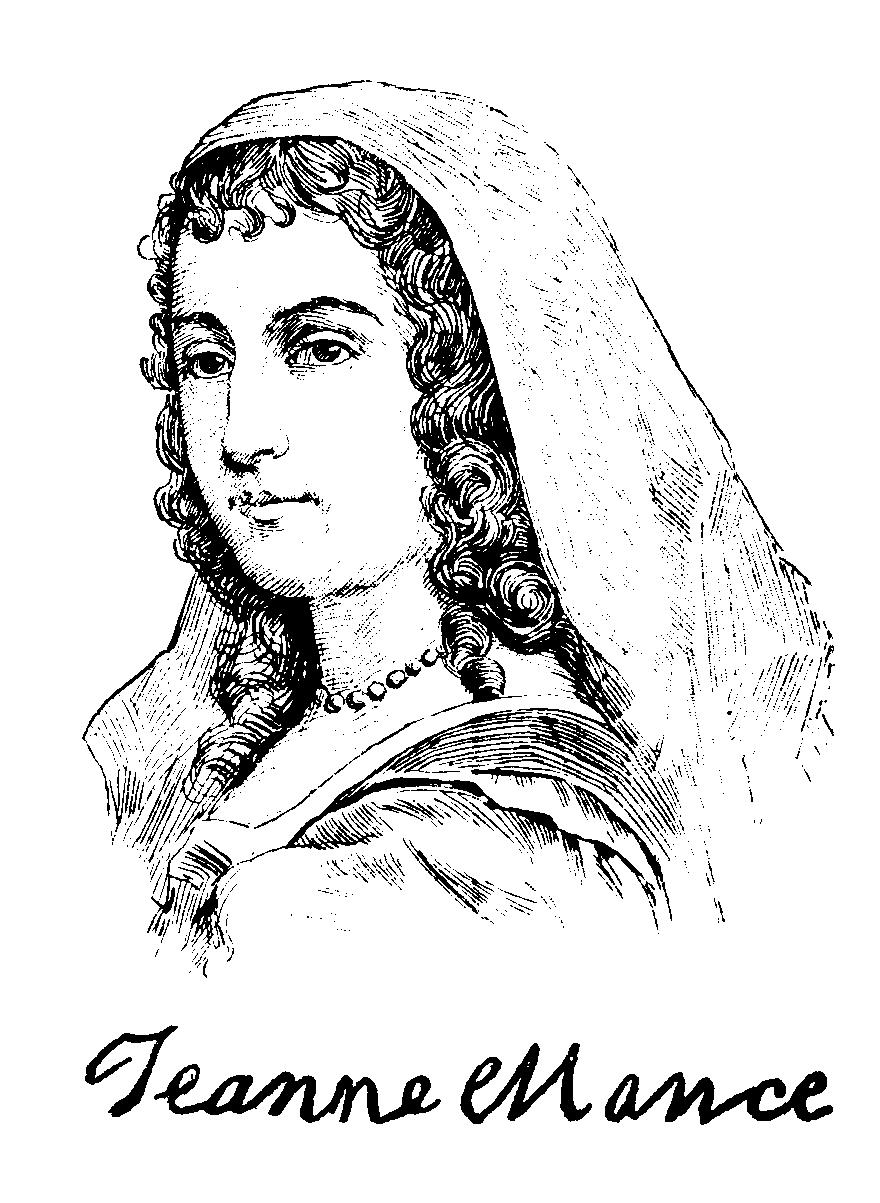
MANCE, Jeanne,
Canadian philanthropist, born near Langres, France, in 1606: died in Montreal,
Canada, in June, 1673. She made a vow in childhood to devote herself to a
religious life. After the death of her parents she resolved to labor on the
Canadian mission, and put herself in relation with Madame de Bullion, a wealthy
lady, who consented to furnish her with the funds necessary to found a hospital
in Montreal, provided she took the direction of the institution. She consented,
and went to La Rochelle in 1641 in order to ermbark for her destination.
Here she learned that a body of soldiers that
had been sent out by the Society of Montreal, under De Maisonneuve (q. v.), had
demanded, before embarking, that a woman should accompany them who might nurse
such of them as should fall sick. She consented to become an associate of the
Society of Montreal for this purpose, and sailed with the soldiers. After
landing at Quebec she was obliged to pass the entire winter with the soldiers,
who were engaged in building wooden barracks, which they afterward transported
to the island of Montreal. She took sole charge of the administration of these
colonists, distributed to them their provisions daily, and even had care of the
military stores. She obtained such authority over the soldiers and colonists
that they obeyed her like children.
She left Quebec, 8 May, 1642, and reached
Montreal a few days afterward. She decorated the first altar there on 17 May,
and then, with the funds of Madame de Bullion, she proceeded to build a hospital
at Villemarie, of which, after its erection, she became manager. She had first
to take care of numerous soldiers that were wounded in almost daily combats with
the Iroquois, and as the town grew her labors increased. She went to France in
1649, saw the members of the association of Montreal, who were thinking of
abandoning their colony, and prevailed on them to reorganize it.
In 1650, after her return to Villemarie, it
was attacked by the Iroquois, and, after enduring great dangers, she was obliged
to abandon the hospital and retire with her patients into the fort. Seeing that
the colonists must succumb, if they were not succored, she persuaded De
Maisonneuve to return to France for soldiers, giving him part of the money that
remained in her hands for the expenses of the hospitals, on condition that when
peace was restored lands should be given in exchange.
During the absence of the governor she did her
best to keep up the courage of the colonists, only seventeen of whom were able
to bear arms. The return of Maisonneuve restored security to the colony; the
hospital buildings were repaired and enlarged, and Mdlle. Mance was enabled to
leave the fort with her sick. The resolution of this courageous woman and the
money that she gave at a critical time to arm and pay soldiers saved not only
the island of Montreal, but the whole of Canada to France, which was recognized
by successive governors in their reports to their government.
But the hospital she had founded continued to
grow to such an extent that she was no longer capable of directing it alone. De
Maisonneuve consented to visit France again in search of nuns to aid and succeed
her in its management. During his absence a fall on the ice in the winter of
1657 injured her right arm, and she decided to go to France to obtain funds.
On her way home a plague broke out on the
vessel, and her attendance on the sick soon resulted in her own prostration, but
she recovered, and landed in Canada toward the end of the year 1659. Although in
feeble health, she continued to govern the Hotel-Dieu, and took another journey
to France in 1662, in order to defend certain interests of the colony that had
been attacked. After her arrival she saw that the Society of Montreal was in a
disorganized condition, and she persuaded the members to dissolve it and cede
their rights over the island of Montreal to the Sulpicians. On her return to
Canada she consecrated the remainder of her life to the work she had founded.
Her life has been published (2 vols., Villemarie, 1854).
MANCE, Jeanne, Canadian philanthropist, born near Langres, France, in 1606: died in Montreal, Canada, in June, 1673. She made a vow in childhood to devote herself to a religious life. After the death of her parents she resolved to labor on the Canadian mission, and put herself in relation with Madame de Bullion, a wealthy lady, who consented to furnish her with the funds necessary to found a hospital in Montreal, provided she took the direction of the institution. She consented, and went to La Rochelle in 1641 in order to era-bark for her destination. Here she learned that a body of soldiers that had been sent out by the Society of Montreal, under De Maisonneuve (q. v.), had demanded, before embarking, that a woman should accompany them who might nurse such of them as should fall sick. She consented to become an associate of the Society of Montreal for this purpose, and sailed with the soldiers. After landing at Quebec she was obliged to pass the entire winter with the soldiers, who were engaged in building wooden barracks, which they afterward transported to the island of Montreal. She took sole charge of the administration of these colonists, distributed to them their provisions daily, and even had care of the military stores. She obtained such authority over the soldiers and colonists that they obeyed her like children. She left Quebec, 8 Nay, 1642, and reached Montreal a few days afterward. She decorated the first altar there on 17 May, and then, with the funds of Madame de Bullion. She proceeded to build a hospital at Villemarie, of which, after its erection, she became manager. She had first to take care of numerous soldiers that were wounded in almost daily combats with the Iroquois, and as the town grew her labors increased. She went to France in 1649 saw the members of the association of Montreal, who were thinking of abandoning their colony, and prevailed on them to reorganize it. In 1650, after her return to Villemarie, it was attacked by the Iroquois, and, after enduring great dangers, she was obliged to abandon the hospital and retire with her patients into the fort. Seeing that the colonists must succumb, if they were not succored, she persuaded De Maisonneuve to return to France for soldiers, giving him part of the money that remained in her hands for the expenses of the hospitals, on condition that when peace was restored lands should be given in exchange. During the absence of the governor she did her best to keep up the courage of the colonists, only seventeen of whom were able to bear arms. ]'he return of Maisonneuve restored security to the colony; the hospital buildings were repaired and enlarged, and Mdlle. Mance was enabled to leave the fort with her sick. The resolution of this courageous woman and the money that she gave at a critical time to arm and pay soldiers saved not only the island of Montreal, but the whole of Canada to France, which was recognized by successive governors in their reports to their government. But. the hospital she had founded continued to grow to such an extent that she was no longer capable of directing it alone. De Maisonneuve consented to visit France again in search of rams to aid and succeed her in its management. During his absence a fall on the ice in the winter of 1657 injured her right arm, and she decided to go to France to obtain funds. On her way home a plague broke out on the vessel, and her attendance on the sick soon resulted in her own prostration, but she recovered, and landed in Canada toward the end of the year 1659. Although in feeble health, she continued to govern the Hotel-Dieu, and took another journey to France in 1662, in order to defend certain interests of the colony that had been attacked. After her arrival she saw that the Society of Montreal was in a disorganized condition, and she persuaded the members to dissolve it and cede their rights over the island of Montreal to the Sulpitians. On her return to Canada she consecrated the remainder of her life to the work she had founded. Her life has been published (2 vols., Villemarie, 1854).
Unauthorized Site:
This site and its contents are not affiliated, connected,
associated with or authorized by the individual, family,
friends, or trademarked entities utilizing any part or
the subject's entire name. Any official or affiliated
sites that are related to this subject will be hyper
linked below upon submission
and Evisum, Inc. review.
Please join us in our mission to incorporate The Congressional Evolution of the United States of America discovery-based curriculum into the classroom of every primary and secondary school in the United States of America by July 2, 2026, the nation’s 250th birthday. , the United States of America: We The
People. Click Here