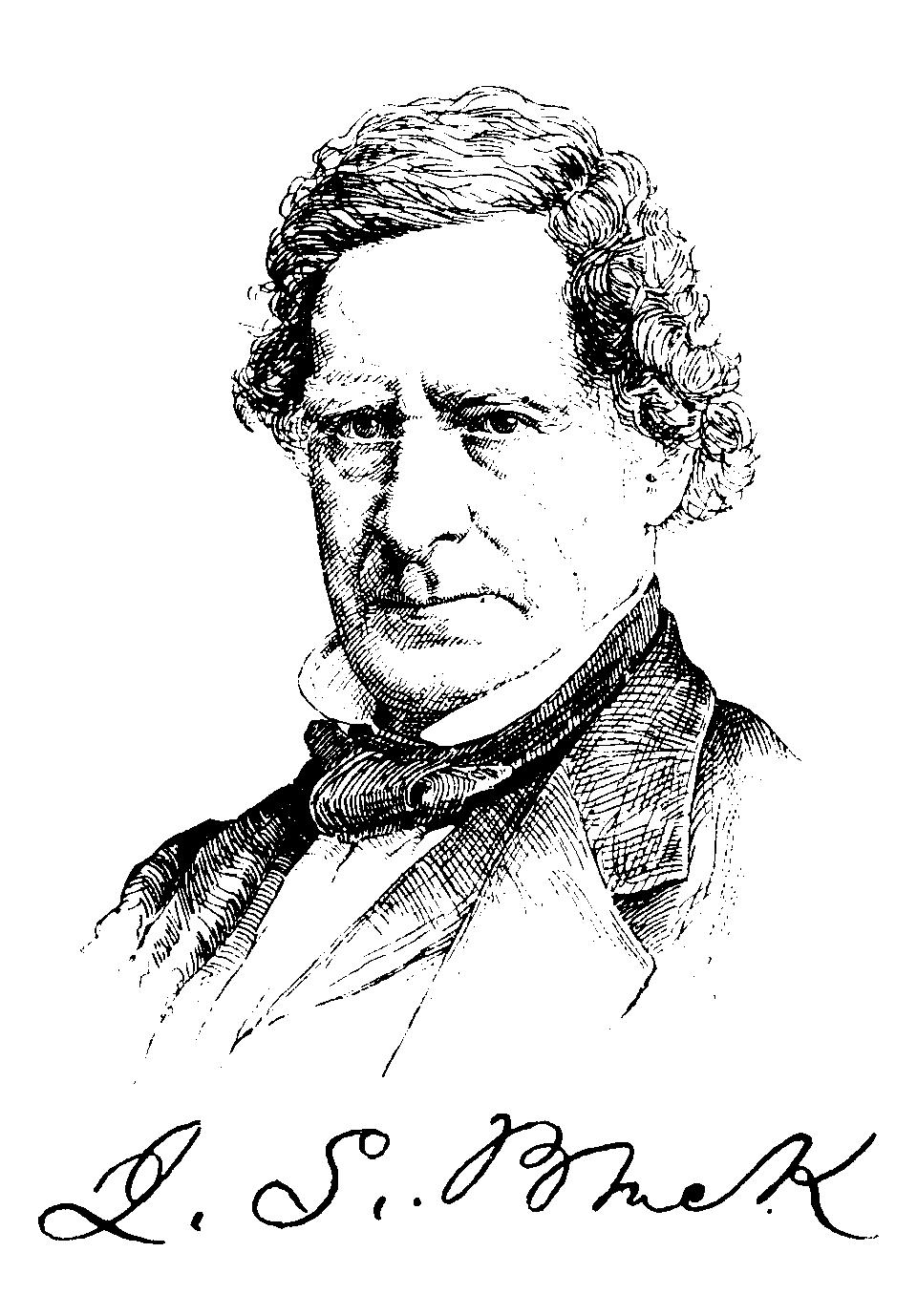
Appleton's Cyclopedia of American Biography, edited by James
Grant Wilson, John Fiske and Stanley L. Klos. Six volumes, New York: D. Appleton
and Company, 1887-1889 and 1999. Virtualology.com warns that these 19th Century
biographies contain errors and bias. We rely on volunteers to edit the historic
biographies on a continual basis. If you would like to edit this biographyplease
submit a rewritten biography in text form.
If acceptable, the new biography will be published above the 19th Century
Appleton's Cyclopedia Biography citing the volunteer editor
Virtual American Biographies
Over 30,000 personalities
with thousands of 19th Century illustrations, signatures, and exceptional life
stories. Virtualology.com
welcomes editing and additions to the
biographies. To become this site's editor or a contributor
Click Here
or e-mail Virtualology here.
BLACK, Jeremiah Sullivan, jurist, born in the Glades, Somerset County, Pennsylvania, 10 January 1810; died at his home in York, Pennsylvania, 19 August 1883. His ancestry was Scotch-Irish. James Black, his grandfather, came to America from the north of Ireland, and settled in Somerset County, Pennsylvania, where, in 1778, Henry Black, father of Jeremiah, a man of note in his day, was born. Jeremiah's early education was obtained at school near his father's farm. He studied law, was taken into the office of Chauncey Forward, a lawyer in Somerset county, and was admitted to the bar in 1831. In 1838 he mar-tied a daughter of Mr. Forward. After an active and successful practice of eleven years, he was raised to the bench. He was a Jeffersonian democrat, and was nominated ..by a democratic governor, in April 1842, for president-judge of the district where he lived, which post he held for nine years. In 1851 Judge Black was elected one of the Supreme Court judges of Pennsylvania. After serving the short term of three years, he was re-elected, in 1854, for a full term of fifteen years. On the accession of James Buchanan to the presidency, in 1857, Judge Black became attorney general. He was very industrious and successful, in connection with Edwin M. Stanton, in protecting the interests of the nation against false claimants to grants of land made by the Mexican government to settlers in California before that country came under the control of the United States. When the secession crisis arrived, in 1860-'1, Buchanan held that there was no authority for coercing a state, if it chose to secede and set up as an independent government; but Attorney-General Black was of the opinion that it was the duty of the government to put down insurrection, and that the constitution contained no provision for a dissolution of the union in any manner whatever. General Cass having resigned as secretary of state in December 1860, Judge Black was appointed to fill the vacancy, Edwin M. Stanton taking the post of attorney general. Judge Black occupied this office during the remainder of Buchanan's administration, and exerted himself to save the government from falling into the hands of the secessionists. In March 1861, when Abraham Lincoln became president, Judge Black retired from public life. He was appointed United States Supreme Court reporter, but soon resigned that office, and entered again upon the practice of law at his home, near York, Pennsylvania He was engaged in several prominent lawsuits during the last twenty years of his life, and retained his vigor and professional skill to the close of his career. The Vanderbilt will contest, the Milliken case, and the McGarrahan claim were among the more noted cases in which he was engaged. He was a contributor to periodical literature, furnished an account of the Erie railway litigation, argued the third-term question in magazine articles, and had a newspaper discussion with Jefferson Davis.*His son, Chauncey Forward, was elected lieutenant governor of Pennsylvania in 1882, and in 1886 was the democratic candidate for the governorship.
Unauthorized Site:
This site and its contents are not affiliated, connected,
associated with or authorized by the individual, family,
friends, or trademarked entities utilizing any part or
the subject's entire name. Any official or affiliated
sites that are related to this subject will be hyper
linked below upon submission
and Evisum, Inc. review.
Please join us in our mission to incorporate The Congressional Evolution of the United States of America discovery-based curriculum into the classroom of every primary and secondary school in the United States of America by July 2, 2026, the nation’s 250th birthday. , the United States of America: We The
People. Click Here