Appleton's Cyclopedia of American Biography, edited by James
Grant Wilson, John Fiske and Stanley L. Klos. Six volumes, New York: D. Appleton
and Company, 1887-1889 and 1999. Virtualology.com warns that these 19th Century
biographies contain errors and bias. We rely on volunteers to edit the historic
biographies on a continual basis. If you would like to edit this biographyplease
submit a rewritten biography in text form.
If acceptable, the new biography will be published above the 19th Century
Appleton's Cyclopedia Biography citing the volunteer editor
Virtual American Biographies
Over 30,000 personalities
with thousands of 19th Century illustrations, signatures, and exceptional life
stories. Virtualology.com
welcomes editing and additions to the
biographies. To become this site's editor or a contributor
Click Here
or e-mail Virtualology here.
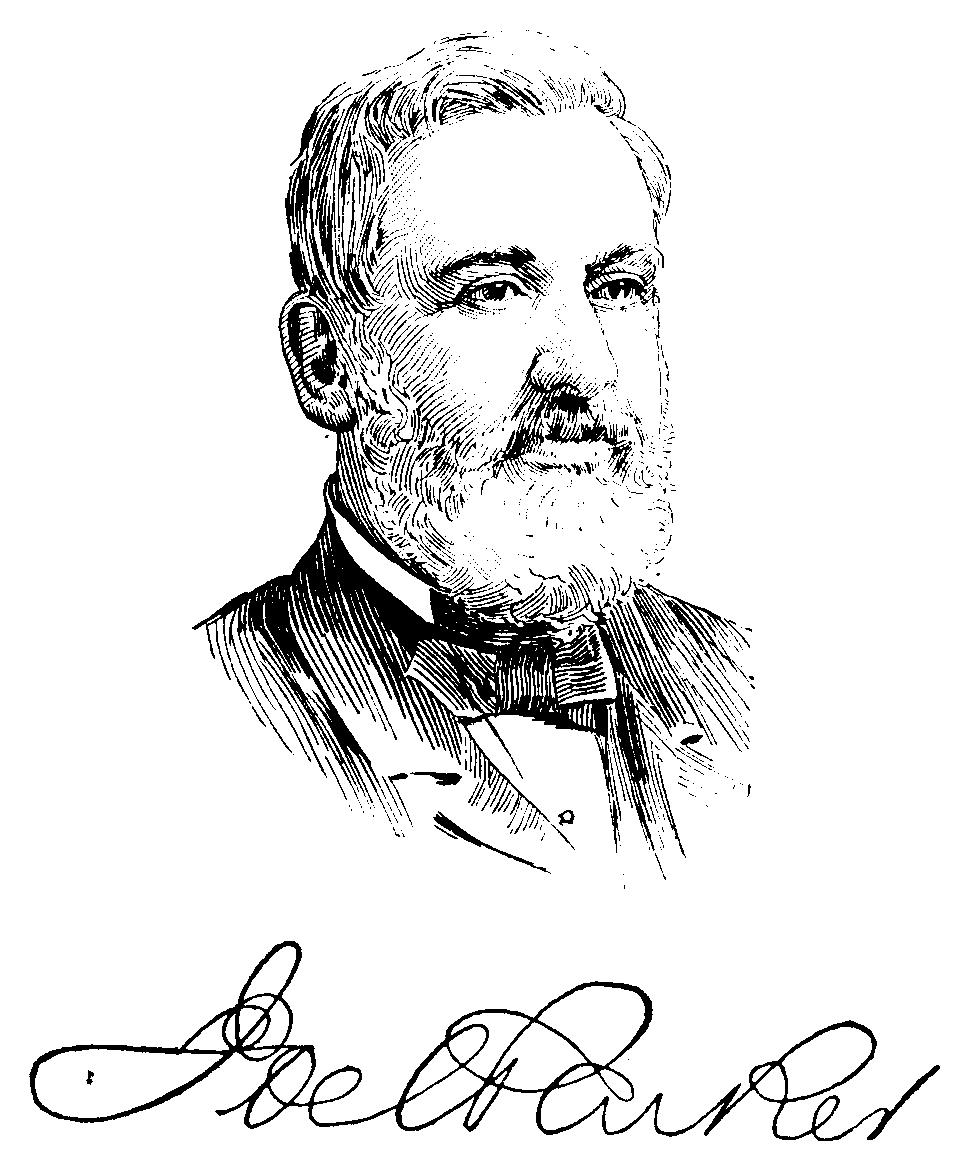
PARKER, Joel, governor of New Jersey, born near Freehold, New Jersey, 24 November, 1816; died in Philadelphia, Pennsylvania, 2 January, 1888. His father, Charles, was a member of the New Jersey legislature for several years, and served one term as state treasurer. Joel removed with his father to Trenton in 1821, was graduated at Princeton in 1839, studied law under Chief-Jus-flee Henry W. Green, and settled in Freehold, New Jersey He began his political career in 1844 as a Democratic speaker, and was in the assembly in 1847-'50, prosecuting attorney in 1852-'7, and a presidential elector in 1860, casting his vote for Stephen A. Douglas. He had been commissioned brigadier-general of militia in 1857, and in 1861 became major-general. He had ardently opposed the civil war, but when it began he actively supported the National government. He was elected governor of New Jersey in 1862, as a Democrat, served till 1866, and during his occupation of that office conducted the affairs of state with prudence and ability. During Lee's invasion of Pennsylvania in 1863 he supplied several organized regiments of New Jersey volunteers that were sent to the protection of that state, but when a levy of 12,000 men was made on New Jersey in 1864, to make good a supposed deficiency in her former quotas, he obtained from President Lincoln the withdrawal of the order. Governor Parker also established a method of settlement of the war debt, so that not a bond of the state of New Jersey was sold below par, and at the close of the war in i865 there was a surplus of $200,000 in the state treasury. He took strong grounds in favor of an amnesty toward those that had taken part in the war against the National government. In 1868 the New Jersey delegation to the National Democratic convention, in New York city, cast their full vote for him in every ballot for the presidential nomination. He was again elected governor in 1870, and at the conclusion of his term became attorney-general of the state. He was chosen a judge of the supreme court of New Jersey in 1880, and was re-elected in 1887, presiding over the central circuit of the state. In 1883 he declined the nomination for governor. Rutgers gave him the degree of LB. D. in 1872.
Unauthorized Site:
This site and its contents are not affiliated, connected,
associated with or authorized by the individual, family,
friends, or trademarked entities utilizing any part or
the subject's entire name. Any official or affiliated
sites that are related to this subject will be hyper
linked below upon submission
and Evisum, Inc. review.
Please join us in our mission to incorporate The Congressional Evolution of the United States of America discovery-based curriculum into the classroom of every primary and secondary school in the United States of America by July 2, 2026, the nation’s 250th birthday. , the United States of America: We The
People. Click Here