Appleton's Cyclopedia of American Biography, edited by James
Grant Wilson, John Fiske and Stanley L. Klos. Six volumes, New York: D. Appleton
and Company, 1887-1889 and 1999. Virtualology.com warns that these 19th Century
biographies contain errors and bias. We rely on volunteers to edit the historic
biographies on a continual basis. If you would like to edit this biographyplease
submit a rewritten biography in text form.
If acceptable, the new biography will be published above the 19th Century
Appleton's Cyclopedia Biography citing the volunteer editor
Virtual American Biographies
Over 30,000 personalities
with thousands of 19th Century illustrations, signatures, and exceptional life
stories. Virtualology.com
welcomes editing and additions to the
biographies. To become this site's editor or a contributor
Click Here
or e-mail Virtualology here.
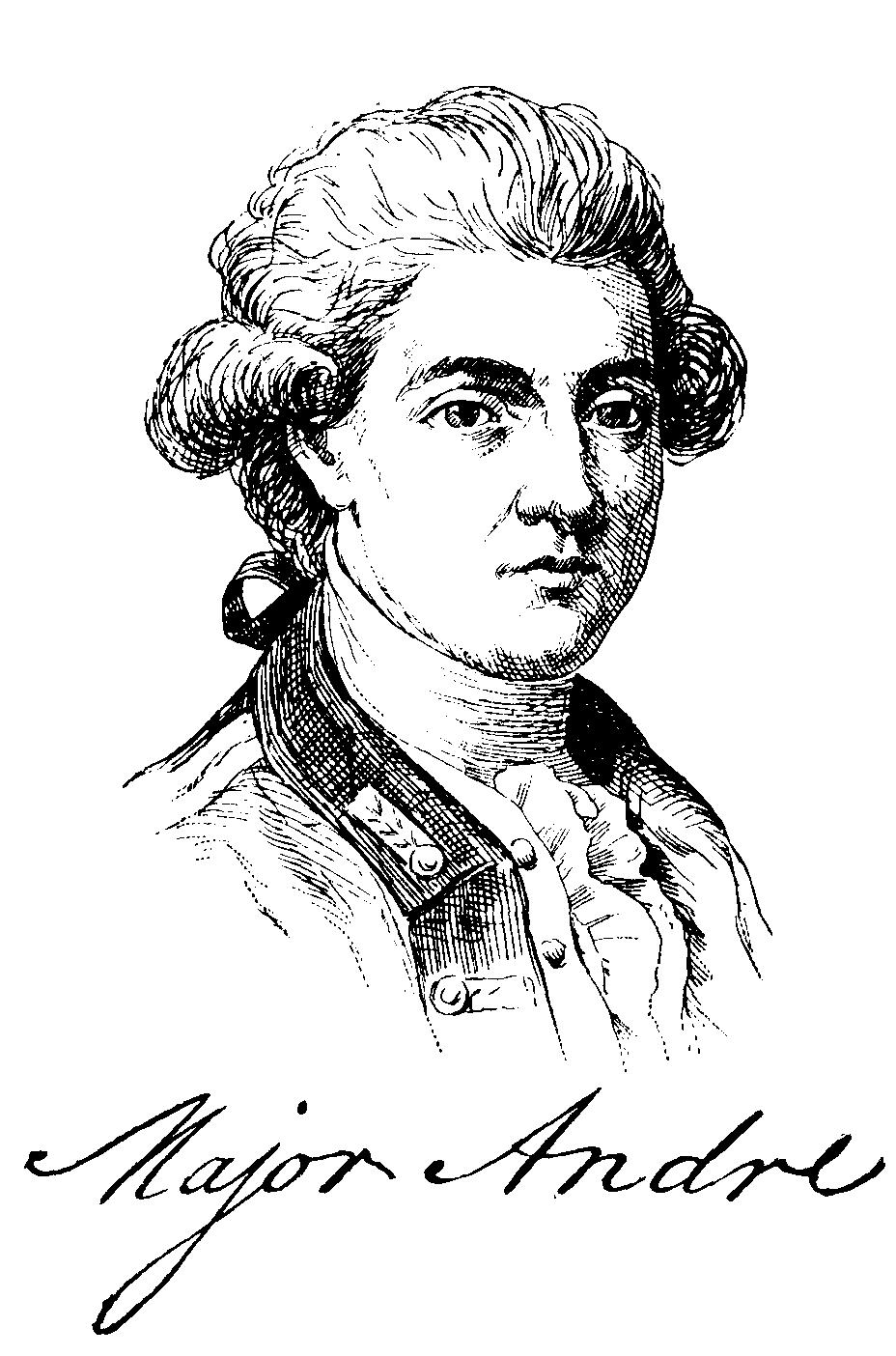
ANDRE, John, British soldier, born in London in 1751, of Swiss parents; died at Tappan, New York, 2 October 1780. In the autumn of 1775 he was taken prisoner at St. John's by General Montgomery. He afterward served on the staff of General Gray, and then on that of Sir Henry Clinton, who, in 1779, made him adjutant-general of the British army in America. Under the name of " John Anderson" he conducted the treacherous negotiations with Benedict Arnold for the surrender of West Point. On the night of 21 September 1780, he had an interview with Arnold in the woods near Stony Point, and took breakfast with him in the house of Joshua Smith, who was not privy to the plot. On leaving him, Arnold gave him six papers containing full information as to the state of the defenses at West Point, and also passes enabling him to return either by land or by water to New York. Smith persuaded him to take the journey by land, and accompanied him part of the way. Contrary to Clinton's positive instructions, Andre adopted a disguise, and, contrary to Arnold's positive instructions, Smith left him before he had reached the British lines. Soon after Smith left him three young men whom he supposed to be Tories, and incautiously let them know that he was a British officer stopped him. The young men, who were patriotic Americans, searched his person, and, finding the treasonable documents in his stockings, arrested him. A board of six Major-Generals and eight brigadiers, found guilty of acting as a spy, and condemned to the gallows, tried him. His remains were buried on the spot where he suffered, but in 1821 they were taken to England and interred in Westminster Abbey. His hard fate has been much commiserated on account of his engaging personal qualities, but British writers as well as American generally concede the justice of his sentence. Each of Andre's captors*John Paulding, David Williams, and Isaac Van Wart*received from congress a silver medal and an annuity of $200. His life has been written by Sparks, in his " American Biographies," and much more fully by Winthrop Sargent, " Life and Career of Major John Andrr" (Boston, 1861).
Unauthorized Site:
This site and its contents are not affiliated, connected,
associated with or authorized by the individual, family,
friends, or trademarked entities utilizing any part or
the subject's entire name. Any official or affiliated
sites that are related to this subject will be hyper
linked below upon submission
and Evisum, Inc. review.
Please join us in our mission to incorporate The Congressional Evolution of the United States of America discovery-based curriculum into the classroom of every primary and secondary school in the United States of America by July 2, 2026, the nation’s 250th birthday. , the United States of America: We The
People. Click Here