Appleton's Cyclopedia of American Biography, edited by James
Grant Wilson, John Fiske and Stanley L. Klos. Six volumes, New York: D. Appleton
and Company, 1887-1889 and 1999. Virtualology.com warns that these 19th Century
biographies contain errors and bias. We rely on volunteers to edit the historic
biographies on a continual basis. If you would like to edit this biographyplease
submit a rewritten biography in text form.
If acceptable, the new biography will be published above the 19th Century
Appleton's Cyclopedia Biography citing the volunteer editor
Virtual American Biographies
Over 30,000 personalities
with thousands of 19th Century illustrations, signatures, and exceptional life
stories. Virtualology.com
welcomes editing and additions to the
biographies. To become this site's editor or a contributor
Click Here
or e-mail Virtualology here.
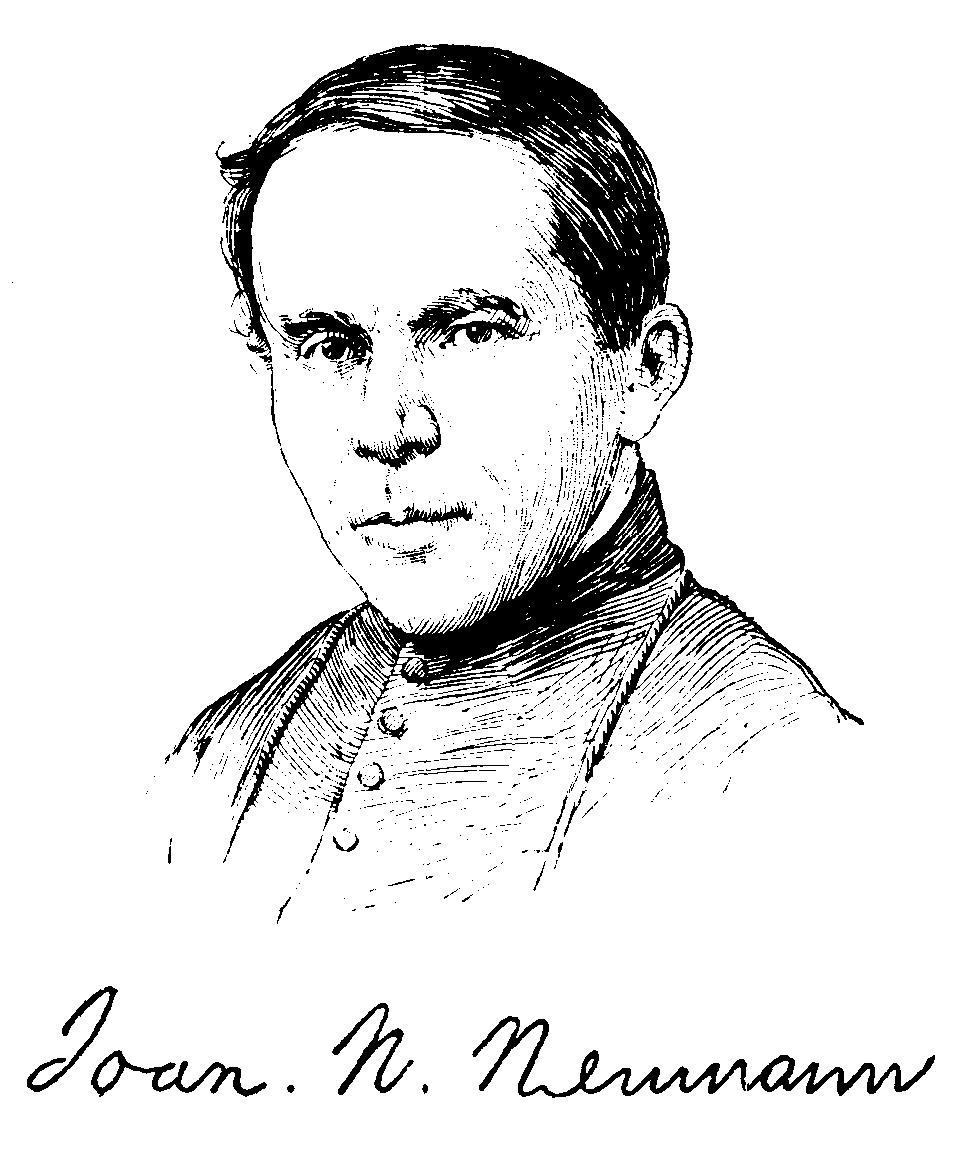
NEUMANN,
John Nepomucene, R. C. bishop, born in Prachatitz, Bohemia, 28 March,
1811 ; died in Philadelphia, Pennsylvania, 5 January, 1860. He studied in
gymnasium of Budweis in 1823-'31, and in the theological seminary there for two
years, after which he finished his theological studies at Prague in 1835. His
desire always had been to labor among.... his countrymen in the United States
and, after meeting with many obstacles, he arrived in New York on 31 May, 1836,
and was ordained priest by Bishop Dubois on 25 June.
He was appointed, a few days after, to take charge of
the missions around Niagara Falls. He next went to Buffalo, New York, and thence
to Williamsville, near that place, where he completed the building of a church.
He also attended various places within a radius of fifty miles, and taught for
nearly a year, his parishioners being too poor to pay a teacher. He also began
the study of medicine, for which an extensive knowledge of botany served him.
While journeying through the forests on his missionary duties he searched for
flowers and plants to be used in compounding medicines, and also found means to
form a valuable collection, which he afterward forwarded to the museum at
Munich.
In 1840 he was prostrated by an intermittent fever, and
he then sought admittance at the Redemptorist convent in Pittsburg,
Pennsylvania, on 18 October, and two years later he made his vows, being the
first Redemptorist that professed in the United States. He spent the two
following years in giving missions in Maryland, Virginia, and Pennsylvania. He
was appointed in 1844 superior of the Redemptorist convent of Pittsburg, and
built the church of St. Philomena, the whole superintendence of which devolved
on him. He also wrote a catechism and a Bible history for the use of schools,
spending night hours on these compilations when the day's work was over. At the
same tithe he composed manuals for the various confraternities of the
Redemptorist churches. Before leaving Pittsburg he had nearly finished a new
Redemptorist convent and novitiate.
He was appointed superior of the American province on 15
December, 1846, and during his provincialship Redemptorist foundations were made
and churches were erected under his direction in the chief cities of the United
States. In 1847 he entrusted the three female schools under his jurisdiction in
Baltimore to the School-sisters of Notre Dame, who had just arrived from
Bavaria, and his zeal in spreading this order throughout the United States
entitles him to be regarded as its founder in this country.
In 1849 he laid down his office and was made consultor
to the provincial. In 1851 he was made rector of St. Alphonsus's church,
Baltimore, and in the same year was appointed bishop of Philadelphia. Alter
vainly endeavoring to decline the office he was consecrated by Archbishop
Kenrick on 20 March, 1852. He set about erecting churches wherever they were
needed, and during the first five years of his episcopate he opened more than
fifty. In some parishes where there was a feeling against ecclesiastical
authority he restored peace by his prudence and firmness.
At his death parochial schools in his diocese had
increased from a few to more than a hundred. He also founded St. Joseph's
college in Susquehanna County, and various academies and hospitals. The Sisters
of the third order of St. Francis owe their existence to Bishop Neumann. They
now have twenty-five convents and over 200 professed sisters, who are
principally engaged in nursing the sick at their own homes. In 1854 he visited
Rome to take part in the definition of the dogma of the Immaculate Conception,
and after his return he devoted his energies to the completion of the cathedral
of Philadelphia, which had been begun by his predecessor. In 1858 it was opened
for worship. It was said of him that in the eight years of his episcopate he had
accomplished the work of twenty.
To a great sanctity of life he added a high degree of
learning and scholarship. He could converse freely in at least twelve modern
languages. The Roman Catholics of his diocese believed after his death that many
wonderful cures were affected through his intercession. In 1884 steps were taken
toward his canonization. St. John Neumann was canonized in 1977 by Pope Paul VI,
the first American male saint. See "Life of Right Reverend John Neumann, D.
D.," by Reverend Eugene Grimm, from the German of Reverend John A. Berger (New
York, 1884); Dictionary of Saints, by John J. Delaney, Doubleday, Garden City
NY, 1980 p. 421
NEUMANN, John Nepomucene, R. C. bishop, born in Prachatitz, Bohemia, 28 March, 1811 ; died in Philadelphia, Pennsylvania, 5 January, 1860. He studied in gymnasium of Budweis in 1823-'31, and in the theological seminary there for two years, after which he finished his theological studies at Prague in 1835. His desire always had been to labor among .... his countrymen in the United States and, after meeting with many obstacles, he arrived in New York on 31 May, 1836, and was ordained priest by Bishop Dubois on 25 June. He was appointed, a few days after, to take charge of the missions around Niagara Falls. He next went to Buffalo, New York, and thence to Williamsville, near that place, where he completed the building of a church. He also attended various places within a radius of fifty miles, and taught for nearly a year, his parishioners being too poor to pay a teacher. He also began the study of medicine, for which an extensive knowledge of botany served him. While journeying through the forests on his missionary duties he searched for flowers and plants to be used in compounding medicines, and also found means to form a valuable collection, which he afterward forwarded to the museum at Munich. In 1840 he was prostrated by an intermittent fever, and he then sought admittance at the Redemptorist convent in Pittsburg, Pennsylvania, on 18 October, and two years later he made his vows, being the first Redemptorist that professed in the United States. He spent the two following years in giving missions in Maryland, Virginia, and Pennsylvania. He was appointed in 1844 superior of the Redemptorist convent of Pittsburg, and built the church of St. Philomena, the whole superintendence of which devolved on him. He also wrote a catechism and a Bible history for the use of schools, spending night hours on these compilations when the day's work was over. At the same tithe he composed manuals for the various confraternities of the Redemptorist churches. Before leaving Pittsburg he had nearly finished a new Redemptorist convent and novitiate. He was appointed superior of the American province on 15 December, 1846, and during his provincialship Redemptorist foundations were made and churches were erected under his direction in the chief cities of the United States. In 1847 he intrusted the three female schools under his jurisdiction in Baltimore to the School-sisters of Notre Dame, who had just arrived from Bavaria, and his zeal in spreading this order throughout the United States entitles him to be regarded as its founder in this country. In 1849 he laid down his office and was made consultor to the provincial. In 1851 he was made rector of St. Alphonsus's church, Baltimore, and in the same year was appointed bishop of Philadelphia. Alter vainly endeavoring to decline the office he was consecrated by Archbishop Kenrick oil 20 March, 1852. He set about erecting churches wherever they were needed, and during the first five years of his episcopate he opened more than fifty. In some parishes where there was a feeling against ecclesiastical authority he restored peace by his prudence and firmness. At his death parochial schools in his diocese had increased from a few to more than a hundred. He also founded St. Joseph's college in Susquehanna county, and various academies and hospitals. The Sisters of the third order of St. Francis owe their existence to Bishop Neumann. They now have twenty-five convents and over 200 professed sisters, who are principally engaged in nursing the sick at their own homes. In 1854 he visited Rome to take part in the definition of the dogma of the immaculate conception, and after his return he devoted his energies to the completion of the cathedral of Philadelphia, which had been begun by his predecessor. In 1858 it. was opened for worship. It was said of him that in the eight years of his episcopate he had accomplished the work of twenty. To a great sanctity of life he added a high degree of learning and scholarship. He could converse freely in at least twelve modern languages. The Roman Catholics of his diocese believed after his death that many wonderful cures were effected through his intercession. In 1884 steps were taken toward his canonization. See "Life of Right Reverend John Neumann, D. D.," by Reverend Eugene Grimm, from the German of Reverend John A. Berger (New York, 1884).
Unauthorized Site:
This site and its contents are not affiliated, connected,
associated with or authorized by the individual, family,
friends, or trademarked entities utilizing any part or
the subject's entire name. Any official or affiliated
sites that are related to this subject will be hyper
linked below upon submission
and Evisum, Inc. review.
Please join us in our mission to incorporate The Congressional Evolution of the United States of America discovery-based curriculum into the classroom of every primary and secondary school in the United States of America by July 2, 2026, the nation’s 250th birthday. , the United States of America: We The
People. Click Here