Appleton's Cyclopedia of American Biography, edited by James
Grant Wilson, John Fiske and Stanley L. Klos. Six volumes, New York: D. Appleton
and Company, 1887-1889 and 1999. Virtualology.com warns that these 19th Century
biographies contain errors and bias. We rely on volunteers to edit the historic
biographies on a continual basis. If you would like to edit this biographyplease
submit a rewritten biography in text form.
If acceptable, the new biography will be published above the 19th Century
Appleton's Cyclopedia Biography citing the volunteer editor
Virtual American Biographies
Over 30,000 personalities
with thousands of 19th Century illustrations, signatures, and exceptional life
stories. Virtualology.com
welcomes editing and additions to the
biographies. To become this site's editor or a contributor
Click Here
or e-mail Virtualology here.
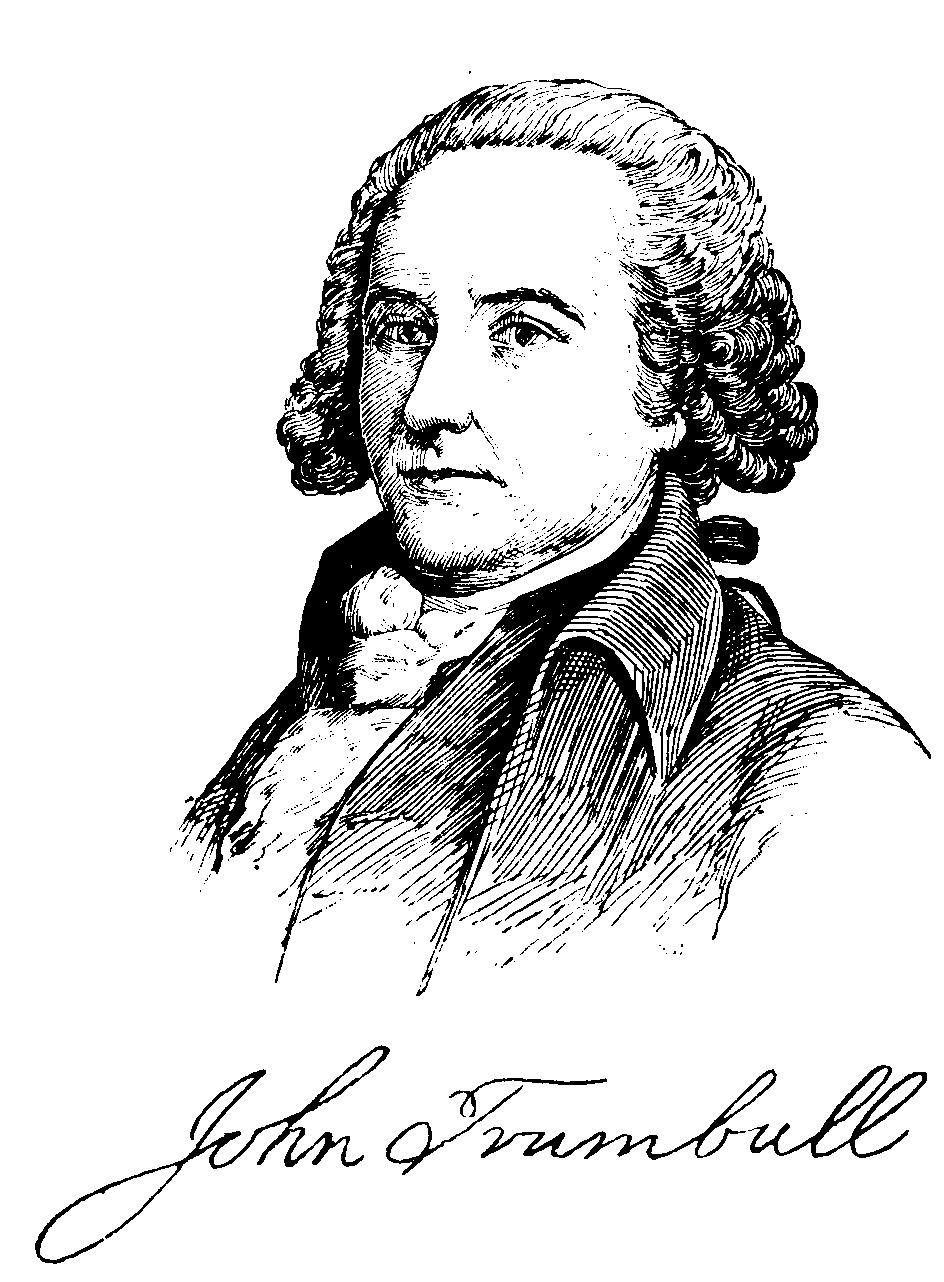
TRUMBULL, John, poet, born in Westbury (now Watertown), Connecticut, 24 April, 1750; died in Detroit, Michigan, 10 May, 1831. At five years of age, without the knowledge of any one but his mother, he began the study of Latin. In 1757 he passed his examination for admission to Yale, but, in consequence of his youth, he did not enter, and spent six years in study. He was graduated in 1767, and with his friend and fellow-student, Timothy Dwight, wrote papers in the style of the "Spectator," which they published in the Boston and New Haven journals in 1769. They became tutors at Yale in 1771, and Trumbull at the same time studied law, which he was licensed to practise in 1773. He published a poetical satire on the prevailing mode of education, entitled " The Progress of Dulness " (1772), adding the second and third parts a year later. In 1773 he entered the law-office of John Adams in Boston, and recorded his impressions of the spirit of freedom and resistance in an "Elegy on the Times," a poem of sixty-three stanzas on the port bill, and other colonial themes (Boston, 1774). He re turned to New Ha yen in 1774, and, while practising law, wrote the first two cantos of "McFingal," a modern epic poem in Hudibrastic verse, in which he described the American contest and the character and customs of the times, and satirized the manner and extravagances of both his own countrymen and the British (Philadelphia, 1774). He married Sarah, daughter of Colonel Leveret Hubbard, in 1776, and returned to Westbury, whence he removed to Hartford in 1781. He there completed "McFingal" (Hartford, 1782; 6th ed., London, 1793 ; new ed., with notes, Boston, 1826; revised and corrected, with notes by Benson J. Lossing, New York, 1860). Its popularity was great, , and there were more than thirty pirated impressions of the poem in pamphlet and other forms. Two or three couplets of McFingal that still circulate as proverbs are generally credited to Samuel Butler, author of " Hudibras": " No man e'er felt the halter draw, With good opinion of the law," and, "But optics sharp it needs, I ween, To see what is not to be seen." After the peace, with David Humphreys, Joel Barlow, and Lemuel Hopkins, he wrote a series of essays that were designed to check, by the boldness of their satire, the then prevalent spirit of disorganization and anarchy. They were extensively copied in the newspapers, under the title of "American Antiquities, Extracts from the 'Anarchiad' and Other Papers." He became state's attorney for Hartford county in 1789, served in the legislature in 1792 and 1800, and in 1801-'19 was a judge of the superior court. In 1808 he received from the legislature the additional appointment of judge of the supreme court of errors, which he held till 1819. He was for several years treasurer of Yale, from which he received the degree of LL.D. in 1818. He removed to Detroit, Michigan, in 1825, where he subsequently resided for six years.
Unauthorized Site:
This site and its contents are not affiliated, connected,
associated with or authorized by the individual, family,
friends, or trademarked entities utilizing any part or
the subject's entire name. Any official or affiliated
sites that are related to this subject will be hyper
linked below upon submission
and Evisum, Inc. review.
Please join us in our mission to incorporate The Congressional Evolution of the United States of America discovery-based curriculum into the classroom of every primary and secondary school in the United States of America by July 2, 2026, the nation’s 250th birthday. , the United States of America: We The
People. Click Here