Appleton's Cyclopedia of American Biography, edited by James
Grant Wilson, John Fiske and Stanley L. Klos. Six volumes, New York: D. Appleton
and Company, 1887-1889 and 1999. Virtualology.com warns that these 19th Century
biographies contain errors and bias. We rely on volunteers to edit the historic
biographies on a continual basis. If you would like to edit this biographyplease
submit a rewritten biography in text form.
If acceptable, the new biography will be published above the 19th Century
Appleton's Cyclopedia Biography citing the volunteer editor
Virtual American Biographies
Over 30,000 personalities
with thousands of 19th Century illustrations, signatures, and exceptional life
stories. Virtualology.com
welcomes editing and additions to the
biographies. To become this site's editor or a contributor
Click Here
or e-mail Virtualology here.
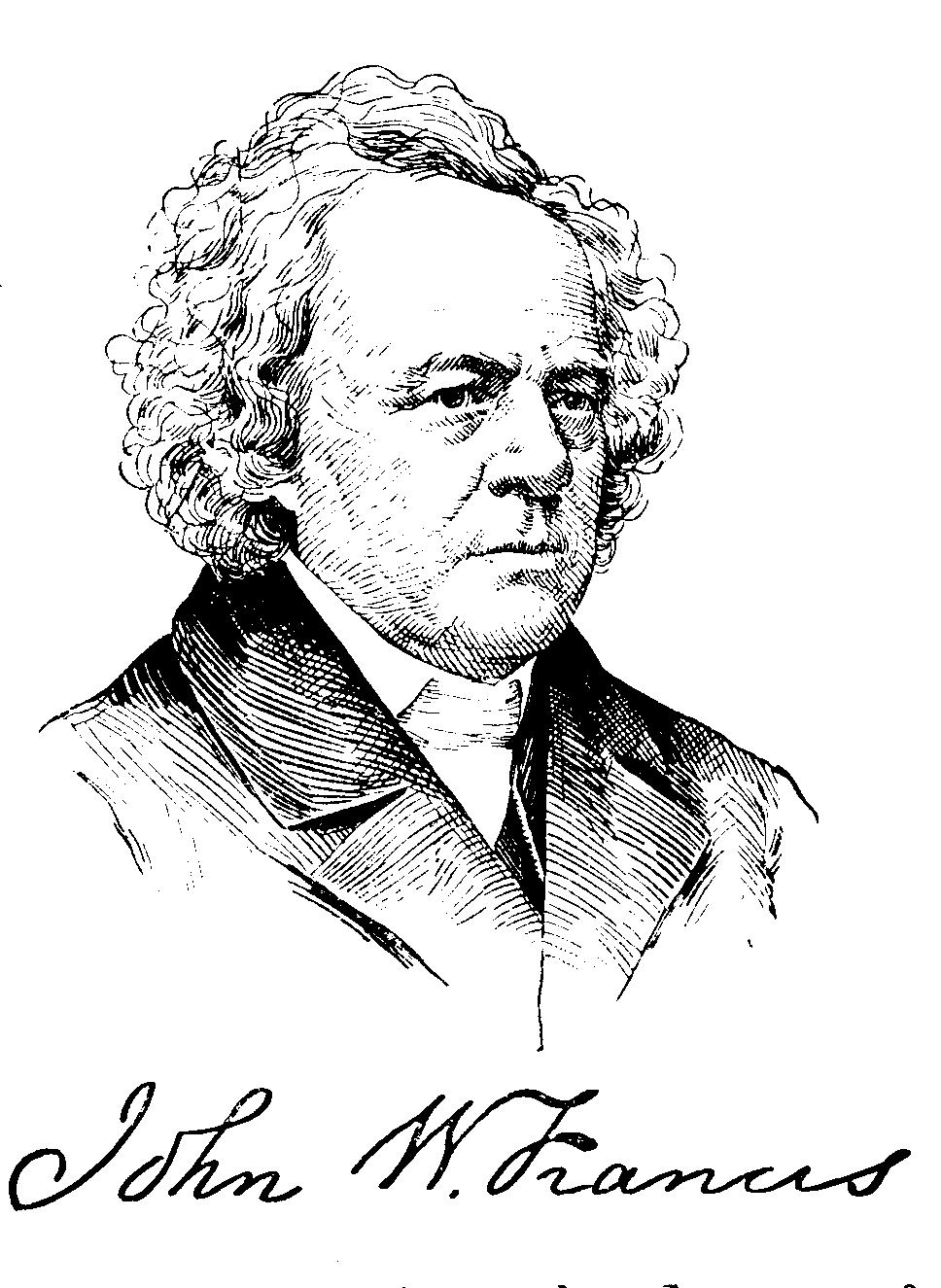
FRANCIS, John Wakefiehl, physician, born in New York City, 17 November 1789; died there, 8 February 1861 his father was a German, who emigrated to this country soon after the close of the Revolutionary war. The son was apprenticed to a printer, but subsequently entered Columbia in advance in 1807, and was graduated in 1809. He soon afterward began the study of medicine in the office of Dr. Hosack, whose partner he was till 1820. He was graduated in medicine in 1811, at the College of physicians and surgeons. In 1810 he became associated with Dr. Hosack in editing the "American Medical and Philosophical Register," a quarterly which was continued for four years.
In 1813 he was appointed lecturer in the institutes of medicine and materia medica at the College of physicians and surgeons, and soon afterward, when the medical faculty of Columbia was consolidated with that institution, he was appointed professor of materia medica in the united body. After delivering one course of lectures he sailed for Europe in 1816, and while there studied under Abernethy, and formed the acquaintance of the most eminent physicians and literary men of the time. On his return he reentered on his duties as professor, first of the institutes of medicine, afterward of medical jurisprudence, in 1817, and then of obstetrics from 1819 to 1826. In the latter year the whole faculty resigned, and the majority of them formed the Rutgers medical school, with Dr. Francis as professor of obstetrics and forensic medicine for four years, when the school was closed by the legislature. He afterward devoted himself to the practice of his profession and to literature. He actively promoted the interests of the New York historical society, the New York lyceum of natural history, the Woman's hospital, the State inebriate asylum, and the Typographical society, of which he was a member till his death. His taste in art was fine and his judgment correct, and young painters and sculptors always found in him a friend. He was one first president of the New York academy of medicine after its organization in 1847, and was elected an associate of numerous medical and scientific associations abroad as well as in the United States. He was a fine conversationalist and was a social favorite. In 1822'4 he was one of the editors of the "Medical and Physical Journal." Trinity College gave him the degree of LL. D. in 1850.
Dr. Francis was intimately acquainted with the history and antiquities of New York, and was looked upon as an oracle in matters relating to his native City. He was the author of biographical sketches of many of the distinguished men of his time, and of articles in medical periodicals. His published works are " Use of Mercury" (New York, 1811); "Cases of Morbid Anatomy" (1814); "Febrile Contagion" (1816); "Notice of Thomas Eddy "(1823), "Denman's Practice of Midwifery," with notes (1825); "Letter on Cholera Asphyxia of 1832 "(1832); "Observations on the Mineral Waters of Avon" (1834); "The Anatomy of Drunkenness ";" Old New York, or Reminiscences of the past Sixty Years" (1857; enlarged ed., 1858 ; reprint, with a memoir by H. T. Tuckerman, 1865); and numerous addresses.
His son, Valentine Mott Francis, physician, born in New York City, 25 April 1834, was graduated in medicine at the University of New York in 1859. After practicing in New York for several years he removed to Newport, Rhode Island. He was correspondent of an American newspaper while traveling on the continent of Europe in 1869'70, and is the author of " Hospital Hygiene" (New York, 1859), and "Fight for the Union," a poem (1863)
Another son, Samuel Ward Francis, physician, born in New York City, 26 December 1835; died in Newport, R. I., 25 March 1886, was graduated at Columbia in 1857, and at the medical department of the University of New York in 1860. He began practice in New York City, but subsequently removed to Newport, Rhode Island. He was physician in the New York dispensary in 1860'2, and at other times Dr. Francis patented twelve surgical inventions, and published "Mott's Clinics" (New York, 1860); a medical essay on " Water" (1861); "lnside and Out" (1863); " Biographical Sketches of Living New York Surgeons" (1866); "Biographical Sketches of Living New York Physicians" (1867); "Life and Death" (1870); and "Curious Facts Concerning Man and Nature" (1874'5).
Unauthorized Site:
This site and its contents are not affiliated, connected,
associated with or authorized by the individual, family,
friends, or trademarked entities utilizing any part or
the subject's entire name. Any official or affiliated
sites that are related to this subject will be hyper
linked below upon submission
and Evisum, Inc. review.
Please join us in our mission to incorporate The Congressional Evolution of the United States of America discovery-based curriculum into the classroom of every primary and secondary school in the United States of America by July 2, 2026, the nation’s 250th birthday. , the United States of America: We The
People. Click Here