Appleton's Cyclopedia of American Biography, edited by James
Grant Wilson, John Fiske and Stanley L. Klos. Six volumes, New York: D. Appleton
and Company, 1887-1889 and 1999. Virtualology.com warns that these 19th Century
biographies contain errors and bias. We rely on volunteers to edit the historic
biographies on a continual basis. If you would like to edit this biographyplease
submit a rewritten biography in text form.
If acceptable, the new biography will be published above the 19th Century
Appleton's Cyclopedia Biography citing the volunteer editor
Virtual American Biographies
Over 30,000 personalities
with thousands of 19th Century illustrations, signatures, and exceptional life
stories. Virtualology.com
welcomes editing and additions to the
biographies. To become this site's editor or a contributor
Click Here
or e-mail Virtualology here.
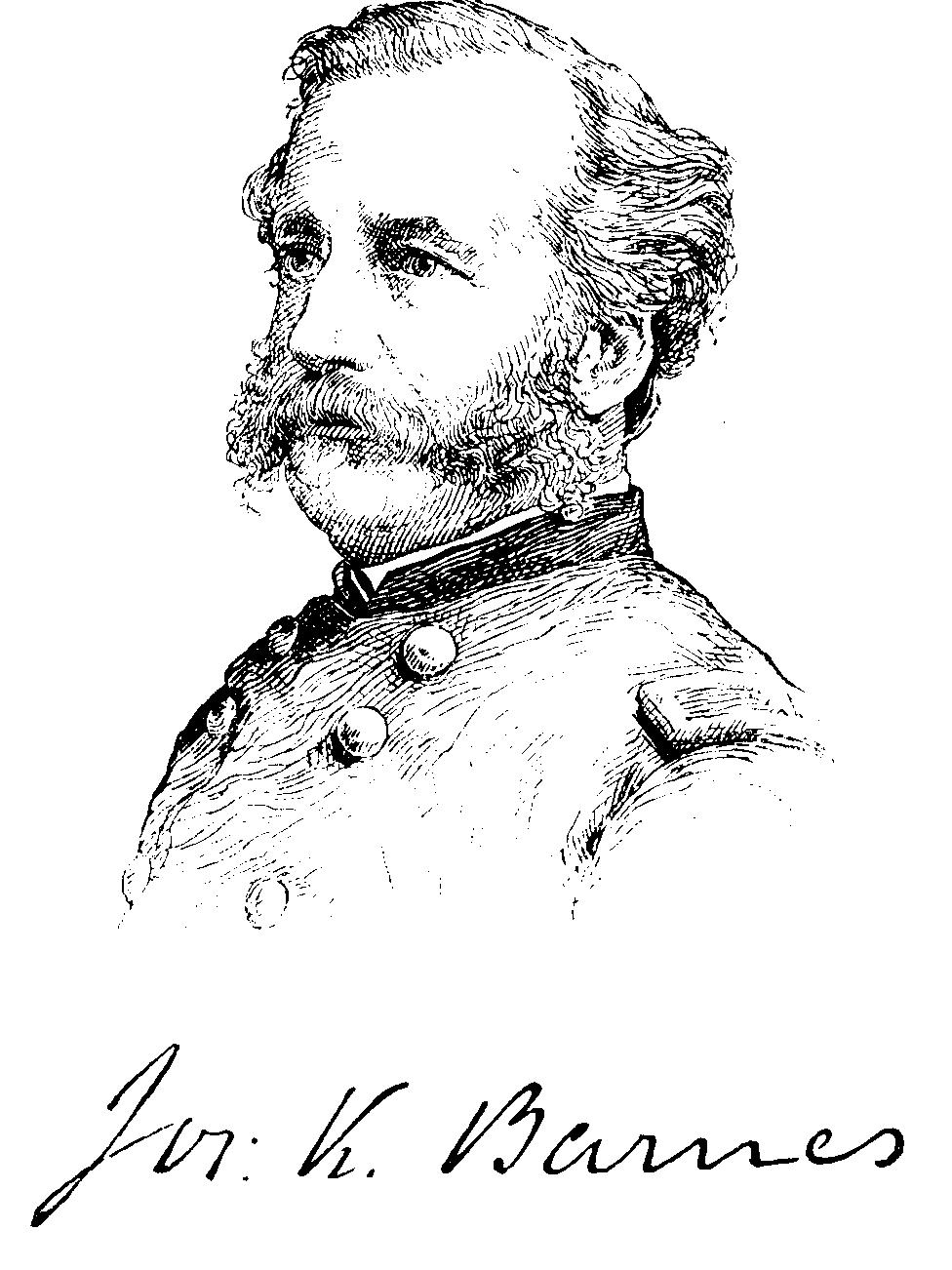
BARNES, Joseph K., surgeon-general United States A., born in Philadelphia, 21 July 1817; died in Washington, District of Columbia, 5 April 1883. After preliminary schooling at Dr. Cogswell's "Round Hill" school at Northampton, Massachusetts, he entered the academic department at Harvard, but was obliged, on account of his health, to leave College. He began his medical studies under Surgeon-General Harris, United States N., and was graduated in the medical department of the University of Pennsylvania in 1838, practicing for two years in his native city. In 1840 he was appointed an assistant surgeon in the army, and assigned to duty at West Point. At the close of the year he was transferred to Florida, where for two years he was with General Harnes expedition against the Seminoles. Thence, in 1842, he went to Fort Jessup, La., where he served four years. When the Mexican war began, Surgeon Barnes was appointed chief medical officer of the cavalry brigade, and he was in active service throughout the war. He was assigned to duty again at West Point in 1854, and remained there for several years. At the beginning of the civil war he was in Oregon, and was among the first summoned to Washington. In 1861 he was assigned to duty in the office of the surgeon-general, where his experience in field and hospital service was of great value. Two years later he was appointed to a medical inspectorship, with the rank of colonel, and ill September 1863, he was pro-meted at the request of the secretary of war to fill a vacancy in the surgeon-general's department, with the rank of Brigadier-General. In 1865 he was brevetted Major-General. For the position of chief medical officer of the army he had been fitted by twenty years of experience under all the conditions afforded by our military service. Under his care the medical department, then organized on a gigantic scale, attained an admirable degree of efficiency and discipline. It was at his suggestion and through his influence that the army medical museum and the library of the surgeon-general's office were established, and the medical and surgical history of the war was compiled. He was present at the death-bed of Lincoln, attended Secretary Seward when he was wounded by the knife of a confederate assassin, and attended Mr. Garfield through his long confinement. He was a trustee of Peabody educational fund, a commissioner for the Soldiers' Home, and the custodian of other important public trusts. The royal medical societies of London and Paris and Moscow made him an honorary member, as did also many of the other important European schools. He was buried at Oak-Hill cemetery, Georgetown, District of Columbia, with the military honors befitting his rank. He was placed on the retired list the year before his death.
Unauthorized Site:
This site and its contents are not affiliated, connected,
associated with or authorized by the individual, family,
friends, or trademarked entities utilizing any part or
the subject's entire name. Any official or affiliated
sites that are related to this subject will be hyper
linked below upon submission
and Evisum, Inc. review.
Please join us in our mission to incorporate The Congressional Evolution of the United States of America discovery-based curriculum into the classroom of every primary and secondary school in the United States of America by July 2, 2026, the nation’s 250th birthday. , the United States of America: We The
People. Click Here