Appleton's Cyclopedia of American Biography, edited by James
Grant Wilson, John Fiske and Stanley L. Klos. Six volumes, New York: D. Appleton
and Company, 1887-1889 and 1999. Virtualology.com warns that these 19th Century
biographies contain errors and bias. We rely on volunteers to edit the historic
biographies on a continual basis. If you would like to edit this biographyplease
submit a rewritten biography in text form.
If acceptable, the new biography will be published above the 19th Century
Appleton's Cyclopedia Biography citing the volunteer editor
Virtual American Biographies
Over 30,000 personalities
with thousands of 19th Century illustrations, signatures, and exceptional life
stories. Virtualology.com
welcomes editing and additions to the
biographies. To become this site's editor or a contributor
Click Here
or e-mail Virtualology here.
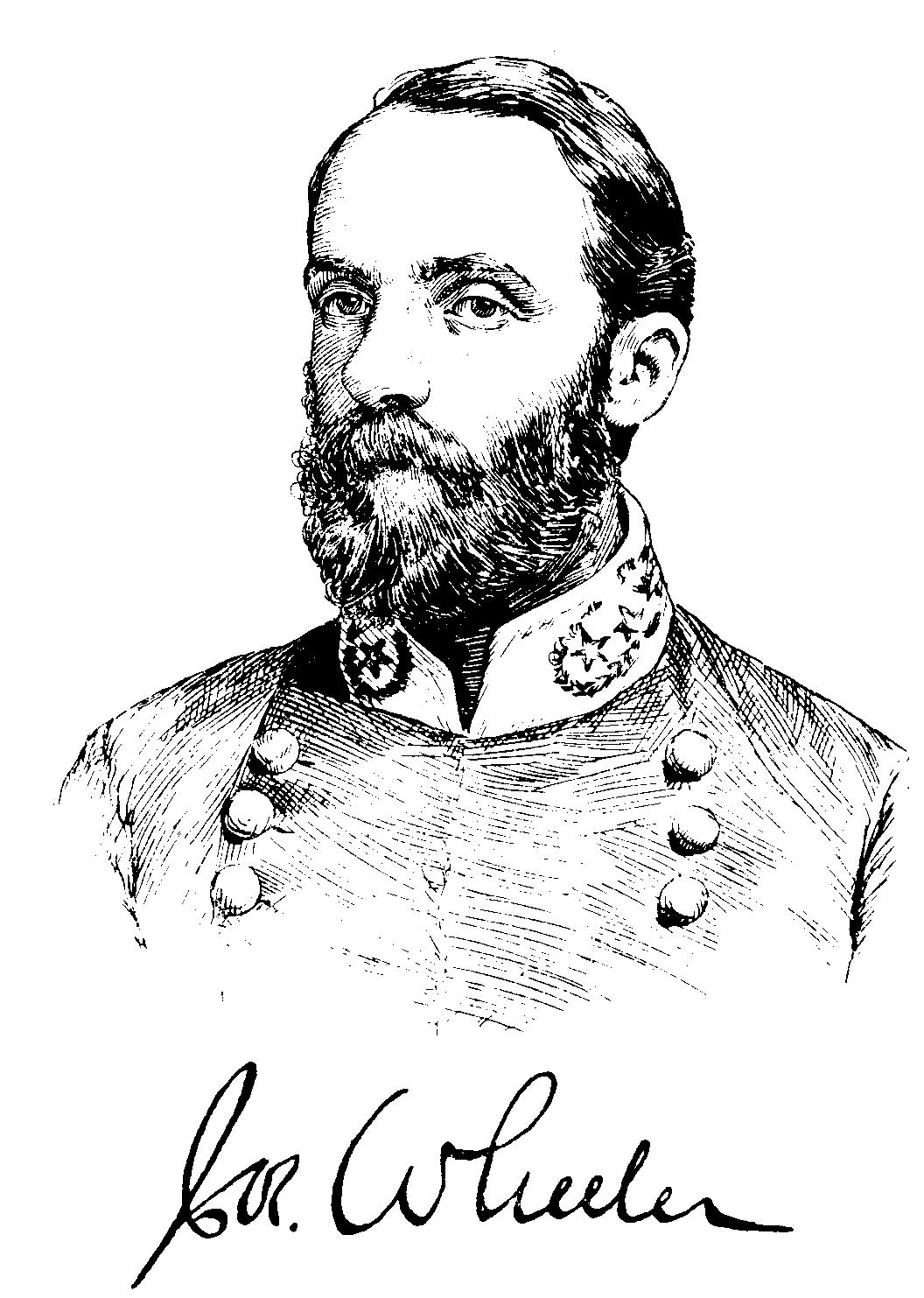
WHEELER, Joseph, soldier, born in Augusta, Georgia, 10 September, 1836. He was graduated at the United States military academy in 1859, and assigned to the dragoons. After a year's service at the cavalry school for practice at Carlisle, Pennsylvania, he received the full rank of 2d lieutenant, but on 22 April, 1861, resigned and entered the Confederate army. He was made colonel of the 19th Alabama September, 1861, and served principally in the west. At Shiloh he commanded a brigade and covered the Confederate retreat from the field. In July, 1862, he was transferred to a cavalry command, and engaged in raiding western Tennessee. During the Kentucky campaign of that year he had charge of General Braxton Bragg's cavalry, and fought at Green River and Perryville. He commanded the rear-guard of the Confederate army when it retreated into Tennessee, and on 30 October, 1862, was promoted brigadier-general. At Murfreesboro he was in charge of the cavalry, and thereafter he was continuously active in contesting General William S. Rosecrans's advance, also attacking his flanks, raiding in the rear, and destroying his trains. On 19 January, 1863, he received his commission as major-general, and opposed the National advance on Chattanooga. He commanded the cavalry at Chickamauga, and after the battle crossed Tennessee river and fell upon Rosecrans's line of communications, defeating the force that was sent against him and destroying over 1,200 wagons, with stores. On this raid he succeeded in damaging National property to the value of $3,000,000, but, after losing 600 men, was driven back to northern Alabama. Subsequently he took part in the siege of Knoxville and covered Bragg's retreat from Mission ridge and Lookout mountain. During the winter and spring he continually harassed the National troops, and, on the advance of General William T. Sherman's army toward Atlanta, he opposed every movement and fought almost daily, often with his men dismounted. During July 27-30 he fought the raiding force of General George Stoneman, General Kenner Garrard, and General Edward M. McCook, and captured many prisoners, including General Stone-man, and all the artillery and transportation. On 9 August, 1864, he was sent by General John B. Hood to capture the National supplies, burn bridges, and break up railways in the rear of General Sherman's army. Passing through northern Georgia, he went into eastern Tennessee as far as the Kentucky line, and thence through middle Tennessee back into northern Alabama. During this raid, which lasted one month, he was continuously engaged and ruined much property. He was unsuccessful in destroying Sherman's communications, and was finally driven back by the National cavalry. When the Confederate commander became convinced of the impossibility of arresting Sherman's advance, Wheeler was sent in front of the army to prevent the National troops from raiding and foraging. He then engaged in the defence of Savannah, and for his defence of Aiken received the thanks of the legislature of South Carolina. General Wheeler received his promotion to the rank of lieutenant-general on 28 February, 1865, and continued in charge of the cavalry under General Joseph E. Johnston until the surrender in April, 1865. The death of General James E. B. Stuart, on 11 May, 1864, made him senior cavalry general of the Confederate armies. After the war, he studied law, which profession and the occupation of cotton-planting he followed until 1880, when he was elected to congress as a Democrat, and took his seat on 5 December, 1881; but his place was successfully contested by William M. Lowe, and he was unseated, 3 June, 1882. He was re-elected to the same congress on the death of Mr. Lowe, a few months later, and has served since 4 March, 1885. In January, 1888, he was appointed a regent of the Smithsonian institution.
Unauthorized Site:
This site and its contents are not affiliated, connected,
associated with or authorized by the individual, family,
friends, or trademarked entities utilizing any part or
the subject's entire name. Any official or affiliated
sites that are related to this subject will be hyper
linked below upon submission
and Evisum, Inc. review.
Please join us in our mission to incorporate The Congressional Evolution of the United States of America discovery-based curriculum into the classroom of every primary and secondary school in the United States of America by July 2, 2026, the nation’s 250th birthday. , the United States of America: We The
People. Click Here