Appleton's Cyclopedia of American Biography, edited by James
Grant Wilson, John Fiske and Stanley L. Klos. Six volumes, New York: D. Appleton
and Company, 1887-1889 and 1999. Virtualology.com warns that these 19th Century
biographies contain errors and bias. We rely on volunteers to edit the historic
biographies on a continual basis. If you would like to edit this biographyplease
submit a rewritten biography in text form.
If acceptable, the new biography will be published above the 19th Century
Appleton's Cyclopedia Biography citing the volunteer editor
Virtual American Biographies
Over 30,000 personalities
with thousands of 19th Century illustrations, signatures, and exceptional life
stories. Virtualology.com
welcomes editing and additions to the
biographies. To become this site's editor or a contributor
Click Here
or e-mail Virtualology here.
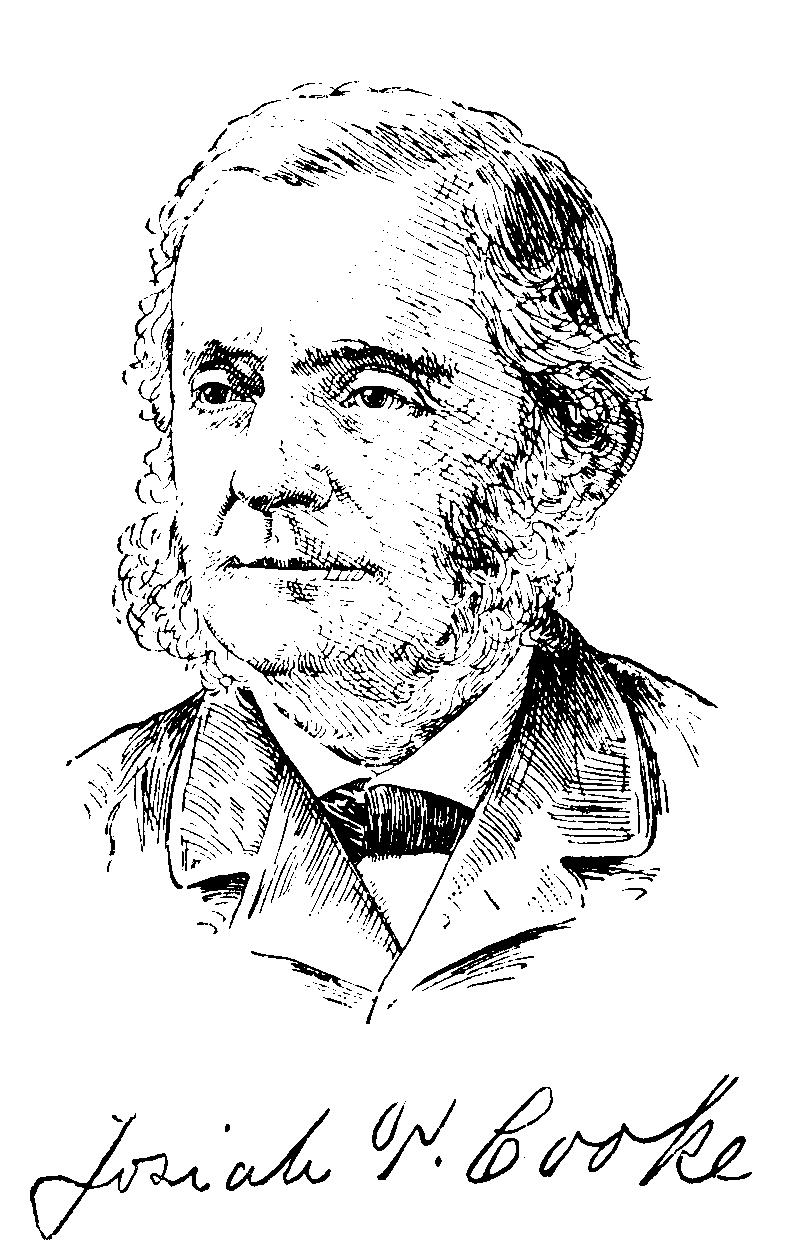
COOKE, Josiah Parsons, chemist, born in Boston, Massachusetts, 12 October, 1827. He received his early education at the Boston Latin-school, and was graduated at Harvard in 1848. During the following year he became tutor in mathematics, subsequently instructor in chemistry, and in 1850 Erving professor of chemistry and mineralogy. Under his direction the course in chemistry has been developed from a very small beginning until facilities are afforded for study and investigation not excelled elsewhere. Prof. Cooke was the first to introduce laboratory instruction into the undergraduate course of an American College; and has successfully labored to render the inductive methods of experimental science a legitimate means of liberal culture not only in the College but also in the preparatory school. Prof. Cooke's work has been largely that of instructing, and, in addition to his duties at Harvard, he has given courses of popular lectures in Baltimore, Brooklyn, Lowell, Washington, and Worcester, besides five courses at the Lowell institute in Boston. As director of the chemical laboratory of Harvard College, he has published numerous contributions to chemical science, most of which have been collected in a volume entitled "Chemical and Physical Researches" (1881), which includes much of his scientitle work. The investigation on the atomic weight of antimony (1880) was one of the most brilliant and perfect pieces of chemical work ever executed in this country. It received the commendation of chemists both in the United States and Europe, and its results have been accepted. His numerous mineral analyses, with descriptions of new species, have appeared in the "American Journal of Sciences" and in the "Proceedings of the American Academy of Sciences and Arts," with both of which journals he has been editorially connected. His "New Chemistry" was the earliest exposition of a consistent system of chemistry based on the principles of molecular mechanics. Its philosophy has been widely accepted both in England and in Germany, and the book has been translated into most of the languages of Europe. Prof. Cooke is a member of many scientific societies. In 1872 he was elected to the National academy of sciences, and he is also an honorary fellow of the London chemical society, a distinction which, in this country, is shared with but one other. In 1882 he received the degree of LL.D. from the University of Cambridge, England. His published works are of two kinds. The scientific includes "Chemical Problems and Reactions" (Cambridge, 1857);" Elements of Chemical Physics" (Boston, 1860); "First Principles of Chemical Philosophy" (1868 ; revised ed., 1882); and The New Chemistry" (New York, 1872; revised ed., 1884); "Fundamental Principles of Chemistry" (Cambridge, 1886). The literary comprise "Religion and Chemistry" (New York, 1864) and "Scientitle Culture and other Essays " (New York, 1881 ; with additions, 1885).
Unauthorized Site:
This site and its contents are not affiliated, connected,
associated with or authorized by the individual, family,
friends, or trademarked entities utilizing any part or
the subject's entire name. Any official or affiliated
sites that are related to this subject will be hyper
linked below upon submission
and Evisum, Inc. review.
Please join us in our mission to incorporate The Congressional Evolution of the United States of America discovery-based curriculum into the classroom of every primary and secondary school in the United States of America by July 2, 2026, the nation’s 250th birthday. , the United States of America: We The
People. Click Here