Appleton's Cyclopedia of American Biography, edited by James
Grant Wilson, John Fiske and Stanley L. Klos. Six volumes, New York: D. Appleton
and Company, 1887-1889 and 1999. Virtualology.com warns that these 19th Century
biographies contain errors and bias. We rely on volunteers to edit the historic
biographies on a continual basis. If you would like to edit this biographyplease
submit a rewritten biography in text form.
If acceptable, the new biography will be published above the 19th Century
Appleton's Cyclopedia Biography citing the volunteer editor
Virtual American Biographies
Over 30,000 personalities
with thousands of 19th Century illustrations, signatures, and exceptional life
stories. Virtualology.com
welcomes editing and additions to the
biographies. To become this site's editor or a contributor
Click Here
or e-mail Virtualology here.
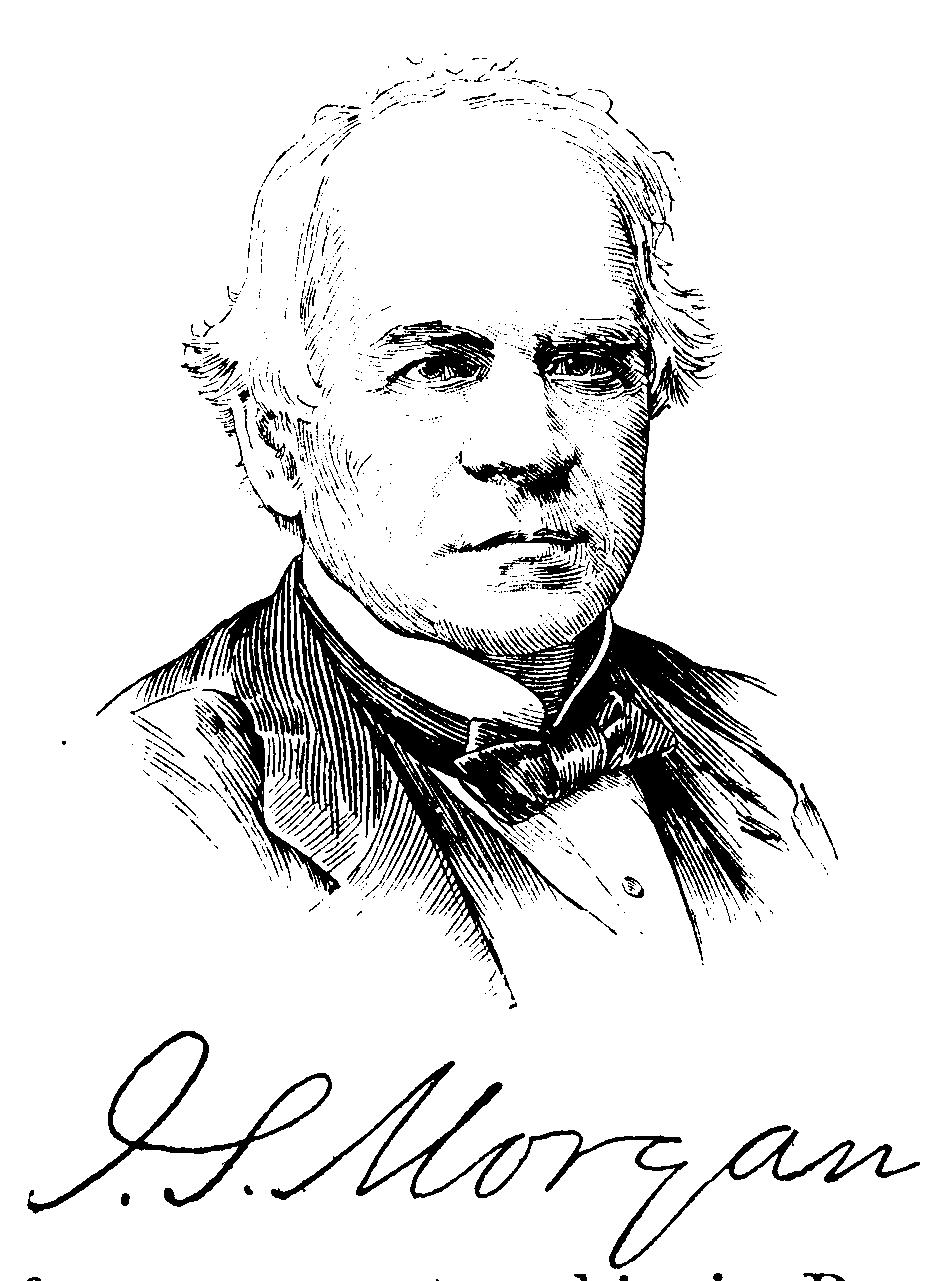
MORGAN, Junius Spencer, banker, born in West Springfield (now Holyoke), Massachusetts, 14 April, 1813. He began his business career in 1829 by entering the employ of Alfred Welles, of Boston, with whom he continued until he became of age.--In July, 1834, he joined the banking-house of Morgan, Ketchum and Co., of New York, but he returned to Hartford about eighteen months later. He then became junior partner in the drygoods house of Howe, Mather and Co., which in 1850 became Mather, Morgan and Co. A year later he was invited by James M. Beebe to form a co-partnership in Boston, which, under the style of J. 3I. Beebe, Morgan and Co., became one of the largest dry-goods establishments in the United States. Mr. Morgan visited England in 1853, and was offered a partnership in the firm of George Peabody and Co., which he accepted on 1 October, 1854, and ten years later, on the retirement of Mr. Peabody, the firm became J. S. Morgan and Co. Under this name the house has grown in strength and influence until at present it ranks among the great banking-houses of the world. During his residence in Hartford, Mr. Morgan was active in the affairs of the Protestant Episcopal church, and also in various charitable enterprises. He has been a liberal donor to Trinity college, and in 1886 presented to the Hartford orphan asylum a generous contribution, known as the Sarah Morgan fund, in memory of his mother, Mrs. Sarah Spencer Morgan. In 1887 he gave a large and valuable painting, by Sir Joshua Reynolds, which he had purchased for that purpose, to the Metropolitan museum of art in New York city. He married in 1836 Juliet, daughter of John Pierpont, the poet (q. v.).--His son, John Pierpont, banker, born in Hartford, Connecticut, 17 April, 1837, was educated at the English high-school in Boston, and then studied at the University of Gottingen, Germany. He returned to the United States in 1857, and entered the banking-firm of Duncan, Sherman and Co., of New York. In 1.860 he became agent and attorney in the United States for George Peabody and Co., of London, which relation he has since held with that firm and its successor. He became the junior partner of the banking-firm of Dabney, Morgan and Co. in 1864, and that of Drexel, Morgan and Co. in 1871. This house is among the chief negotiators of railroad bonds, and was active in the reorganization of the West Shore railroad and its absorption by the New York Central railroad. In 1887 it was conspicuous in the reorganization of the Philadelphia and Reading railroad, which a syndicate Of capitalists formed by Mr. Morgan placed on a sound basis.
Unauthorized Site:
This site and its contents are not affiliated, connected,
associated with or authorized by the individual, family,
friends, or trademarked entities utilizing any part or
the subject's entire name. Any official or affiliated
sites that are related to this subject will be hyper
linked below upon submission
and Evisum, Inc. review.
Please join us in our mission to incorporate The Congressional Evolution of the United States of America discovery-based curriculum into the classroom of every primary and secondary school in the United States of America by July 2, 2026, the nation’s 250th birthday. , the United States of America: We The
People. Click Here