Casimer Pulaski - A Klos Family Project - Revolutionary War General
Click on an image to view full-sized
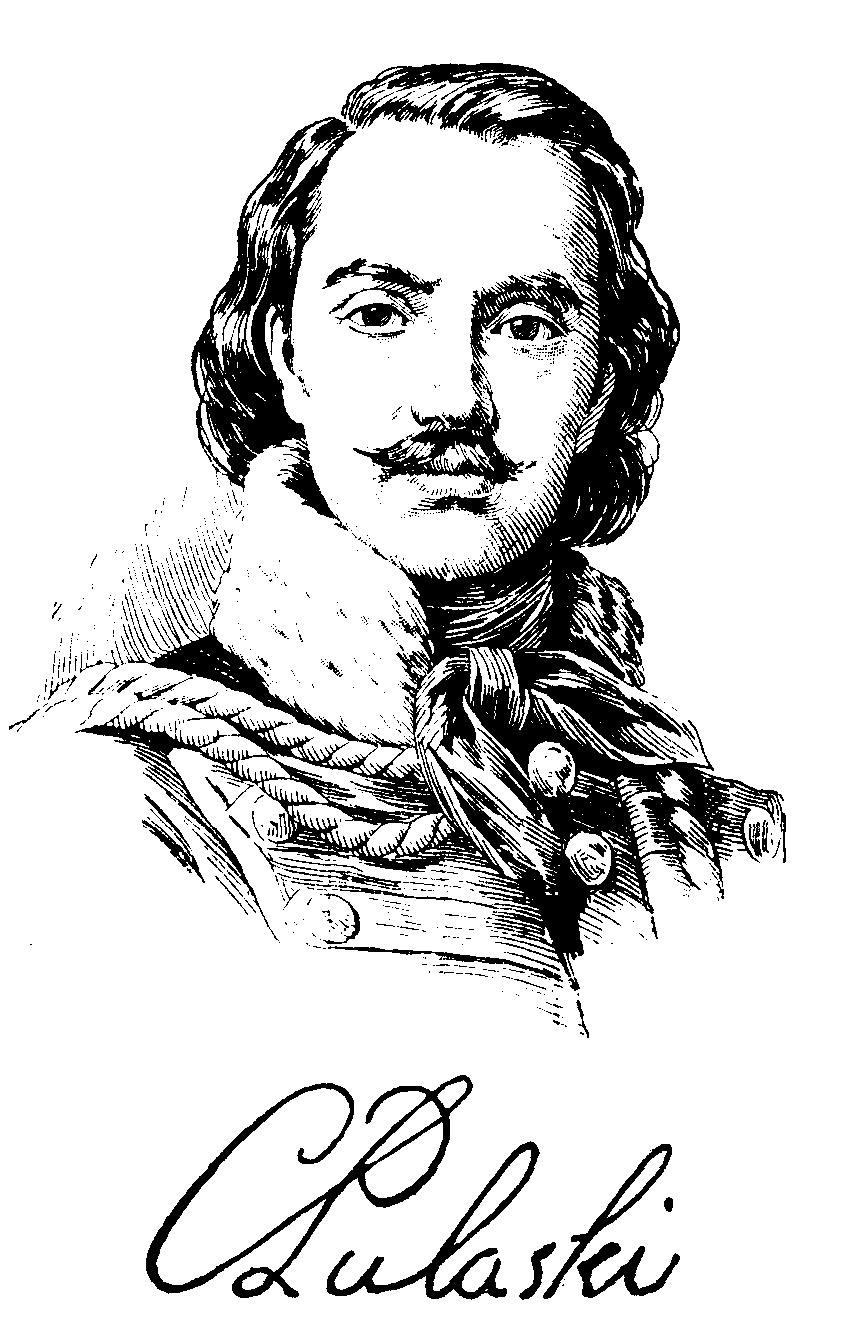
Kazimierz Pulaski
PULASKI, Kazimierz (or Casimir),
Polish soldier, born in Podolia, 4 March, 1748; died near Savannah, Georgia, 11
October, 1779. He was the eldest son of Joseph Pulaski, founder of the
confederation of Barr. He received a thorough education and served in the guard
of Duke Charles, of, Courland. In 1767 he returned to Poland and joined his
father as one of the eight original associates of the confederation of Barr, 29
February, 1768. He continued to carry on a partisan warfare after the arrest and
death of his father. He raised a revolt in Lithuania in 1769, and, although he
was driven into the fortified monastery of Czenstochova, he finally compelled
the besieging Russian army to withdraw. He helped to drive the Russians across
the Vistula, but opposed the plans of the French commissioner, Francois
Dumouriez, and refused to join the main army, thus causing the loss of the
battle of Landskron in 1770.
He was then elected commander-in-chief, but was defeated, and returned to
Czenstochova. He has been accused of planning the abduction of King Stanislas
Poniatowski from Warsaw, but modern historians have cleared him of all
participation in it. The plot had for its result the intervention of Prussia and
Austria, and led ultimately to the partition of Poland in 1773. Pulaski's
estates were confiscated, he was outlawed, and a price was set on his head. He
escaped to Turkey, but, failing to obtain succor from the sultan, went to Paris
toward the close of 1775. He had there several interviews with Benjamin
Franklin, and, becoming interested in the American
struggle for independence, came to this country in March, 1777.
He proceeded immediately to Philadelphia, and was attached to the staff of Washington.
The first action in which he took part was at the Brandywine.
When the Continental troops began to yield, he made a reconnaissance with the
general's bodyguard, and reported that the enemy were endeavoring to cut off the
line of retreat. He was authorized to collect as many of the scattered troops as
came in his way, and employ them according to his discretion, which he did in a
manner so prompt as to effect important aid in the retreat of the army Four days
later, on recommendation of Washington, he
was commissioned brigadier-general, and placed in charge of the cavalry. He
saved the army from a surprise at Warren tavern, near Philadelphia, took part in
the battle of Germantown, and in the winter
of 1777-'8 engaged in the operations of General Anthony
Wayne, contributing to the defeat of a British division at Haddonfield, New
Jersey.
The cavalry officers could not be reconciled to the orders of a foreigner who
could scarcely speak English and whose ideas of discipline and tactics differed
widely from those to which they had been accustomed, and these circumstances
induced Pulaski to resign his command in March, 1778, and return to Valley
Forge, where he was assigned to special duty. At his suggestion, which was
adopted by Washington, congress authorized
the formation of a corps of lancers and light infantry, in which even deserters
and prisoners of war might enlist. This corps, which became famous under the
name of Pulaski's legion, was recruited mainly in Baltimore.
In September it numbered about 350 men, divided into three companies of
cavalry and three of infantry. The poet Longfellow
has commemorated in verse this episode of Pulaski's life. In the autumn he was
ordered to Little Egg Harbor with his legion, a company of artillery, and a
party of militia. A German deserter named Gustav Juliet, who held a subordinate
command in the legion and who entertained a grudge against Colonel de Bosen, the
leader of the infantry, betrayed their whereabouts to the British, who made a
night attack upon De Bosen's camp. Pulaski heard the tumult and, assembling his
cavalry, repelled the enemy, but the legion suffered a loss of forty men. During
the following winter he was stationed at Ninisink, New Jersey He was
dissatisfied with his petty command, and intended to leave the service and
return to Europe, but was dissuaded by General Washington.
He was ordered to South Carolina, and entered Charleston on 8 May, 1779. The
city was invested on the 11th by 900 British from the army of General Prevost.
Pulaski made a furious assault upon them, but was repelled. The governor and the
city council were inclined to surrender, but Pulaski held the city till the
arrival of support on 13 May. Prevost retreated in the night of the same day
across Ashley river, and Pulaski, hovering upon the enemy's flanks, harassed
them till they evacuated South Carolina.
Although he had frequent attacks of malarial fever, he remained in active
service, and toward the beginning of September received orders to join General
John McIntosh at Augusta, and to move with him toward Savannah in advance of the
army of General Benjamin Lincoln. Before the
enemy was aware of his presence he captured an outpost, and, after several
skirmishes, established permanent communications with the French fleet at
Beaufort. He rendered great services during the siege of Savannah, and in the
assault of 9 October commanded the whole cavalry, both French and American.
Toward the close of the action he received a shot in the upper part of his right
thigh, and was taken to the United States brig" Wasp." He died
as the vessel was leaving the river. His body was buried at sea, but his funeral
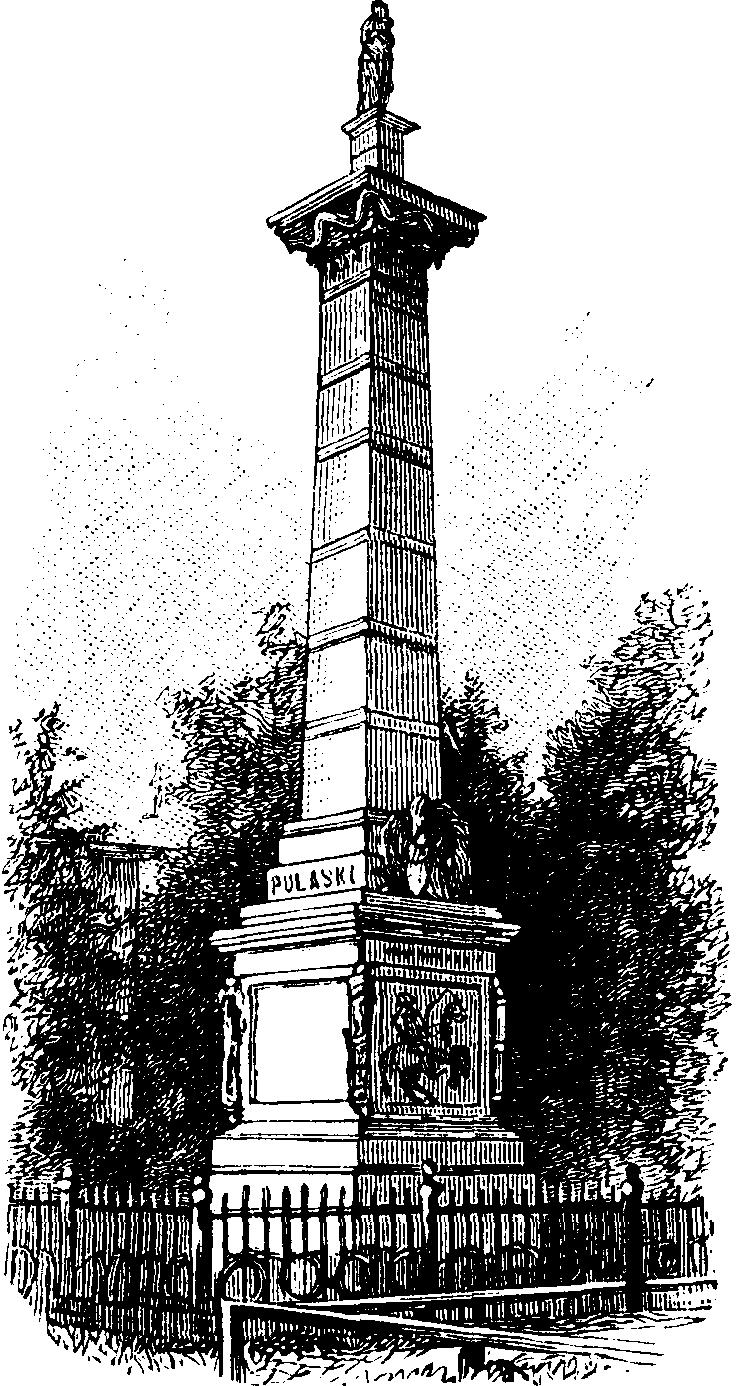
ceremony took place afterward in Charleston. Congress voted a monument to his
memory, which has never been erected, but one was raised by the citizens of
Savannah, of which Lafayette laid the
corner-stone during his visit to the United States in 1824. It was completed on
6 January, 1855, and is represented in the accompanying illustration.
Edited Appletons Encyclopedia, Copyright
© 2001 VirtualologyTM