Appleton's Cyclopedia of American Biography, edited by James
Grant Wilson, John Fiske and Stanley L. Klos. Six volumes, New York: D. Appleton
and Company, 1887-1889 and 1999. Virtualology.com warns that these 19th Century
biographies contain errors and bias. We rely on volunteers to edit the historic
biographies on a continual basis. If you would like to edit this biographyplease
submit a rewritten biography in text form.
If acceptable, the new biography will be published above the 19th Century
Appleton's Cyclopedia Biography citing the volunteer editor
Virtual American Biographies
Over 30,000 personalities
with thousands of 19th Century illustrations, signatures, and exceptional life
stories. Virtualology.com
welcomes editing and additions to the
biographies. To become this site's editor or a contributor
Click Here
or e-mail Virtualology here.
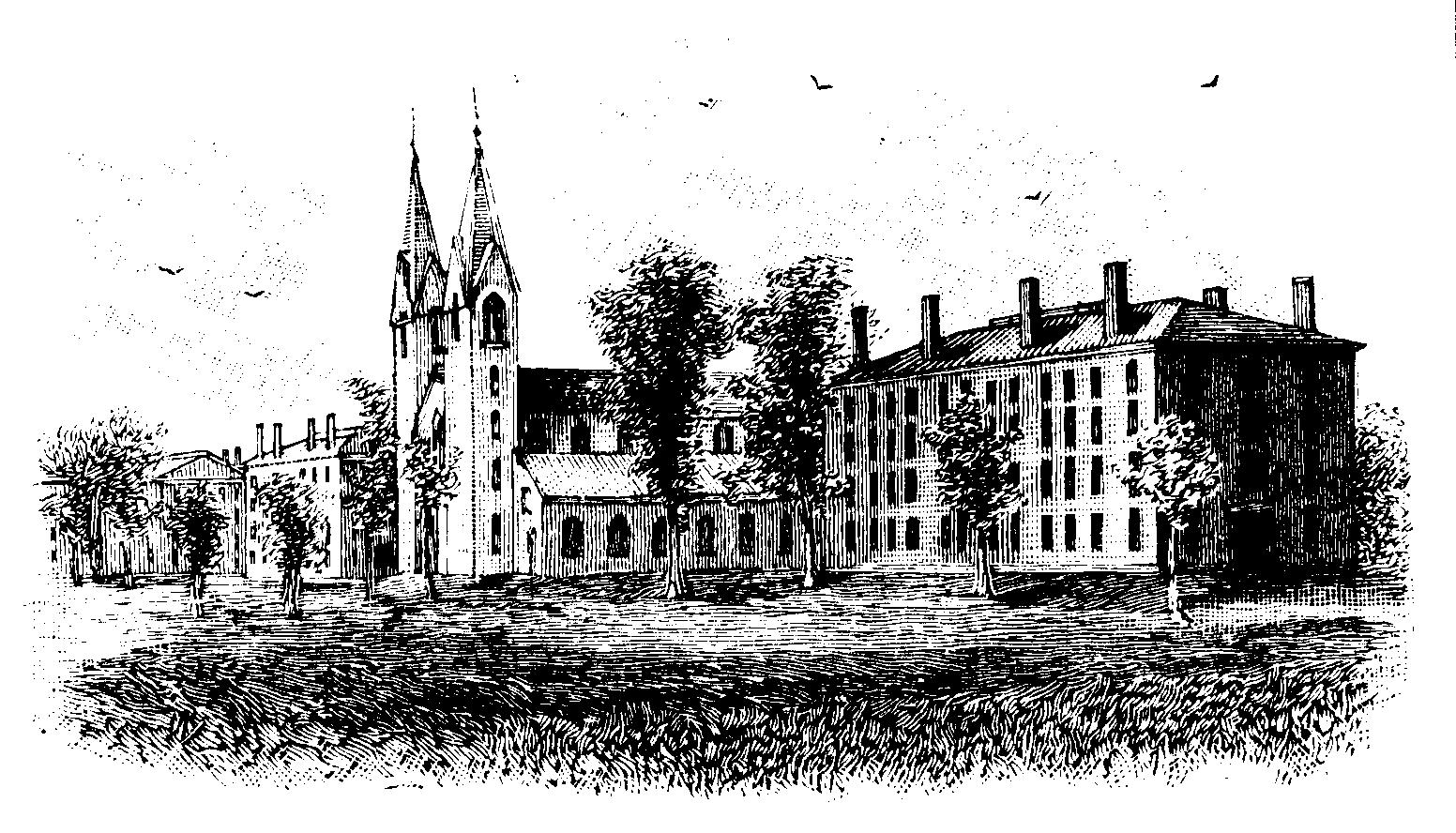
WOODS, Leonard, clergyman, born in Princeton, Massachusetts, 19 June, 1774; died in Andover, Massachusetts, 24 August, 1854. His father, Samuel, possessed "Puritanic piety," and his habits of serious thought on metaphysical subjects obtained for him the title of "Philosopher Woods." The son was brought up strictly, and while very young was conversant with the works of John Locke and Jonathan Edwards. He was graduated at Harvard in 1796, taught, studied theology at Somers, Connecticut, and in 1798 was ordained pastor at Newbury, Massachusetts When the Andover theological seminary was founded in 1808 he became professor of Christian theology there, holding that chair for thirty-eight years, and becoming professor emeritus in 1846. Dartmouth gave him the degree of D. D. in 1810. Dr. Woods was active in the establishment of the American tract society, the Temperance society, and the board of commissioners of foreign missions, of whose prudential committee he was a member for twenty-five years. He ably defended orthodox Calvinism against Unitarian theology, and while he admitted improvements in theologians and theological science, thought theological truths were fixed and unalterable. His literary reputation dates from his contribution in 1805 of a series of papers in the " Panoplist," a religious periodical, in which he defended Calvinism against Joseph Buckminster, William Channing, and other Unitarian divines. Dr. Henry B. Smith says of him : "He is emphatically the' judicious ' divine of the later New England theology. He educated more than 1,000 preachers, who had neither crotchets nor airy aims." He left in manuscript a "History of Andover Seminary." His publications in-chide " Letters to Unitarians" (Andover, 1820) ; "Lectures on the Inspiration of the Scriptures" (1829); " Memoirs of American Missionaries" (1833); " Examination of the Doctrine of Perfection" (1841); "Lectures on Church Government" (New York, 1843);" Lectures on Swedenborgianism" (1846); and his collected works, containing lectures, essays, sermons, and reviews (5 vols., Andover, 1849-'50).--His son, Leonard, scholar, born in Newbury, Massachusetts, 24 November, 1807; died in Boston, Massachusetts, 24 December, 1878, was graduated at Union college in 1827 and at Andover theological seminary in 1830. In 1831-'3 he was resident graduate scholar at Andover, and in 1833 he was licensed to preach. His private pupil, Richard Henry Dana, says of him: " At the age of twenty-four years he had been the first scholar in the Phillips academy, the first in every branch at Union, had been graduated at the Theological seminary the acknowledged foremost man of his period, and had published a translation of Knapp's 'Christian Theology, ' enriched with a long and fully thought-out preface, with original notes showing profound scholarship. He was assisting Professor Stuart in his commentary on the Epistle to the Romans, ' and aiding Professor Robinson in editing the ' Biblical Repository, ' then the most scholastic periodical in America, and was assistant instructor of Hebrew in the seminary." He edited the " Literary and Theological Review" in New York city in 18"34-'7, and although that periodical was the organ of the Presbyterian and Congregational churches, he directly opposed the opinions of many of its supporters, objecting to the proposals of temperance and anti-slavery societies and popular revivalists, and to the German Reformation, and defending the few and simple conditions of admission into the Anglican communion, as compared with the minute requirements of doctrine in his own church. He was professor of sacred literature in Bangor theological seminary in 1836-'9, and from 1839 till 1866 president of Bowdoin. He never accepted a pastoral charge, but occasionally delivered sermons and addresses. He went abroad in 1833, and contracted friendships with eminent theologians in Rome and in Oxford. His familiarity with the classics caused him to be congratulated by Gregory XVI. for his "excellent Latin and the richness of his discourse," and the Oxford theology having won his approval, he was the theological champion and personal friend of Dr. Edward B. Pusey. "He was even more remarkable, perhaps, for his conversations than for his public addresses," says his biographer, Professor Edwards A. Park. Having resigned the presidency of Bowdoin in 1866 (see the accompanying vignette), he accepted from the legislature of Maine a commission to visit Europe to obtain materials for the early history of the state. "He engaged the assistance of Dr. John G. Kohl in the work, which subsequently assumed shape in his "Discovery of Maine" (Portland, Maine, 1868), and procured the Hakluyt manuscript of the "Westerne Planting." Dr. Woods was preparing this document for the press when his health declined, and the papers were completed and published by Charles Deane, in the "Proceedings of the Maine Historical Society" (Portland, 1877). Dr. Woods furnished other valuable matter, which appeared in the 1st and 2d volumes of the publications of that society, and was engaged in further work when his materials were destroyed by a fire that consumed his entire library. Harvard gave him the degree of D. D. in 1846, and Bowdoin that of LL. D. in 1866. Besides the works already referred to, including his translation of George Christian Knapp's "Christian Theology" (2 vols., New York, 1831-'3), Dr. Woods published an "Address on the Life and Character of Parker Cleveland (Portland, Maine, 1859), and "Address on the Opening of the New Medical Hall of the Medical School of Maine" {1862). See a "Memorial " of him. by Edwards A. Park (Andover, 1880), and an article by Richard H. Dana in the "Century Magazine" for June, 1881.--The first Leonard's nephew, Alva, educator, born in Shoreham, Vermont, 13 August, 1794; died in Providence, Rhode Island, in July, 1887, was graduated at Harvard in 1817, and at Andover seminary in 1821. Immediately upon his graduation at the seminary he was elected professor of mathematics and natural philosophy in Columbian college, Washington, D. C. In 1824 he was elected to the same chair in Brown university, where he remained until 1828, when he was made president of Transylvania university. Ky. He continued in this place until 1831, when he became president of the University of Alabama, at Tuscaloosa. Resigning this office in 1837, he removed soon afterward to Providence, Rhode Island, where he spent the remainder of his days. He was a trustee and fellow of Brown, and a trustee of Newton theological institution. He founded five fellowships in the former, and a lectureship on elocution in the latter. He received from Brown, in 1828, the degree of D.D. Dr. Woods published several inaugural and other addresses.
Unauthorized Site:
This site and its contents are not affiliated, connected,
associated with or authorized by the individual, family,
friends, or trademarked entities utilizing any part or
the subject's entire name. Any official or affiliated
sites that are related to this subject will be hyper
linked below upon submission
and Evisum, Inc. review.
Please join us in our mission to incorporate The Congressional Evolution of the United States of America discovery-based curriculum into the classroom of every primary and secondary school in the United States of America by July 2, 2026, the nation’s 250th birthday. , the United States of America: We The
People. Click Here