Appleton's Cyclopedia of American Biography, edited by James
Grant Wilson, John Fiske and Stanley L. Klos. Six volumes, New York: D. Appleton
and Company, 1887-1889 and 1999. Virtualology.com warns that these 19th Century
biographies contain errors and bias. We rely on volunteers to edit the historic
biographies on a continual basis. If you would like to edit this biographyplease
submit a rewritten biography in text form.
If acceptable, the new biography will be published above the 19th Century
Appleton's Cyclopedia Biography citing the volunteer editor
Virtual American Biographies
Over 30,000 personalities
with thousands of 19th Century illustrations, signatures, and exceptional life
stories. Virtualology.com
welcomes editing and additions to the
biographies. To become this site's editor or a contributor
Click Here
or e-mail Virtualology here.
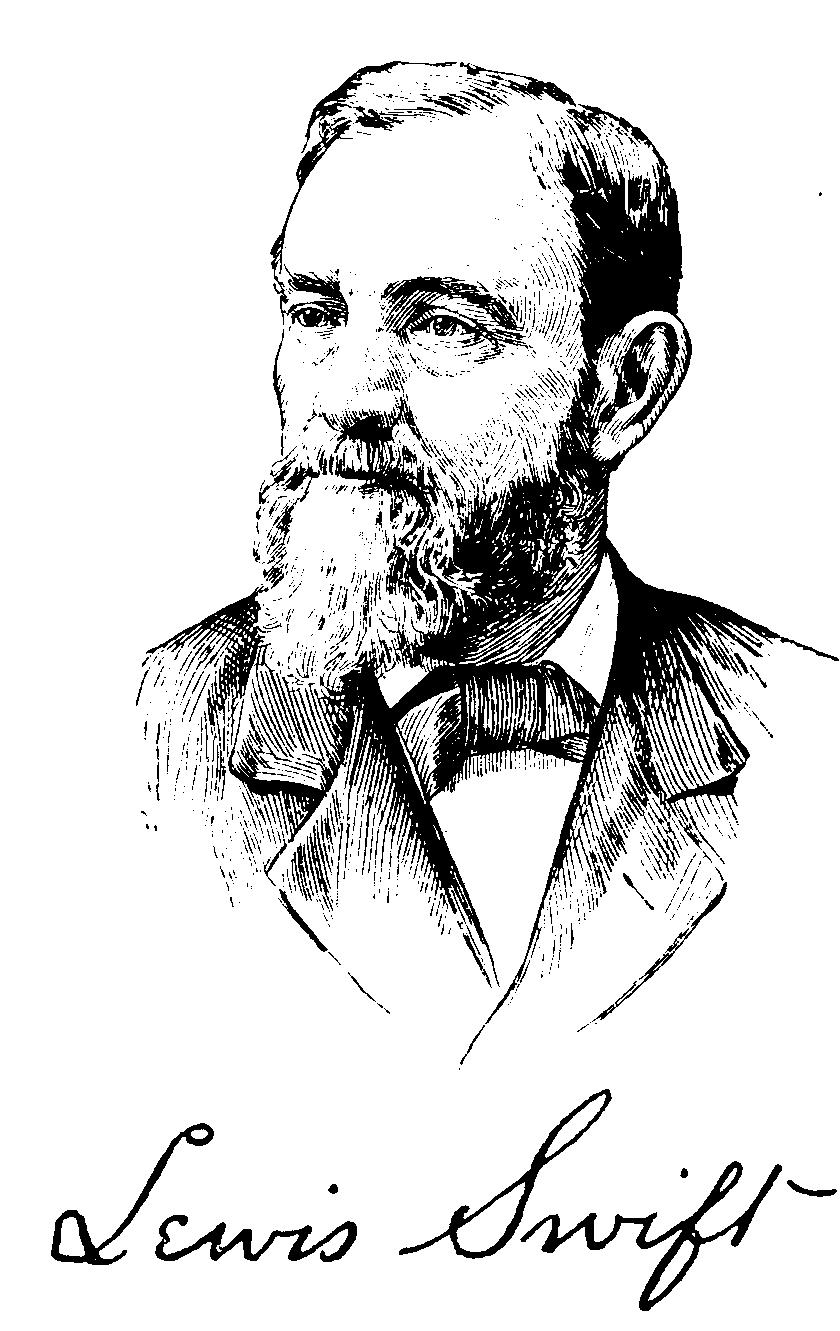
SWIFT, Lewis, astronomer, , . in Clarkson, New York, 29 February, 1820. He was educated at Clarkson academy, where he completed his course in 1838, and then turned his attention to farm work. His father died in 1846, and, thrown upon his own resources, he studied magnetism and electricity, and for four years lectured on these subjects in Canada and the western states. He returned to farming in 1850, but soon began again to lecture on the wonders of the microscopic world, which he illustrated by means of a calcium light. All of his apparatus was constructed by himself and parts of it were of his own invention. In 1854 he established a hardware-store in Cortland county, New York, which in 1872 he moved to Rochester, where he has since resided. Meanwhile, he became interested in astronomy, and, building his own telescope, he began to make observations. His first work was in 1858, on Donati's comet, and his first astronomical paper was on this subject. For years he eagerly scanned the heavens for new comets, and in 1862 the great comet of that year was discovered by him. In 1869 he observed at Mattoon, Illinois, a total solar eclipse, and, making particular study of the protuberances and corona, secured some valuable results. Two years later he found another comet, but it had been seen earlier in Europe. Three times since he has caught brief glimpses of comets that no other observer has ever seen. After his removal to Rochester he discovered comets in 1877-'9, for which he thrice received the comet prize, a gold medal valued at sixty dollars, from the Imperial academy of sciences in Vienna. Hulbert H. Warner of Rochester, knowing under what disadvantages Dr. Swift was laboring in pursuing his astronomical studies, offered to build for his use an observatory, provided the people of the city would raise a sum sufficient to get him a refractor of sixteen-inch aperture. Nearly $12,000 were contributed, and the telescope is doing service in the great dome of the observatory, which, together with the attached residence for the family of the director, cost, exclusive of the instrument, nearly $100,000. In 1880 Dr. Swift found a comet with a period of five and a half years, and in 1881 he discovered two others For the former he received a special prize of $500 from Mr. Warner, which is the largest sum ever awarded for the discovery of any heavenly body, and for the latter in 1882 he received the Lalande prize of 540 francs from the French academy of sciences. Besides the foregoing, he independently discovered Winnecke's comet in 1871, Coggia's in 1874, and the Brooks-Swift comet in 1883, there being in the latter case a difference of fifteen minutes in favor of William R. Brooks. In 1878 he observed the total eclipse of the sun at Denver, Colorado, and he saw at that time what he thinks were two intra-mercurial planets His report of this discovery excited great interest and much controversy on both continents. Since he assumed in 1882 the directorship of the War-net observatory, he has found about 700 new nebulae, which entitles him to third place as discoverer of these bodies, the two Herschels alone exceeding him. The degree of Ph.D. was conferred on him by the University of Rochester in 1879. He has invented a horse hay-rake (1842) ; an oxyhydrogen microscope (1858); an improvement in the construction of domes (1881); and an automatic right-ascension circle (1887). Dr. Swift; has been elected a fellow of the Royal astronomical society of Great Britain, and he is a member of various societies in this country. His writings have been confined to cyclopaedia articles and papers that have appeared in various astronomical journals or as popular articles ill the press.
Unauthorized Site:
This site and its contents are not affiliated, connected,
associated with or authorized by the individual, family,
friends, or trademarked entities utilizing any part or
the subject's entire name. Any official or affiliated
sites that are related to this subject will be hyper
linked below upon submission
and Evisum, Inc. review.
Please join us in our mission to incorporate The Congressional Evolution of the United States of America discovery-based curriculum into the classroom of every primary and secondary school in the United States of America by July 2, 2026, the nation’s 250th birthday. , the United States of America: We The
People. Click Here