Appleton's Cyclopedia of American Biography, edited by James
Grant Wilson, John Fiske and Stanley L. Klos. Six volumes, New York: D. Appleton
and Company, 1887-1889 and 1999. Virtualology.com warns that these 19th Century
biographies contain errors and bias. We rely on volunteers to edit the historic
biographies on a continual basis. If you would like to edit this biographyplease
submit a rewritten biography in text form.
If acceptable, the new biography will be published above the 19th Century
Appleton's Cyclopedia Biography citing the volunteer editor
Virtual American Biographies
Over 30,000 personalities
with thousands of 19th Century illustrations, signatures, and exceptional life
stories. Virtualology.com
welcomes editing and additions to the
biographies. To become this site's editor or a contributor
Click Here
or e-mail Virtualology here.
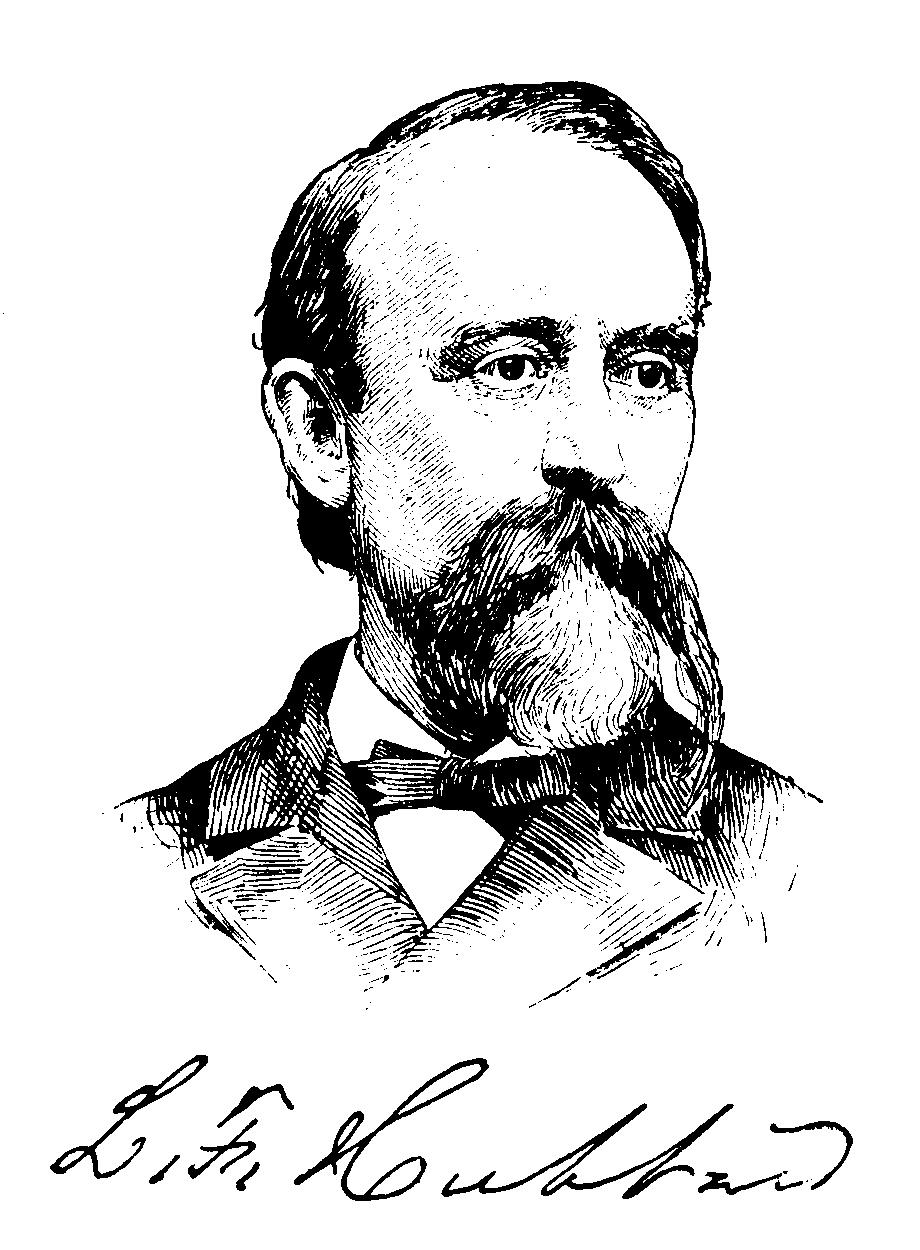
HUBBARD, Lucius Frederick, governor of Minnesota, born in Troy, New York, 26 January, 1836. He was but three years old when he lost his father, Charles F. Hubbard, sheriff of Rensselaer county, and was sent to live with an aunt at Chester, Vermont He was educated in the academy at Granville, New York, and apprenticed to the tinner's trade, at which he worked in Chicago for three years, and in 1857 he removed to Red Wing, Minnesota, where he established the "Republican." He was elected register of deeds in 1858, and in 1861 was a Republican candidate for the state senate, but lacked seven votes of being elected. He enlisted as a private, in the 5th Minnesota infantry in December, l86l, became captain in February, and lieutenant-colonel in March, 1862, and was severely wounded in the first battle of Corinth. He was promoted colonel, 31 August, 1862, commanded his regiment in the battle of Iuka and the 2d brigade of the 1st division, Army of the Mississippi, in the battles of Jackson and Mississippi Springs, and remained in command of the brigade till the spring of 1863, when the 5th Minnesota was transferred to the 15th army corps and took part in the siege of Vicksburg. After the fall of that city he resumed command of his brigade, which in March, 1864, was assigned to the 16th corps under General A. J. Smith, took part in General Banks's Red River expedition, and within a very brief period was in seven battles, the last being that of Greenfield, Louisiana, where the enemy was routed and the Mississippi river relieved from blockade. Afterward he was in several engagements in northern Mississippi, marched across Arkansas and Missouri to the Kansas line to attack Price's force, and then returned to Memphis, where Colonel Hubbard's regiment re-enlisted as veterans and was furloughed. Under his command his brigade, in the battle of Nashville, 16 December, 1864, was in the first line of the assaulting column, and captured seven pieces of artillery, several stand of colors, and many prisoners. But it suffered heavy loss, and Colonel Hubbard was severely wounded. He was brevetted brigadier-general for "conspicuous gallantry" in this battle. In the campaign of Mobile, under General E. R. S. Canby, his brigade was one of the foremost in the siege and capture of Spanish Fort. He was mustered out of the service in October, 1865. In 1866 he engaged in the grain business at Red Wing, and afterward in milling. He projected and secured the construction of the Midland railway from Wabashaw to Zumbrota, and the Cannon Valley railway from Red Wing to Waterville. In 1872 and 1874 he was elected as a Republican to the state senate. He was one of the arbitrators to settle the dispute between the state and the prison contractors, and also one of a commission to investigate the state railroad bonds. In 1881 he was elected governor of Minnesota by a majority of 27,857. He entered upon his office 10 January, 1882, and was re-elected in 1883, serving till January, 1887. In 1886 he contributed a paper on Minnesota to the "North American Review."
Unauthorized Site:
This site and its contents are not affiliated, connected,
associated with or authorized by the individual, family,
friends, or trademarked entities utilizing any part or
the subject's entire name. Any official or affiliated
sites that are related to this subject will be hyper
linked below upon submission
and Evisum, Inc. review.
Please join us in our mission to incorporate The Congressional Evolution of the United States of America discovery-based curriculum into the classroom of every primary and secondary school in the United States of America by July 2, 2026, the nation’s 250th birthday. , the United States of America: We The
People. Click Here