Appleton's Cyclopedia of American Biography, edited by James
Grant Wilson, John Fiske and Stanley L. Klos. Six volumes, New York: D. Appleton
and Company, 1887-1889 and 1999. Virtualology.com warns that these 19th Century
biographies contain errors and bias. We rely on volunteers to edit the historic
biographies on a continual basis. If you would like to edit this biographyplease
submit a rewritten biography in text form.
If acceptable, the new biography will be published above the 19th Century
Appleton's Cyclopedia Biography citing the volunteer editor
Virtual American Biographies
Over 30,000 personalities
with thousands of 19th Century illustrations, signatures, and exceptional life
stories. Virtualology.com
welcomes editing and additions to the
biographies. To become this site's editor or a contributor
Click Here
or e-mail Virtualology here.
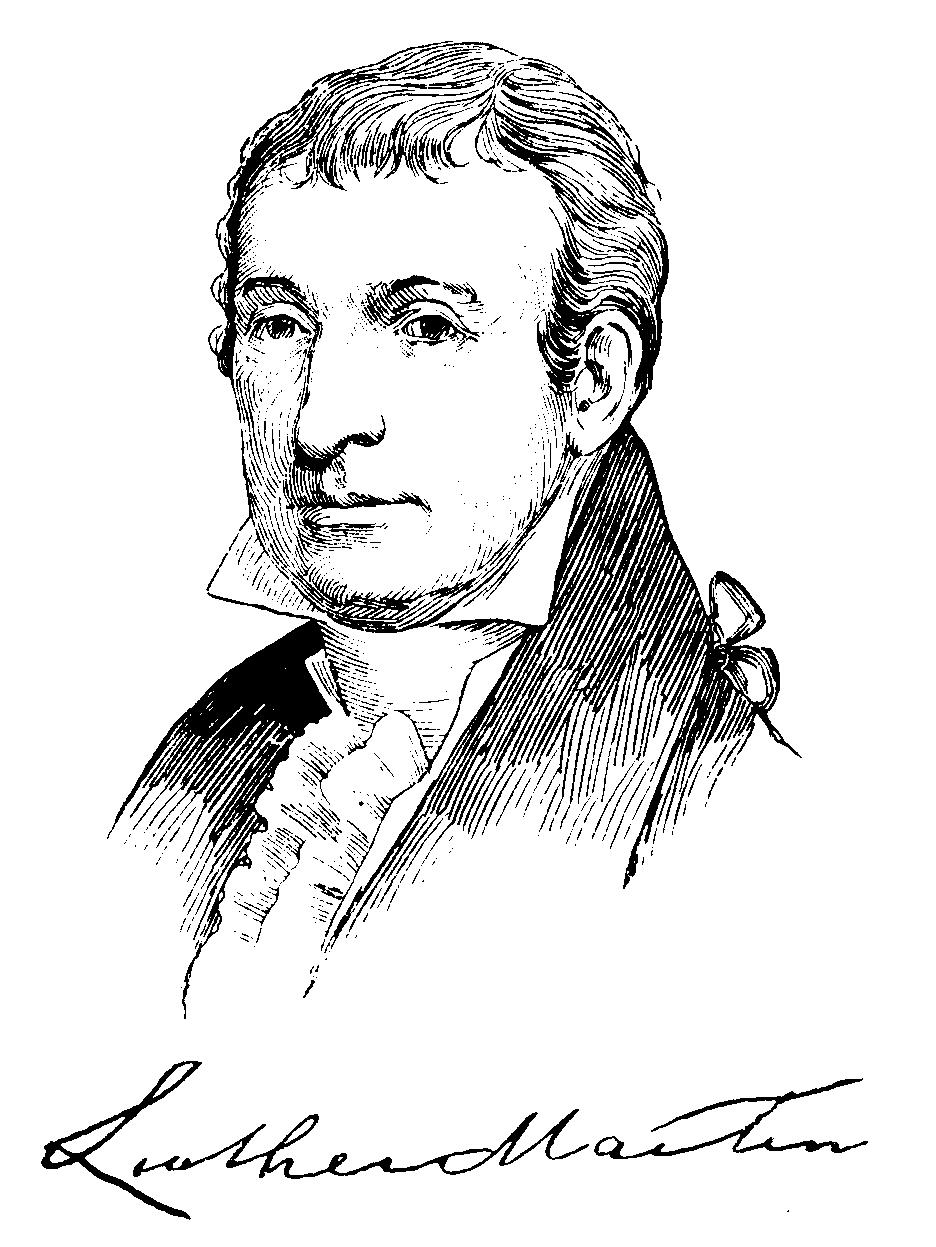
MARTIN, Luther, lawyer, born in New Brunswick, New Jersey, 9 February, 1748; died in New York city, 10 July, 1826. He was graduated at Princeton in 1766, and at once went to Queenstown, Maryland, where he studied law and supported himself by teaching. In 1771 he was admitted to the bar, and afterward settled in Somerset, Maryland, where he attained a lucrative practice. At one of the early terms of the Williamsburg, Virginia, court he defended thirty-eight persons, of whom twenty-nine were acquitted. He was appointed in 1774 one of the commissioners of his county to oppose the claims of Great Britain, and also a member of the convention that was called at Annapolis for a similar purpose. In August, 1777, he published a reply to the address that was sent out by the brothers Howe from their ships in Chesapeake bay; also an address "to the inhabitants of the peninsula between the Delaware and the Chesapeake to the southward of the British lines," which was circulated on printed handbills. In 1778 he was appointed attorney-general of Maryland, and in 1787 he was sent by the Maryland legislature as one of the delegates to the convention that framed the United States constitution, but he opposed the constitution and left the convention rather than sign the instrument. His opposition to this measure led to his being called "the Federal bull-dog" by his antagonist, Thomas Jefferson. In 1804 he appeared as counsel for the defence in the impeachment of Samuel Chase (q. v.) before the United States senate, he is described on this occasion as the rollicking, witty, audacious attorney-general of Maryland; drunken, generous, slovenly, grand, shouting with a school-boy's fun at the idea of tearing John Randolph's indictment to pieces, and teaching the Virginia Democrats some law. A year later he resigned from the attorney-generalship of Maryland, but continued his law practice, then the largest in that state. He again brought himself into notice as counsel for Aaron Burr in the latter's trial at Richmond in 1807, and at its close entertained both Burr and Harman Blennerhassett at his residence in Baltimore. In 1814-'16 he held the office of chief judge of the court of oyer and terminer in Baltimore, and in 1818 he was again appointed attorney-general of Maryland, but two years later a stroke of paralysis made him entirely dependent upon his friends, as he had never saved money. The Maryland legislature passed an act in 1822, that is unparalleled in American history, requiring every lawyer in the state to pay annually a license fee of $5, the entire proceeds to be paid over to trustees "for the use of Luther Martin." His last days were spent in New York city, where Burr, who was his debtor in every sense, gave him a home in his own house. He was the author of a "Defence of Captain Cresap," whose daughter he married in 1783, "from the charge of murder made in Jefferson's notes"; "Genuine Information delivered to the Legislature of the State of Maryland relative to the Proceedings of the General Convention lately held at Philadelphia" (Philadelphia, 1788) ; and a series of pamphlets called " Modern Gratitude" (1801-'2). See "Luther Martin, the Federal Bull-Dog," by Henry P. Goddard (Baltimore, 1887).
Unauthorized Site:
This site and its contents are not affiliated, connected,
associated with or authorized by the individual, family,
friends, or trademarked entities utilizing any part or
the subject's entire name. Any official or affiliated
sites that are related to this subject will be hyper
linked below upon submission
and Evisum, Inc. review.
Please join us in our mission to incorporate The Congressional Evolution of the United States of America discovery-based curriculum into the classroom of every primary and secondary school in the United States of America by July 2, 2026, the nation’s 250th birthday. , the United States of America: We The
People. Click Here