Appleton's Cyclopedia of American Biography, edited by James
Grant Wilson, John Fiske and Stanley L. Klos. Six volumes, New York: D. Appleton
and Company, 1887-1889 and 1999. Virtualology.com warns that these 19th Century
biographies contain errors and bias. We rely on volunteers to edit the historic
biographies on a continual basis. If you would like to edit this biographyplease
submit a rewritten biography in text form.
If acceptable, the new biography will be published above the 19th Century
Appleton's Cyclopedia Biography citing the volunteer editor
Virtual American Biographies
Over 30,000 personalities
with thousands of 19th Century illustrations, signatures, and exceptional life
stories. Virtualology.com
welcomes editing and additions to the
biographies. To become this site's editor or a contributor
Click Here
or e-mail Virtualology here.
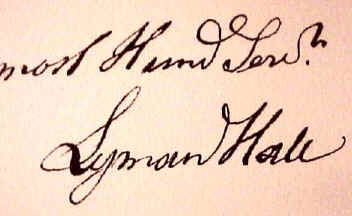
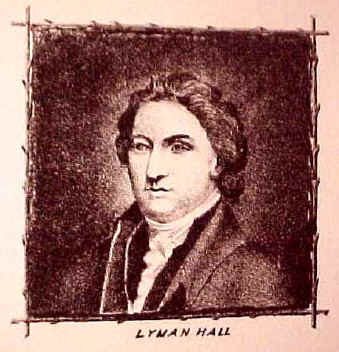
HALL, Lyman, signer of the Declaration of Independence, born in Connecticut in 1725; died in Burke county, Georgia, 19 October, 1790. He was graduated at Yale in 1747, studied medicine, and removed to Georgia in 1752, settling in Sunbury, where he acquired a large practice. He took an active part in the pre-Revolutionary movements, was a member of the conventions held in Savannah in 1774 and 1775, and was influential in causing Georgia to join the other colonies. In 1775 he was elected by the parish of St. John to congress, and served till 1780. When the British took possession of Georgia he removed with his family to the north, and all his property was confiscated by the royal government. In 1782 he returned to Georgia, before the evacuation of Savannah, and was governor of the state for one term, after which he retired from public life.
Lyman Hall - Signer of the Declartion of Independence Biography by
Appleton's edited by Stanley L. Klos
Lyman Hall
Signer of the Declaration of Independence
LYMAN
HALL was born on April 12, 1724 in Wallingford, Connecticut.It
was not in the state of his birth, however, that Hall would gain fame as a
colonial congressman, but further south, in Georgia.
Hall
studied for the ministry at Yale where he graduated in 1747 at the age of
twenty-three.Soon after, he married
Abigail Burr and subsequently decided he would rather heal unhealthy bodies than
tainted souls.So he studied long
and hard and by 1754 he was ready to practice medicine.
First
he opened an office in South Carolina, then he and his family settled in Sunbury
on the Georgia coast.As a dedicated
doctor, Hall's practice expanded and prospered – so much so that he was
financially able to acquire a vast and successful rice plantation in Burke
County, Georgia.
While
the Georgia legislature was at first reluctant to send a representative to the
Second Continental congress in 1775, Lyman Hall was determined to change this
posture.He called a citizen's
meeting that was filled with patriots who outwardly supported his loud cry for
total independence.Thus, he was
elected as a delegate to congress.He
had no authority to vote, however, until the following year when his appointment
was confirmed by the Georgia legislature.
In
1776, two other representatives for Georgia joined Hall at the Old State House
in Philadelphia.He was the oldest
of these signers and the one who spoke out most forcefully for freedom and a
breakaway from the rule of England.
During
the Revolutionary War, while Hall was still serving in Congress, the British
destroyed his beautiful plantation.Hall's
family, however, managed to escape to the north, later joining him in
Philadelphia.
In
1782, LymanHall retuned to Georgia, where he was
elected to the office of governor.He
served just one year before returning in 1784 to a new plantation.
Hall
died on October 19, 1790 in Burke County, Georgia, at the age of sixty-six.
Unauthorized Site:
This site and its contents are not affiliated, connected,
associated with or authorized by the individual, family,
friends, or trademarked entities utilizing any part or
the subject's entire name. Any official or affiliated
sites that are related to this subject will be hyper
linked below upon submission
and Evisum, Inc. review.
Please join us in our mission to incorporate The Congressional Evolution of the United States of America discovery-based curriculum into the classroom of every primary and secondary school in the United States of America by July 2, 2026, the nation’s 250th birthday. , the United States of America: We The
People. Click Here