Appleton's Cyclopedia of American Biography, edited by James
Grant Wilson, John Fiske and Stanley L. Klos. Six volumes, New York: D. Appleton
and Company, 1887-1889 and 1999. Virtualology.com warns that these 19th Century
biographies contain errors and bias. We rely on volunteers to edit the historic
biographies on a continual basis. If you would like to edit this biographyplease
submit a rewritten biography in text form.
If acceptable, the new biography will be published above the 19th Century
Appleton's Cyclopedia Biography citing the volunteer editor
Virtual American Biographies
Over 30,000 personalities
with thousands of 19th Century illustrations, signatures, and exceptional life
stories. Virtualology.com
welcomes editing and additions to the
biographies. To become this site's editor or a contributor
Click Here
or e-mail Virtualology here.
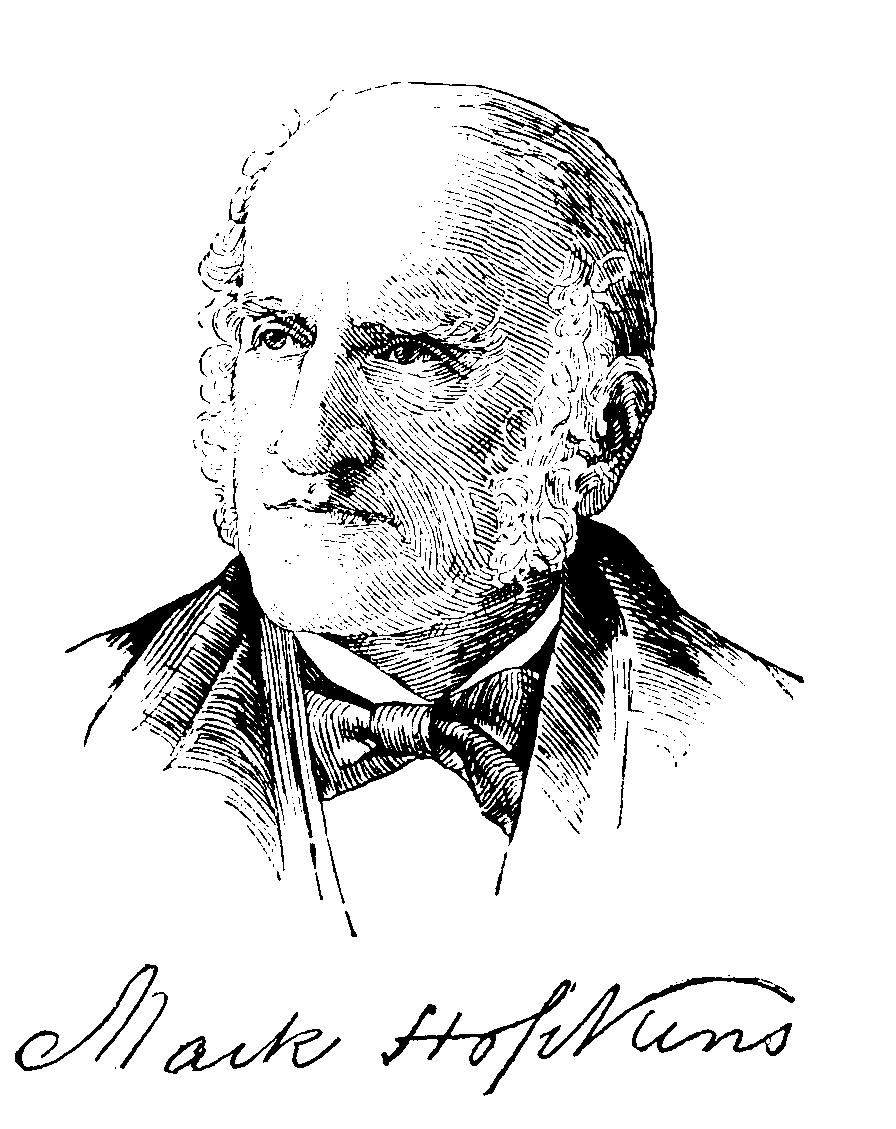
HOPKINS, Mark, educator, born in Stockbridge, Massachusetts, 4 February, 1802; died in Williamstown, Massachusetts, 17 June, 1887. He was a grandson of Colonel Mark, of the Revolutionary army, a graduate of Yale, and the first lawyer in Berkshire county, who was a younger brother of Dr. Samuel, the theologian, and married a half-sister of Ephraim Williams, the founder of Williams college. He was graduated at Williams in 1824, with the valedictory, was a tutor in that college in 1S25-'7, studied medicine at the same time, and was graduated at the Perk-shire medical school in 1829. He began practice in New York city, but in 1S30 was called to the chair of moral philosophy and rhetoric at Williams. He was licensed to preach in 1832. In 1836 he succeeded Dr. Edward D. Griffin as president of the college, which post he held until 1872. when he resigned, though retaining the chair of moral and intellectual philosophy, which was established for him in 1836, and that of Christian theology, which he assumed in 1858. the pastorate or the college church, on which he entered in 1836, he retained till 1883. He became president of the American board of commissioners for foreign missions in 1857. He received the degree of D. D. from Dartmouth in 1837, and Harvard in 1841, and that of LL. D. from the University of the state of New York in 1857, and from Harvard at its 250th anniversary in 1886. President Hopkins had a large influence for good, and was much beloved by his pupils, many of whom became eminent men, among them James A. Garfield. He was one of the most acute students of moral science that this country has produced since Jonathan Edwards. The last and fullest expression of his philosophical system is found in the works entitled "The Law of Love and Love as a Law" and "An Outline Study of Man," both extensively used as college text books, and the latter illustrating his methods in the class room. Williams college grew through his efforts to a famous and powerful institution of learning. Of more than 1,760 graduates living at the time of his death, he had taught all but thirty. His first literary essay was an article on " Mystery" which appeared in the "American Journal of Science and Arts" in 1828, and attracted wide attention. He delivered a course of Lowell lectures which were published under the title of "Lectures on the Evidences of Christianity" (Boston, 1846; new ed., 1864). These lectures are used as a text book in many colleges. His subsequent publications are "Miscellaneous Essays and Discourses" (1847); "Lectures on Moral Science" (1862), originally delivered before the Lowell institute; "Baccalaureate Sermons and Occasional Discourses" (1863); "The Law of Love, and Love as a Law; or, Christian Ethics" (1869); "An Outline Study of Man" (New York, 1873); "Strength and Beauty" (1874), which was reissued in a revised form under the title "Teachings and Counsels" (1884): and "Scriptural Idea of Man" (1883). His published annual baccalaureate sermons were widely read. "The Law of Love," in which his theories of morals were presented, was reviewed by Dr. James McCosh, and a controversy between the two philosophers resulted. --His brother, Albert, astronomer, born in Stockbridge, Massachusetts, 14 July, 1807; died in Williamstown, Massachusetts, 24 May, 1872. He entered Williams in the junior year and was graduated in 1826, subsequently devoting a year to the study of agriculture and engineering. In 1827 he was elected tutor, and in 1829 professor of mathematics and natural philosophy in Williams, and went to Europe in 1834 for the purpose of selecting philosophical and chemical apparatus for the college. In 1835 he began on his own responsibility the building of an astronomical observatory in Williamstown, the first that was ever established in connection with an American college. This building, though equipped with a telescope and other instruments of but moderate power, under Professor Hopkins's management, made many discoveries which aided in establishing a high reputation for American scientists. In 1869 David Dudley Field endowed a memo-rim professorship of astronomy in Williams with $25,000, stipulating that the proceeds should be secured to Professor Hopkins during his life. From 1835 till 1840 he also gave instruction in the French language. He was licensed to preach by the Berkshire Congregational association in 1837, and for many years was stated supply to churches in Williamstown and South Williamstown, and much of the time was acting college pastor. In 1846 he built, largely from his own means, a chapel at White Oaks, a previously neglected district of the town, where he performed missionary work, and in 1868 organized a church there. Professor Hopkins was a skilful botanist, and was the first to organize scientific expeditions from colleges, founding in this connection a natural history society and an Alpine club at Williams. He received the degree of LL.D. from Jefferson college in 1859, and was elected corresponding fellow of the Royal society of Great Britain, to whose transactions he was an occasional contributor of papers on astronomical and philosophical subjects.--Albert's wife, Louisa Payson, born in Portland, Maine, 24 February, 1812; died 24 , January, 1862, was the daughter of Reverend Edward Payson, and married Professor Hopkins in 1842. She contributed articles to Kitto's "Biblical Cyclopedia," "The New York Review," and other periodicals, and composed several question-books for the Massachusetts Sunday school union. Mrs. Hopkins also wrote numerous works for children which have been admired for their excellent method of illustrating the Bible and its doctrines. They include "The Pastor's Daughter, or The Way of Salvation Explained" (New York, new ed., 1868); "Lessons on the Book of Proverbs," "The Young Christian Encouraged," "Henry Langdon, or What was I made for?" (1846); "The Guiding Star, or The Bible God's Message," a sequel to "Henry Langdon" (Boston, 1851); "The Silent Comforter: a Companion for the Sick Room" (1874); and "Payson's Select Thoughts."
Unauthorized Site:
This site and its contents are not affiliated, connected,
associated with or authorized by the individual, family,
friends, or trademarked entities utilizing any part or
the subject's entire name. Any official or affiliated
sites that are related to this subject will be hyper
linked below upon submission
and Evisum, Inc. review.
Please join us in our mission to incorporate The Congressional Evolution of the United States of America discovery-based curriculum into the classroom of every primary and secondary school in the United States of America by July 2, 2026, the nation’s 250th birthday. , the United States of America: We The
People. Click Here