Appleton's Cyclopedia of American Biography, edited by James
Grant Wilson, John Fiske and Stanley L. Klos. Six volumes, New York: D. Appleton
and Company, 1887-1889 and 1999. Virtualology.com warns that these 19th Century
biographies contain errors and bias. We rely on volunteers to edit the historic
biographies on a continual basis. If you would like to edit this biographyplease
submit a rewritten biography in text form.
If acceptable, the new biography will be published above the 19th Century
Appleton's Cyclopedia Biography citing the volunteer editor
Virtual American Biographies
Over 30,000 personalities
with thousands of 19th Century illustrations, signatures, and exceptional life
stories. Virtualology.com
welcomes editing and additions to the
biographies. To become this site's editor or a contributor
Click Here
or e-mail Virtualology here.
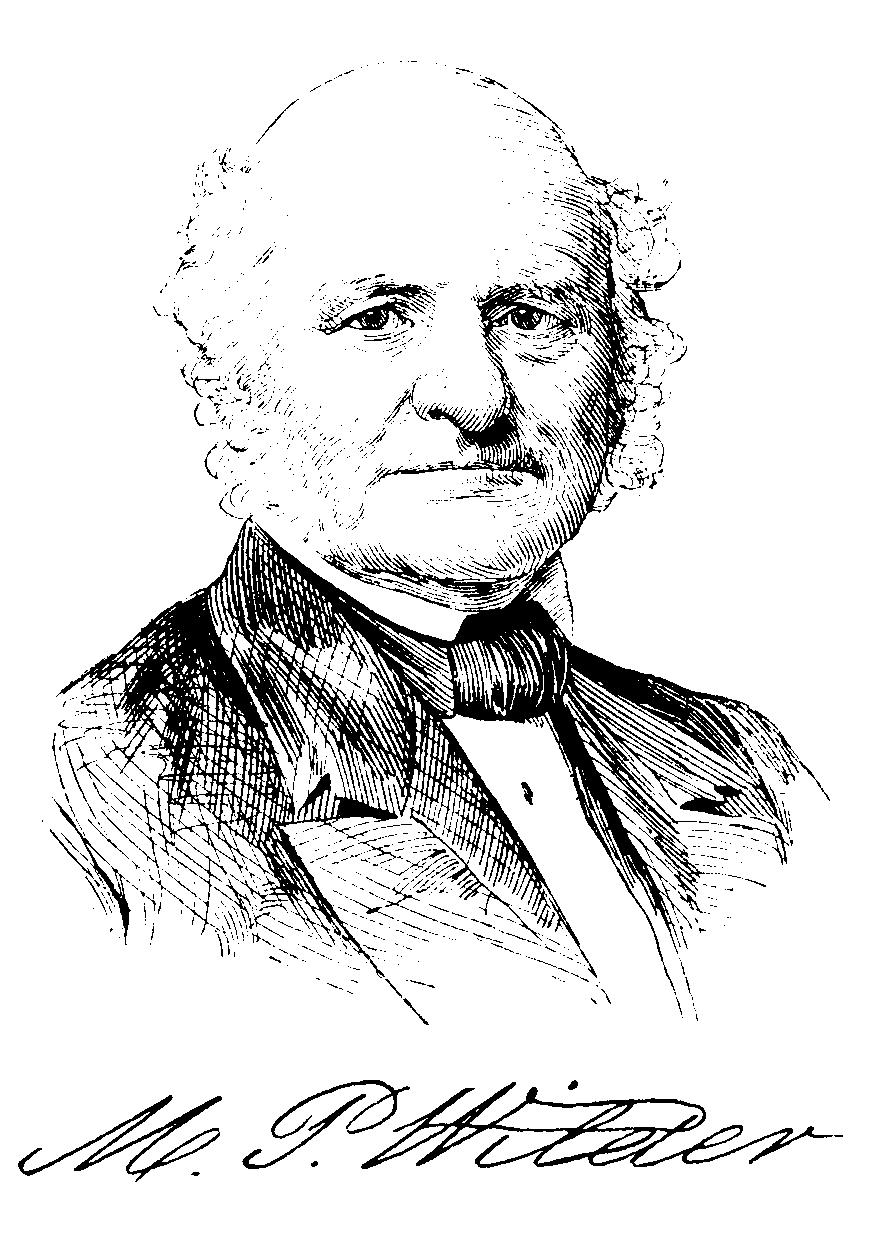
WILDER, Marshall Pinckney, merchant, born in Rindge, New Hampshire, 22 September, 1798; died in Boston, Massachusetts, 16 December, 1886. He received a common-school education, and engaged in farming, but in 1819 became a partner of his father, who was a merchant in his native place. In 1825 he removed to Boston, where he established a wholesale business in West India goods, and in 1837 he became a member of the commission firm of Parker, Blanchard and Wilder. He acquired a large fortune, and served also as a director in many commercial or financial companies. Mr. Wilder served in the legislature in 1839, in the governor's council in 1849, and in the state senate, of which he was president, in 1850, and he was one of the founders of the Constitutional Union party in 1860, being chairman of the Massachusetts delegation to its National convention of that year, which nominated Bell and Everett. Throughout the war he was a firm supporter of the United States government. He took special interest in agriculture and horticulture, was president of the Massachusetts agricultural society for eight years, of the Norfolk agricultural society for twenty years, and for six years of the United States agricultural society, of which he was the founder. He was also a founder of the American pomological society, and became its president on its organization in 1848, continuing many years in office. The value of his researches in hybridization and fruit-culture were recognized not, only in the United States but abroad. Mr. Wilder was also president of the New England historic genealogical society from 1868 till 1886, and was a leader in the movement that gave to Boston the Natural history rooms and the Institute of technology. He published a large number of historical, agricultural, and other addresses, including those " On Laying the Corner-Stone of the First Massachusetts Horticultural Hall" (Boston, 1844)" "On the 225th Anniversary of the Settlement of Dorchester" (1855)" annual addresses before the Historic-genealogical society (1868-'73)" lectures on "California" (1871)and "The Hybridization of Plants" (1872) ; " On the Progress and Influence of Rural Art" (1872)" and addresses before the American pomological society (1848-'73) and the United States agricultural society (1852-'6).
Unauthorized Site:
This site and its contents are not affiliated, connected,
associated with or authorized by the individual, family,
friends, or trademarked entities utilizing any part or
the subject's entire name. Any official or affiliated
sites that are related to this subject will be hyper
linked below upon submission
and Evisum, Inc. review.
Please join us in our mission to incorporate The Congressional Evolution of the United States of America discovery-based curriculum into the classroom of every primary and secondary school in the United States of America by July 2, 2026, the nation’s 250th birthday. , the United States of America: We The
People. Click Here