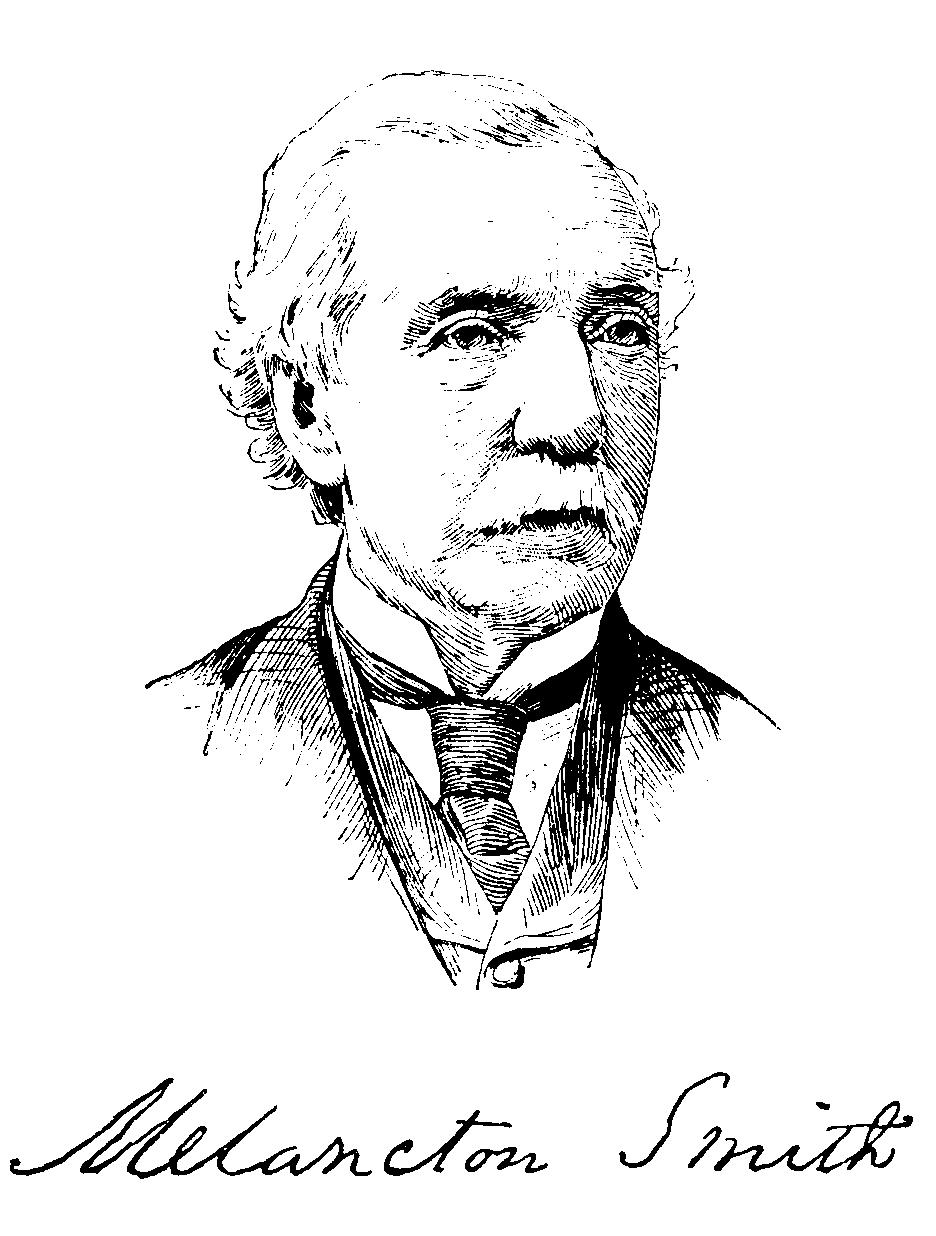
Appleton's Cyclopedia of American Biography, edited by James
Grant Wilson, John Fiske and Stanley L. Klos. Six volumes, New York: D. Appleton
and Company, 1887-1889 and 1999. Virtualology.com warns that these 19th Century
biographies contain errors and bias. We rely on volunteers to edit the historic
biographies on a continual basis. If you would like to edit this biographyplease
submit a rewritten biography in text form.
If acceptable, the new biography will be published above the 19th Century
Appleton's Cyclopedia Biography citing the volunteer editor
Virtual American Biographies
Over 30,000 personalities
with thousands of 19th Century illustrations, signatures, and exceptional life
stories. Virtualology.com
welcomes editing and additions to the
biographies. To become this site's editor or a contributor
Click Here
or e-mail Virtualology here.
SMITH, Melancton, Continental congressman, born in Jamaica, L. I., in 1724; died in New York city, 29 July, 1798. He was educated at home, settled in business in Poughkeepsie, New York, in 1744, became sheriff of Dutchess county in 1777, and, says Chancellor Kent, was early noted "for his love of reading, tenacious memory, powerful intellect, and for the metaphysical and logical discussions of which he was a master." He was a member of the first Provincial congress that met in New York city, 23 May, 1775, and a commissioner in 1777 for detecting and defeating all conspiracies formed in the state, served in the Continental congress in 1785-'8, and in the latter year represented Dutchess county in the convention that met at Poughkeepsie to consider the ratification of the Federal constitution of 1787. In the deliberations of that body he exhibited talents of a high order, and ably supported Governor George Clinton and the State-rights party. He removed to New York city about 1785 and largely engaged in mercantile pursuits, at the same time taking a conspicuous part as an anti-Federalist leader, He was in the legislature in 1791, in which year a commission--consisting of Governor Clinton, State Secretary Lewis L. Scott, Attorney-General Aaron Burr, State Treasurer Gerard Bancker, and Auditor Peter Y. Curtenius--sold 5,500,000 acres of land belonging to New York state, at the sum of eighteen cents per acre, to Alexander McComb, James Caldwell, John and Nicholas Roosevelt, and others. When the transaction became public, resolutions of censure were moved in the legislature ; but Jabez D. Hammond, the historian of New York, says: "After a long and acrimonious discussion of the resolutions of censure, they were finally rejected, and Melancton Smith, as pure a man as ever lived, introduced a resolution approving of the conduct of the commissioners, which was adopted in the assembly by a vote of thirty-five to twenty." He canvassed the state for the re-election of Governor Clinton in 1792, and was subsequently circuit judge. He died of yellow fever, his being the first fatal case in the epidemic of 1798.--His son, Melancton, soldier, born in New York city in 1780; died in Plattsburg, New York, 28 August, 1818, received a military education, and, at the beginning of the second war with Great Britain, joined the United States army, became major of the 29th infantry, 20 February, 1813, and colonel of that regiment the next month, which office he held until the end of the war, serving throughout the frontier campaign of that year, and commanding the principal fort at the battle of Plattsburg in September, 1814.--The second Melancton's son, Melancton, naval officer, born in New York city, 24 May, 1810, entered the navy as a midshipman, 1 November, 1826, attended the naval school in New York in 1831, and became a passed midshipman, 28 April, 1832. He was commissioned lieutenant, 8 March, 1837, served in the steamer "Poinsett" until 1840, and in 1839, on this cruise, he commanded a fort during engagements with the Seminoles in Florida. He made a full cruise in the frigate "Constitution" on the Mediterranean station in 1848-'51, and, after being on waiting orders for several years, was commissioned commander, 14 September, 1855, after which he was light-house inspector. On 9 July, 1861, while in command of the "Massachusetts" off Ship island, he had an engagement with a Confederate fort and three Confederate steamers, and on 31 December, 1861, the fort at Biloxi, Louisiana, surrendered, cutting off all regular communication between North Carolina and Mobile, and getting possession of the sound. When in command of the "Mississippi" he passed Forts Jackson and St. Philip with Farragut, and destroyed the Confederate ram " Manassas," for which he was highly commended by the admiral. He participated in the attack on Port Hudson. In an attempt to run the batteries the "Mississippi " grounded, and he set his ship on fire to prevent her falling into the hands of the enemy. This course was approved by the navy department. He was promoted to captain, 16 July, 1862 (under orders to return north), but was assigned to the temporary command of the "Monongahela," on which vessel the admiral hoisted his flag on his passage from New Orleans to Port Hudson. In 1864 he had command of the monitor "Onondaga," and appointed divisional officer on James river, and subsequently he had charge of the squadron in Albemarle sound, North Carolina, and recaptured the steamer "Bombshell." He participated in both attacks on Fort Fisher in the steam frigate "Wabash." He was commissioned commodore, 25 July, 1866, and served as chief of the bureau of equipment and recruiting in the navy department until 1870. He was commissioned rear-admiral, 1 July, 1870, had charge of the New York navy-yard in 1870-'2, and was retired, 24 May, 1871. After he, was retired, he was appointed governor of the Naval asylum at Philadelphia.
Unauthorized Site:
This site and its contents are not affiliated, connected,
associated with or authorized by the individual, family,
friends, or trademarked entities utilizing any part or
the subject's entire name. Any official or affiliated
sites that are related to this subject will be hyper
linked below upon submission
and Evisum, Inc. review.
Please join us in our mission to incorporate The Congressional Evolution of the United States of America discovery-based curriculum into the classroom of every primary and secondary school in the United States of America by July 2, 2026, the nation’s 250th birthday. , the United States of America: We The
People. Click Here