Appleton's Cyclopedia of American Biography, edited by James
Grant Wilson, John Fiske and Stanley L. Klos. Six volumes, New York: D. Appleton
and Company, 1887-1889 and 1999. Virtualology.com warns that these 19th Century
biographies contain errors and bias. We rely on volunteers to edit the historic
biographies on a continual basis. If you would like to edit this biographyplease
submit a rewritten biography in text form.
If acceptable, the new biography will be published above the 19th Century
Appleton's Cyclopedia Biography citing the volunteer editor
Virtual American Biographies
Over 30,000 personalities
with thousands of 19th Century illustrations, signatures, and exceptional life
stories. Virtualology.com
welcomes editing and additions to the
biographies. To become this site's editor or a contributor
Click Here
or e-mail Virtualology here.
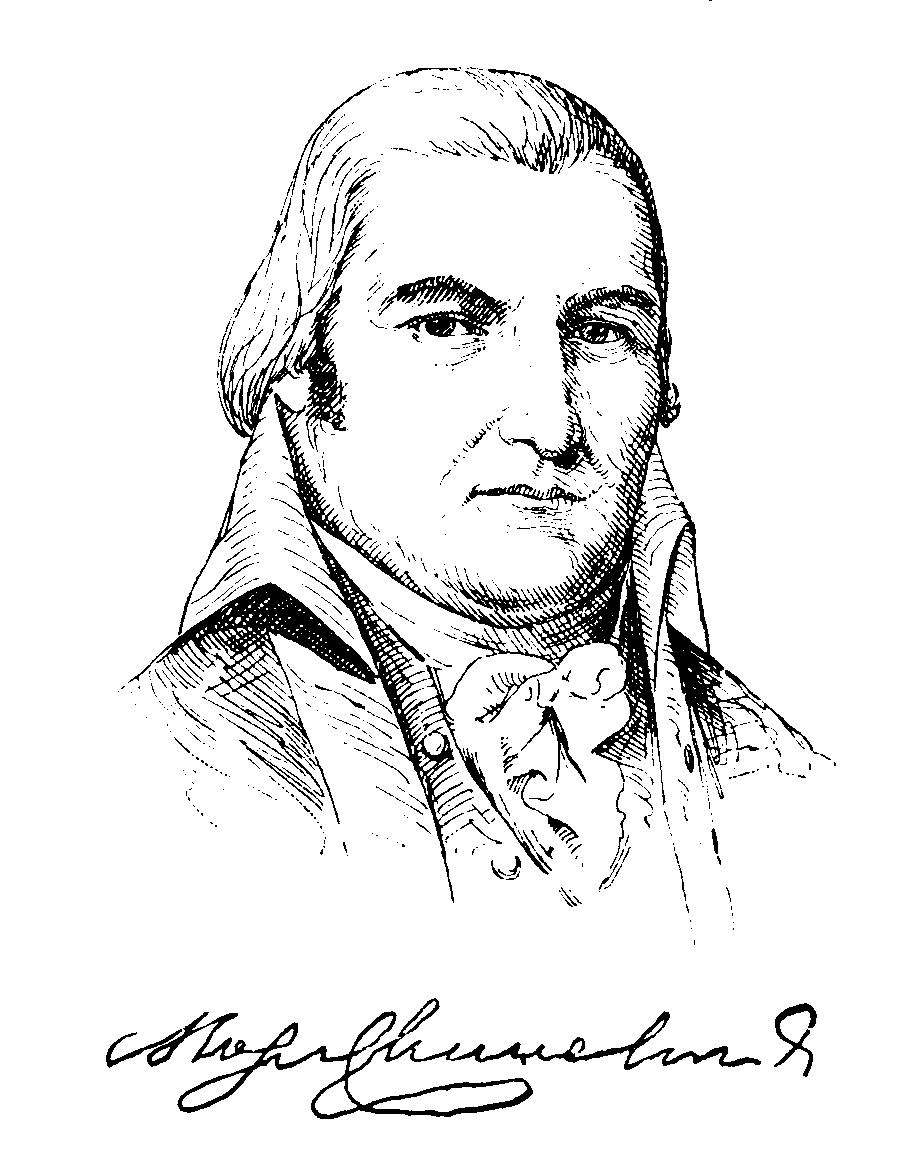
CLEAVELAND, Moses, pioneer, born in Canterbury, Windham County, Connecticut, 29 January, 1754; died there, 16 November, 1806. He was a nephew of John, the minister of Ipswich, was graduated at Yale in 1777, and studied and began the practice of law in his native town. He was commissioned captain of a company of sappers and miners in 1779, served for several years, and then resumed legal practice. He gained a high reputation for ability and energy, was several times elected to the legislature, and in 1796 was commissioned brigadier-general of militia. He was a shareholder in the Connecticut land company, which had purchased for $1,200,000 from the state government of Connecticut the land in northeastern Ohio reserved to Connecticut by congress, known at its first settlement as New Connecticut, and in later times as the Western Reserve. In May, 1796, the directors of the company appointed General Cleaveland their agent to superintend the survey of the tract and the location of purchases, and to negotiate with the Indians living on the land, and obtain their acquiescence in its settlement by white emigrants. He set out from Schenectady, New York, in June, 1796, with a party of fifty, consisting of six surveyors, a physician, a chaplain, a boatman, thirty-seven employes, a few emigrants, and two women who accompanied their husbands. Some journeyed by land with the horses and cattle, while the main body went in boats up the Mohawk, down the Oswego, along the shore of Lake Ontario, and up Niagara river, carrying their boats over the long portage of seven miles at the falls. At Buffalo a delegation of Mohawk and Seneca Indians opposed their entrance into the Western Reserve, claiming it as their territory, but waived their rights on the receipt of goods valued at $1,200. The expedition then coasted along the shore of Lake Erie, and landed, on 4 July, 1796, at the mouth of Conneaut creek, which they named Port Independence. The Indians were propitiated with gifts of beads and whiskey, and allowed the surveys to proceed. General Cleaveland, with a surveying party, coasted along the shore, entered a stream that he took to be the Cuyahoga, and named the Chagrin on learning his vexatious mistake, then proceeded westward, and on 22 July, 1796, landed at the mouth of the Cuyahoga. He ascended the bank, and, beholding a beautiful plain covered with a luxuriant forest-growth, divined that the spot where he stood, with the River on the west and Lake Erie on the north, was a favorable site for a city. He accordingly had it surveyed into town lots, and the employes named the place Cleaveland, in honor of their chief. There were but four settlers the first year, and, on account of the insalubrity of the locality, the growth was at first slow, reaching 150 inhabitants only in 1820. In 1830, when the first newspaper, the "Cleveland Advertiser," was established, the editor discovered that the head-line was too long for the form, and accordingly left out the letter "a" in the first syllable of "Cleaveland," which spelling was at once adopted by the public.
Unauthorized Site:
This site and its contents are not affiliated, connected,
associated with or authorized by the individual, family,
friends, or trademarked entities utilizing any part or
the subject's entire name. Any official or affiliated
sites that are related to this subject will be hyper
linked below upon submission
and Evisum, Inc. review.
Please join us in our mission to incorporate The Congressional Evolution of the United States of America discovery-based curriculum into the classroom of every primary and secondary school in the United States of America by July 2, 2026, the nation’s 250th birthday. , the United States of America: We The
People. Click Here