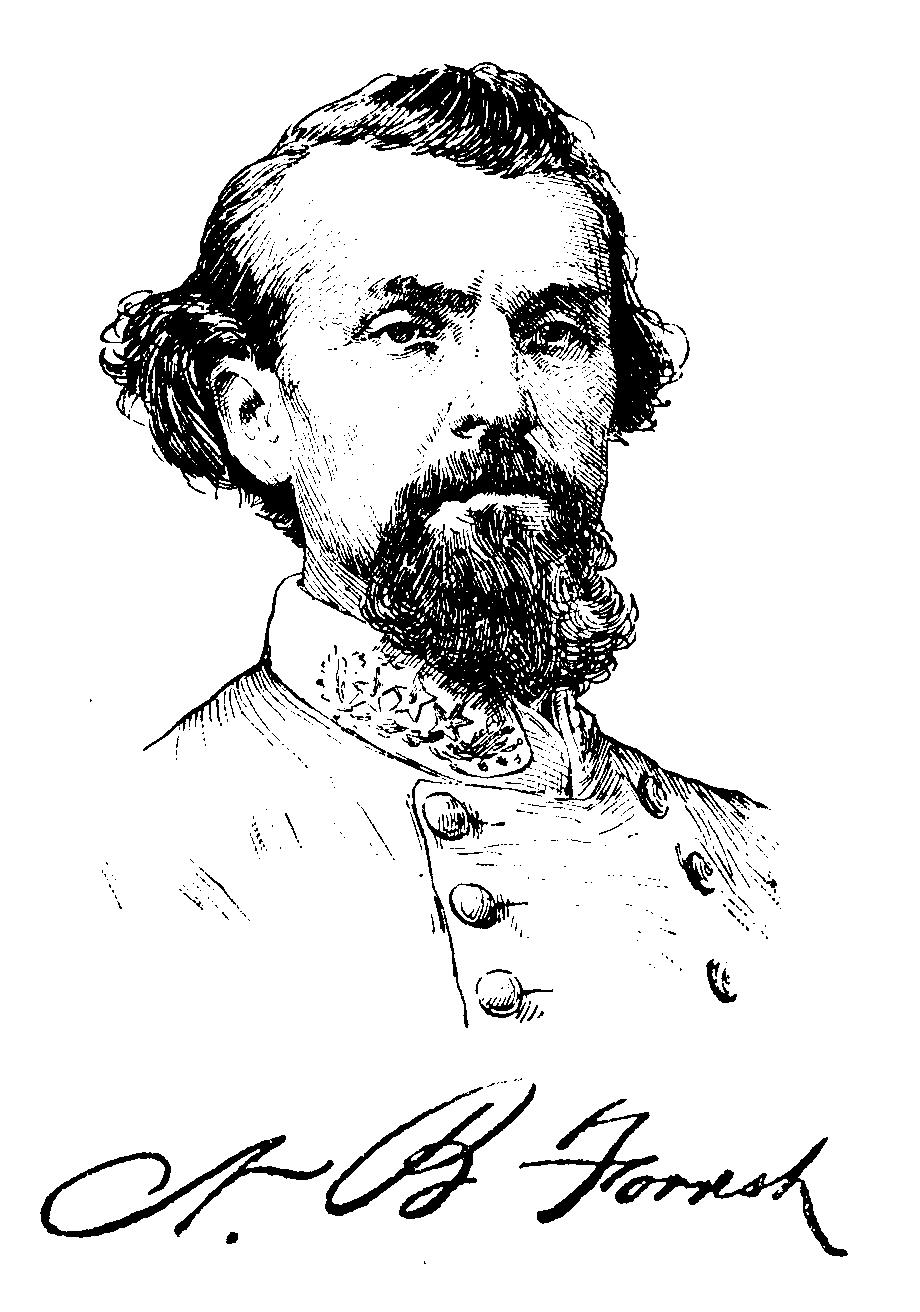
Appleton's Cyclopedia of American Biography, edited by James
Grant Wilson, John Fiske and Stanley L. Klos. Six volumes, New York: D. Appleton
and Company, 1887-1889 and 1999. Virtualology.com warns that these 19th Century
biographies contain errors and bias. We rely on volunteers to edit the historic
biographies on a continual basis. If you would like to edit this biographyplease
submit a rewritten biography in text form.
If acceptable, the new biography will be published above the 19th Century
Appleton's Cyclopedia Biography citing the volunteer editor
Virtual American Biographies
Over 30,000 personalities
with thousands of 19th Century illustrations, signatures, and exceptional life
stories. Virtualology.com
welcomes editing and additions to the
biographies. To become this site's editor or a contributor
Click Here
or e-mail Virtualology here.
FORREST, Nathan Bedford, soldier, born in Bedford County, Tennessee, 13 July 1821; died in Memphis, Tennessee, 29 October 1877. While yet quite young he removed with his family to Mississippi, where his father soon afterward died, leaving Nathan mainly responsible for the support of the household. In 1842 he removed to Hernando, Miss., and established himself as a planter, remaining there till about 1852, when he went to Memphis, Tennessee, and became a real estate broker and dealer in slaves.
When the civil war broke out he had amassed a considerable fortune. In June 1861, he joined the Tennessee mounted rifles, and in July following he raised and equipped, at the request of Governor Harris, a regiment of cavalry, and was made lieutenant colonel. In October he moved with his men to Fort Donelson, where he remained until the approach of General Grant, and whence he was allowed to escape with his men before the flag of truce was sent. After a raiding excursion, during which he visited Nashville, Huntsville, and Iuka he took part in the battle of Shiloh. He was assigned to the command of the cavalry at Chattanooga in the following June participated in the attack on Murfreesboro on 13 July 1862, and on 21 July was made brigadier general. In September he was in command at Murfreesboro, and on 31 Dec. was engaged at Parker's Crossroads. He fought at Chiekamauga on 19 and 20 September 1863, and in November was transferred to northern Mississippi. In the following month he was made major general and assigned to the command of Forrest's cavalry department. He was in command of the Confederate forces that attacked Fort Pillow in April 1864, and, while negotiations for the surrender of the fort were in progress under a flag of truce, moved troops into favorable positions that they could not have gained at any other time.
Major Bradford, the commander of the fort, refused to surrender, whereupon the works were taken by assault, and the garrison, consisting many of colored troops, were given no quarter. The excuse given by Forrest's men was, that the flag of the fort had not been hauled down in token of surrender. During the operations of Hood and Thomas in Tennessee he proved a great source of annoyance to the National commanders, and in February 1865, he was promoted to the rank of lieutenant general. General James H. Wilson finally routed him on 2 April 1865, and on 9 May he surrendered at Gainesville.
After the war he was president of the Selma, Marion, and Memphis railroad, but resigned in 1874. He was a delegate from Tennessee to the New York Democratic national convention of 4 July 1868. Some of General Porrest's official documents are very amusing for their peculiar orthography and phraseology. In his dispatch announcing the fall of Fort Pillow, the original of which is still preserved, he wrote: " We busted the fort at ninerclock and scattered the niggers. The men is still a cillanem in the woods." Accounting for prisoners, he wrote: "Them as was cotch with spoons and brestpins and sieh was cilld and the rest of the lot was payrold and told to git." See "Campaigns of N. B. Porrest," by T. Jordan and J. B. Pryor (New York, 1868).
Unauthorized Site:
This site and its contents are not affiliated, connected,
associated with or authorized by the individual, family,
friends, or trademarked entities utilizing any part or
the subject's entire name. Any official or affiliated
sites that are related to this subject will be hyper
linked below upon submission
and Evisum, Inc. review.
Please join us in our mission to incorporate The Congressional Evolution of the United States of America discovery-based curriculum into the classroom of every primary and secondary school in the United States of America by July 2, 2026, the nation’s 250th birthday. , the United States of America: We The
People. Click Here