Appleton's Cyclopedia of American Biography, edited by James
Grant Wilson, John Fiske and Stanley L. Klos. Six volumes, New York: D. Appleton
and Company, 1887-1889 and 1999. Virtualology.com warns that these 19th Century
biographies contain errors and bias. We rely on volunteers to edit the historic
biographies on a continual basis. If you would like to edit this biographyplease
submit a rewritten biography in text form.
If acceptable, the new biography will be published above the 19th Century
Appleton's Cyclopedia Biography citing the volunteer editor
Virtual American Biographies
Over 30,000 personalities
with thousands of 19th Century illustrations, signatures, and exceptional life
stories. Virtualology.com
welcomes editing and additions to the
biographies. To become this site's editor or a contributor
Click Here
or e-mail Virtualology here.
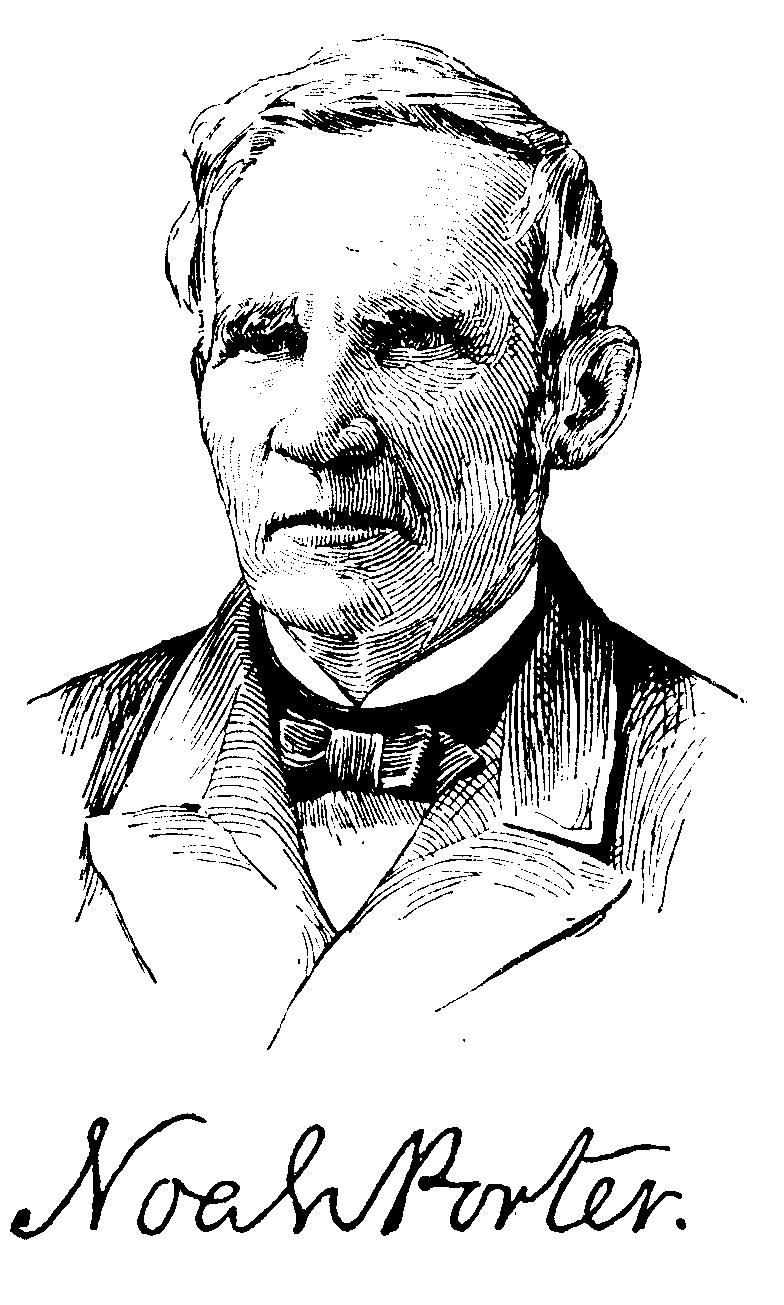
PORTER, Noah, clergyman, born in Farmington, Connecticut, in December, 1781 ; died there, 24 September, 1866. His ancestors, Robert and Thomas Porter, settled in Farmington in 1640. He was graduated at Yale with the highest honor in 1803, and was ordained pastor of the Congregational church in his native town, which charge he held until his death. For many years he was a member of the corporation of Yale. Dartmouth gave him the degree of S. T. D. in 1828. He published occasional sermons in the " National Preacher," a " Half-Century Discourse," in the fiftieth year of his ministry, and contributed to the " Christian Spectator." His " Memoir" was written by his son, Noah.--His son, Samuel, educator of the deaf and dumb, born in Farmington, Connecticut, 12 January, 1810, was .graduated at Yale in 1829. He was instructor of the deaf and dumb in the Hartford institution from 1832 till 1836, and again from 1846 till 1860, also holding the same office in the New York institution in 1843-'6. From 1866 till 1884 he was professor of mental science and English philology in the National deaf-mute college in Washington, D. C., and is now (1888) professor emeritus. He has made a special study of phonetics, was editor of the "American Annals of the Deaf and Dumb" from 1854 till 1860, and has published " The Vowel Elements in Speech, a Phonological and Philological Essay" (New York, 1867), and numerous articles, including "Is Thought possible without Language," in the "Princeton Review" (1881).-Another son, Noah, educator, born in Farmington, Connecticut, 14 December, 1811, was graduated at Yale in 1831, became master of Hopkins grammar-school in New Haven, and was tutor at Yale in 1833-'5, during which time he studied theology. He was pastor of Congregational churches in New Milford, Connecticut, from 1836 till 1843, and in Springfield, Massachusetts, from 1843 till 1846. Mr. Porter was then appointed professor of moral philosophy and metaphysics at Yale, which chair he still (1888) holds. In 1871 he succeeded Theodore D. Woolsey as president of Yale, which post he held till his resignation in 1886. During President Porter's administration the progress of the college was marked. Some of its finest buildings were erected in this period, including the art-school, the Peabody museum, the new theological halls, the Sloane physical laboratory, the Battell chapel, and one of the largest dormitories. The curriculum was also considerably enlarged, especially by the introduction of new elective studies, although Dr. Porter has been an earnest champion of a required course, as opposed to the elective system as it has been recently elaborated at Harvard. He has also ably maintained the claims of the classics to a chief place in a liberal course of education. As an instructor, and in his personal relations with the students, he was one of the most popular presidents of Yale. He is probably the last to hold the presidency and a professor's chair at the same time, as his successor, Timothy Dwight, expressly stipulated on accepting the office that the duties of a teacher should not attach to it. He received the degree of D. D. from the University of the city of New York in 1858, and that of LL.D. from Edinburgh in 1886, and also from Western Reserve college, Ohio, in 1870, and from Trinity in 1871. He is the author of an "Historical Discourse at Farming-ton, November 4, 1840," commemorating the 200th anniversary of its settlement (Hartford, 1841); " The Educational Systems of the Puritans and Jesuits Compared," a prize essay (New York, 1851); "The Human Intellect," which is used as a text-book of metaphysics at Yale and elsewhere (1868; many new editions); " Books and Reading" (1870); " American Colleges and the American Public" (New Haven, 1871); "Sciences of Nature versus the Science of Man," a review of the philosophy of Herbert Spencer (1871) ; "Evangeline ; the Place, the Story, and the Poem" (1882) ; "Science and Sentiment" (1882) ; " The Elements of Moral Science, Theoretical and Practical" (1885) ; "Life of Bishop Berkeley" (1885) ; and "Kant's Ethics a Critical Exposition " (Chicago, 1886). Dr. Porter is one of the most scholarly metaphysicians in this country. He was the principal editor of the revised editions of Noah Webster's " Unabridged Dictionary" (Springfield, Massachusetts, 1864 and 1880).--The first Noah's daughter, Sarah, educator, born in Farmington, Connecticut, 17 August, 1813, opened a small day-school for girls in Farmington, which is now (1888) a large seminary, and attracts students from all parts of the United States. In 1885 a fine building was erected and presented to Miss Porter by some of her former pupils for an art studio.
Unauthorized Site:
This site and its contents are not affiliated, connected,
associated with or authorized by the individual, family,
friends, or trademarked entities utilizing any part or
the subject's entire name. Any official or affiliated
sites that are related to this subject will be hyper
linked below upon submission
and Evisum, Inc. review.
Please join us in our mission to incorporate The Congressional Evolution of the United States of America discovery-based curriculum into the classroom of every primary and secondary school in the United States of America by July 2, 2026, the nation’s 250th birthday. , the United States of America: We The
People. Click Here