Appleton's Cyclopedia of American Biography, edited by James
Grant Wilson, John Fiske and Stanley L. Klos. Six volumes, New York: D. Appleton
and Company, 1887-1889 and 1999. Virtualology.com warns that these 19th Century
biographies contain errors and bias. We rely on volunteers to edit the historic
biographies on a continual basis. If you would like to edit this biographyplease
submit a rewritten biography in text form.
If acceptable, the new biography will be published above the 19th Century
Appleton's Cyclopedia Biography citing the volunteer editor
Virtual American Biographies
Over 30,000 personalities
with thousands of 19th Century illustrations, signatures, and exceptional life
stories. Virtualology.com
welcomes editing and additions to the
biographies. To become this site's editor or a contributor
Click Here
or e-mail Virtualology here.
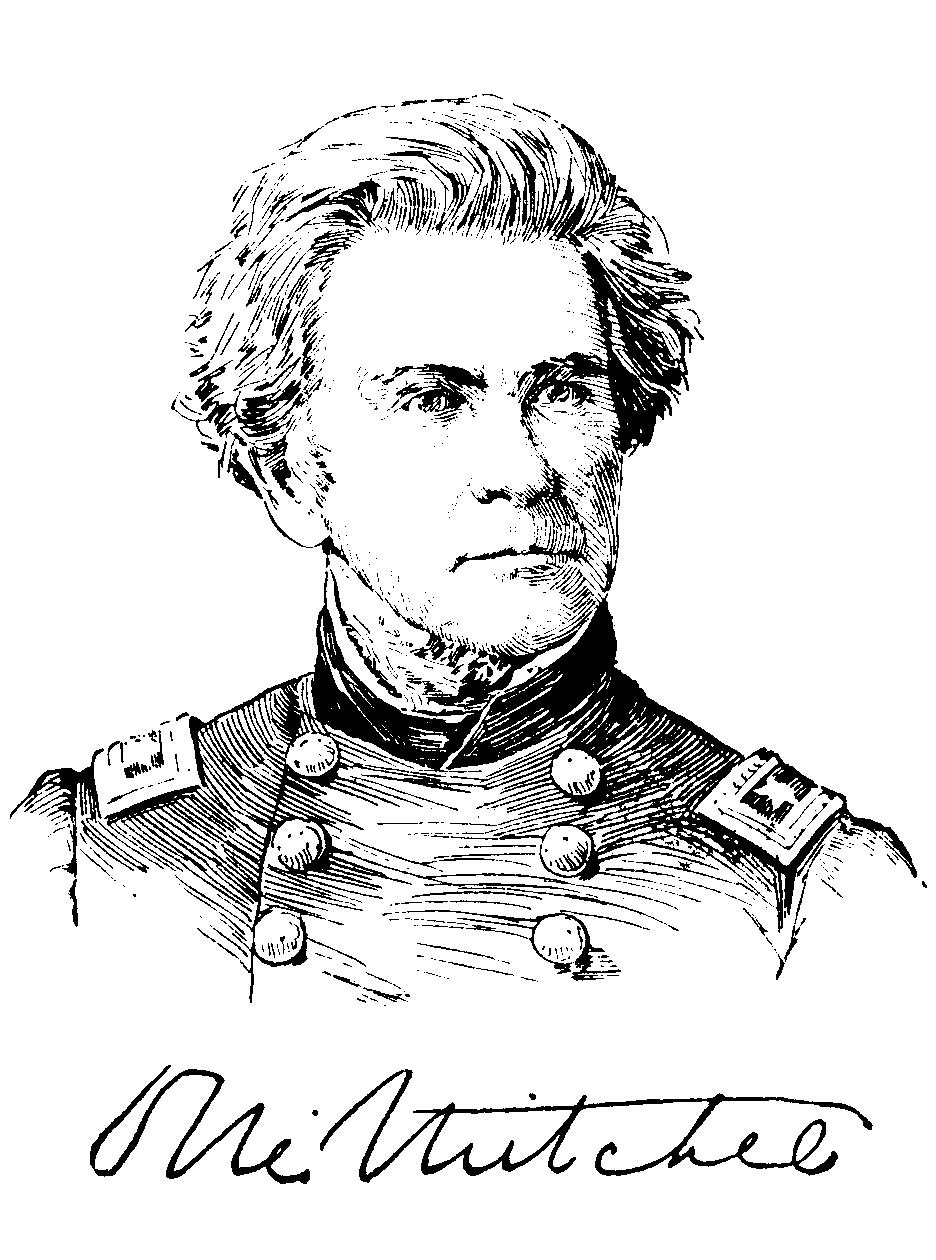
MITCHEL, Ormsby MacKnight, astronomer born in Morganfield, Kentucky, 28 July, 1809; died in Beaufort, South Carolina, 30 October, 1862. He received his early education in Lebanon, Ohio, and when thirteen years old became a clerk in a country store. In 1825 he received an appointment to the United States military academy, where he was graduated four years later, standing fifteenth in the class that included Robert E. Lee and Joseph E. Johnston. He was made 2d lieutenant in the artillery, and assigned to duty as assistant professor of mathematics at the Military academy until 1832, after which he was stationed at Fort Marion, St. Augustine, Florida, but resigned in September of that year. Subsequently he studied law in Cincinnati and was admitted to the bar, meanwhile also holding the appointment of chief-engineer of the Little Miami railroad. He was professor of mathematics, philosophy, and astronomy in Cincinnati college from 1836 until 1844, when he proposed the establishment of an observatory at Cincinnati, and, after raising nearly all of the funds through his own exertions, was made its director. The corner-stone of the pier which was to sustain the great refracting telescope was laid by John Quincy Adams, with an oration, on 9 November, 1843, and the apparatus for the proper equipment of the observatory was obtained by Professor Mitchel during a visit to Europe in 1842 for that purpose. This was the first of the larger observatories to be built in the United States He invented in 1848 a chronograph for automatically measuring and recording right ascensions by an electro-magnetic mechanism, similar to that constructed by John Locke (q. v.). In 1849 he devised an apparatus for the accurate measurement of large differences of declination, which, after successful improvement, was in 1854 attached to the equatorial. During 1854-'9 he made nearly 50,000 observations of faint stars. His other work included the discovery of the duplicity of certain stars, notably Antares, observations of nebulae, solar spots, double stars, and comets, the determination of the longitude of Cincinnati with reference to Washington and St. Louis, and the invention of an apparatus for finding the personal equation. He was also adjutant-general of Ohio in 1847-'8, and chief engineer of the Ohio and Mississippi railroad in 1848-'9 and 1852-'3. In 1859 he was called to the charge of the Dudley observatory in Albany, where he remained until 1861, retaining during the interval his connection with the observatory in Cincinnati. At the beginning of the civil war he was made brigadier-general of volunteers from Ohio, and at first reported to General George B. McClellan, who assigned him to the command of General William B. Franklin's brigade in the Army of the Potomac, but at the request of the citizens of Cincinnati he was transferred to that city, where his duties largely consisted in fortifying the city and in preparation of recruits for the field. He served with the Army of the Ohio during the campaigns of Tennessee and northern Alabama in the winter of 1861-'2, and occupied Bowling Green, Kentucky, and Nashville, Tennessee, in February, 1862, after which he participated in the action near Bridgeport, Alabama, taking possession of the railroad from Decatur to Stephen son, in one of the most famous raids of the early history of the civil war, and is best known as the "locomotive chase." See "Daring and Suffering: a History of the Andrews Railroad Raid into Georgia in 1862," by William Pittenger (New York, 1887). These services gained for him the rank of major-general of volunteers on 11 April, 1862: and anxious to advance into the heart of the south, he was restrained by his superior officer until finally he asked to be relieved. Returning to Washington, he was selected by the president for the command of an expedition to the Mississippi; but the necessary order was refused by General Henry M. Hal-leek, and he remained inactive until September, when he was placed in command of the Department of the South, in South Carolina, at Hilton Head, where he was stricken with yellow fever and died. He was popularly known in the army as "Old Stars." Professor Mitchel lectured extensively during the years 1842-'8 in the principal cities of the United States. He received the degree of A.M. from Harvard in 1851, and that of LL. D. from Washington in 1853 and from Hamilton in 1856, and was also a member of various scientific societies, both in the United States and Europe. He published a popular astronomical journal, entitled " The Sidereal Messenger," in 1846-'8, and also a revised edition of Elijah H. Burritt's "Geography of the Heavens." His own works include "The Planetary and Stellar Worlds" (New York, 1848); "The Orbs of Heaven" (1851) ; "A Concise Elementary Treatise of the Sun, Planets, Satellites, and Comets" (1860) ; and "The Astronomy of the Bible" (1863). See "Ormsby MacKnight Mitchei," by his son, Frederick A. Mitchel (Boston, 1887).
Unauthorized Site:
This site and its contents are not affiliated, connected,
associated with or authorized by the individual, family,
friends, or trademarked entities utilizing any part or
the subject's entire name. Any official or affiliated
sites that are related to this subject will be hyper
linked below upon submission
and Evisum, Inc. review.
Please join us in our mission to incorporate The Congressional Evolution of the United States of America discovery-based curriculum into the classroom of every primary and secondary school in the United States of America by July 2, 2026, the nation’s 250th birthday. , the United States of America: We The
People. Click Here