Appleton's Cyclopedia of American Biography, edited by James
Grant Wilson, John Fiske and Stanley L. Klos. Six volumes, New York: D. Appleton
and Company, 1887-1889 and 1999. Virtualology.com warns that these 19th Century
biographies contain errors and bias. We rely on volunteers to edit the historic
biographies on a continual basis. If you would like to edit this biographyplease
submit a rewritten biography in text form.
If acceptable, the new biography will be published above the 19th Century
Appleton's Cyclopedia Biography citing the volunteer editor
Virtual American Biographies
Over 30,000 personalities
with thousands of 19th Century illustrations, signatures, and exceptional life
stories. Virtualology.com
welcomes editing and additions to the
biographies. To become this site's editor or a contributor
Click Here
or e-mail Virtualology here.
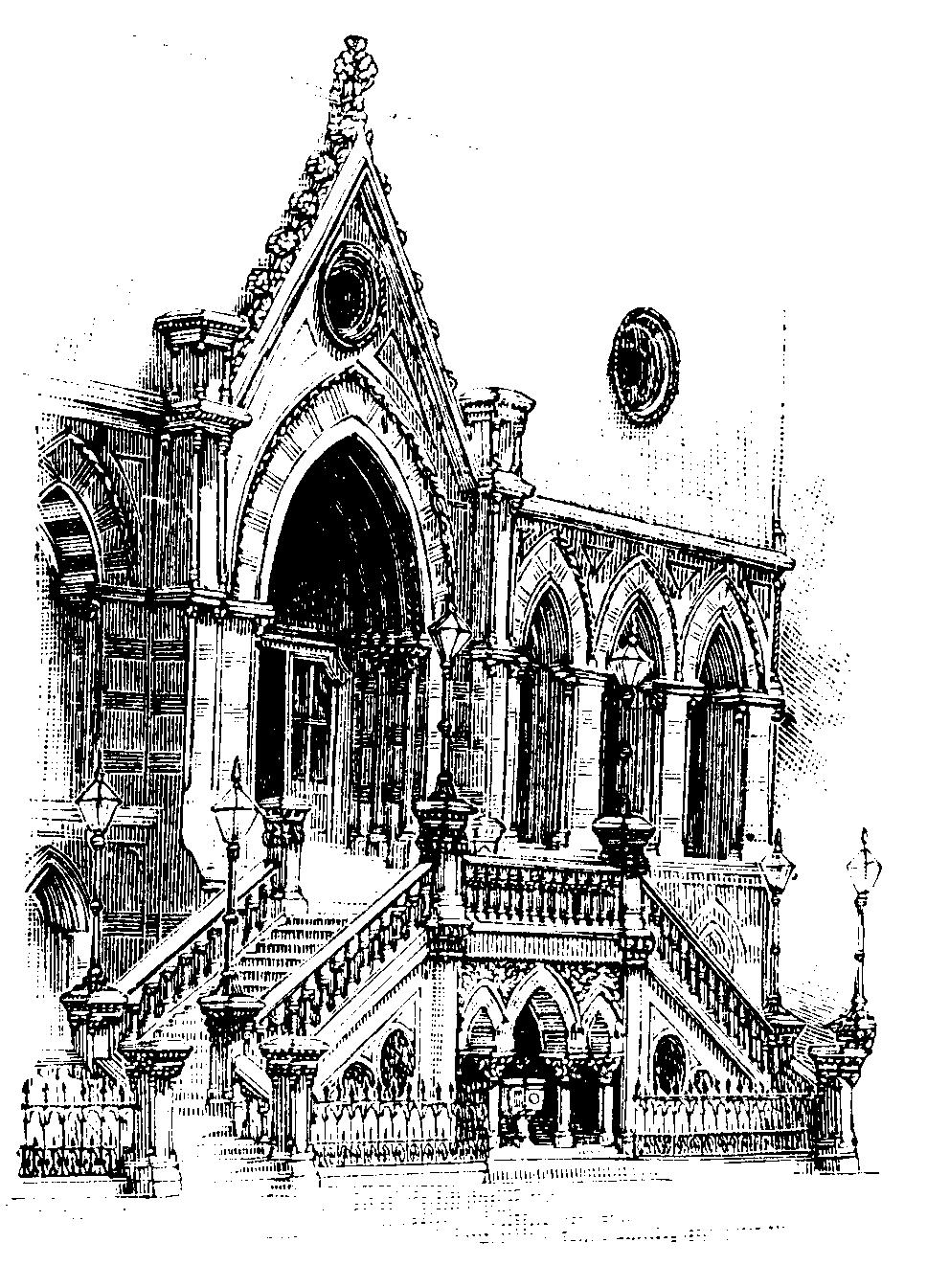
WIGHT, Peter Bonnett, architect, born in New York city, 1 August, 1838. He was graduated at the College of the city of New York in 1S55, and, after studying architecture for eighteen months, went to Chicago in 1858 to practise that profession, but returned the following year to his native city. Between 1862 and 1868 he built the New York academy of design (see vignette), the Yale school of the fine arts, and the Brooklyn mercantile library, now known as the Brooklyn library. In 1862 he planned the first army hospital that was built by the government during the civil war. In 1864 he erected the building of the Union square branch in New York city of the sanitary fair, and managed it until its close. Immediately after the Chicago fire in 1871 he removed to that city, and between 1872 and 1876 was chiefly engaged in the erection of commercial buildings to the value of nearly $2,000,000. Among the latter was the American express building, in executing which he was associated with Henry H. Richardson. In 1878 he retired partially from the more active put-suit of his profession, and practised mainly as a consulting architect, devoting his time to constructive, engineering, and sanitary matters connected with building. In 1880 he organized the Wight fire-proofing company for the construction of fire-proof buildings, of which he is still the general manager and principal stockholder. In 1868 he invented the first improvement in the construction of fire-proof buildings. In 1874 he took out a patent for his method of rendering iron columns fire-proof, and he has since been granted three others for the same purpose. Other patents of his are for the construction of fire-proof ceilings In buildings in which wooden joists are used for floor construction; for making iron floor-beams fireproof when flat, hollow, the floor arches are used; for devices for automatically closing gates to swing-bridges and for making terra-cotta coping for brick walls. Mr. Wight, besides frequently contributing articles on subjects connected with his specialty to various periodicals, has published a monograph on the "National Academy of Design Building," with photographic illustrations (New York, 1865), and "One Phase in the Revival of the Fine Arts in America" (Chicago, 1886).
Unauthorized Site:
This site and its contents are not affiliated, connected,
associated with or authorized by the individual, family,
friends, or trademarked entities utilizing any part or
the subject's entire name. Any official or affiliated
sites that are related to this subject will be hyper
linked below upon submission
and Evisum, Inc. review.
Please join us in our mission to incorporate The Congressional Evolution of the United States of America discovery-based curriculum into the classroom of every primary and secondary school in the United States of America by July 2, 2026, the nation’s 250th birthday. , the United States of America: We The
People. Click Here